Have you ever watched the news and heard a country “annexed” a region — and thought, Wait… what exactly does that mean?
You’re not alone. The term annexation meaning gets thrown around in headlines, history books, and political debates, but it’s rarely explained in simple, human language.
At its core, annexation is about taking control — but it’s also about identity, power, and how people’s lives can change overnight.
It isn’t just a cold political word. It carries real emotional weight for communities, families, and entire nations.
Understanding annexation helps you better grasp world events, historical conflicts, and even current global tensions.
Whether you’re a student, a curious reader, or someone who just wants to stay informed, this concept matters more than most people realize.
In this guide, we’ll explore annexation meaning in clear, friendly terms — no dictionary jargon, no dry political lectures.
Just honest explanations, relatable examples, and real-world insight into why this word still shapes our world today.
What Does Annexation Mean?
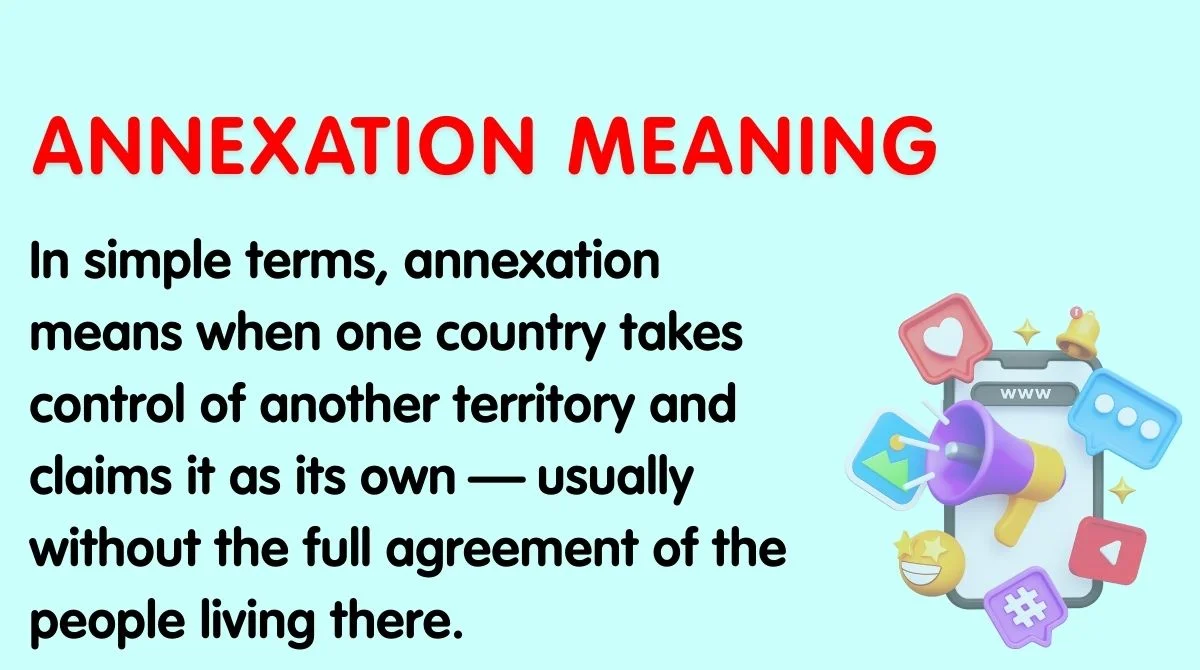
In simple terms, annexation means when one country takes control of another territory and claims it as its own — usually without the full agreement of the people living there.
Think of it like this:
Imagine your neighbor suddenly says, “This part of your yard belongs to me now,” and puts up a fence without your permission. That’s not cooperation — that’s annexation.
Here are a few real-life-style examples:
- A powerful country moves its military into a nearby region and declares it part of its own land.
- A government redraws borders after a war and absorbs neighboring territory.
- A ruling power formally changes maps, laws, and governance over a region it didn’t previously own.
Unlike peaceful agreements or treaties, annexation is usually forced or disputed, which is why it often leads to conflict, protests, or international sanctions.
In short, annexation isn’t just about land — it’s about authority, identity, and control.
Origin and Background of the Term
The word “annexation” comes from the Latin word annexare, meaning “to attach” or “to tie onto.” Originally, it didn’t sound political at all. It was more about physically joining one thing to another.
But over time, especially as empires expanded and borders shifted, the word took on a heavier meaning. During the age of empires — Roman, Ottoman, British, and others — annexation became a way for powerful nations to grow territory, wealth, and influence.
One historical story helps explain this shift.
In the 1800s, many European powers were racing to expand their empires. When Britain annexed territories in South Asia or Africa, it wasn’t just about maps — it changed languages, laws, cultures, and even education systems for generations.
Fast-forward to modern times, and annexation still carries that same weight — but now with international law, global media, and diplomacy shaping how the world responds.
So while the word once meant simply “to attach,” today it often signals conflict, controversy, and global consequences.
How Annexation Is Used in Daily Life
Although annexation is mostly a political term, you’ll encounter it in everyday conversations, classrooms, news articles, and documentaries.
Here are some common ways people use it:
- In news headlines: “Country X condemns the annexation of Region Y.”
- In history lessons: “The empire expanded through annexation.”
- In debates and discussions: “Was the annexation justified or illegal?”
- In legal contexts: “International law prohibits forced annexation.”
- In journalism: “Residents oppose annexation due to loss of autonomy.”
- In social media commentary: “Annexation never ends peacefully.”
Outside politics, people sometimes use the word metaphorically too:
- “That big company basically annexed its competitor.”
- “My roommate annexed my side of the closet.”
Even in casual speech, annexation still implies taking something without asking — which shows how deeply the emotional meaning of the word has stuck.
Emotional or Practical Meaning of Annexation
On paper, annexation might look like a border change. But in real life, it’s far more personal.
For people living in annexed territories, it can mean:
- New laws overnight
- Different passports
- Changed education systems
- Language restrictions
- Fear, uncertainty, or displacement
Imagine waking up and discovering your country — your identity — has changed without your consent. That’s not abstract politics. That’s deeply emotional human experience.
On a broader level, annexation affects:
- Global stability
- Diplomatic relations
- Economic sanctions
- Military tensions
That’s why this word carries such serious weight in international discussions. It’s not just geography — it’s about rights, sovereignty, and dignity.
In today’s world, where borders symbolize independence and self-determination, annexation often feels like a violation of collective will — which is why it triggers such strong reactions globally.
Similar or Related Terms
Here are some commonly confused or related terms — explained simply:
- Occupation – Military control of a territory without claiming permanent ownership.
- Colonization – Settling and governing a region, often far from the ruling country.
- Invasion – Entering another territory by force (may or may not lead to annexation).
- Territorial expansion – A broad term for gaining land, peaceful or otherwise.
- Annex – The verb form meaning “to take over.”
💡 Key difference:
Annexation is about permanent claim of ownership, not just temporary control.
Common Misunderstandings About Annexation
Let’s clear up some of the most common myths — because this word is often misunderstood.
1. Annexation is always legal
Not true. Under international law, forced annexation is usually considered illegal.
2. Annexation only happens after war
Sometimes, but not always. Some annexations occur through political pressure, staged referendums, or diplomatic manipulation.
3. Annexation means everyone agrees
Actually, most annexations happen without full consent from local populations.
4. Annexation is the same as colonization
Not exactly. Colonization often involves settlement and cultural dominance, while annexation focuses on territorial absorption.
5. Annexation is a thing of the past
Unfortunately, it’s still happening today — and continues to shape global politics.
6. Annexation always brings stability
In reality, annexation often leads to long-term conflict, unrest, and international disputes.
Understanding these differences helps you interpret world events more accurately and avoid misinformation.
Examples of Annexation in Sentences
Here are natural, everyday examples using the term:
- “The international community condemned the annexation of the disputed territory.”
- “History books explain how annexation shaped modern borders.”
- “Many residents opposed the annexation because they feared losing autonomy.”
- “The country denied plans for annexation, despite troop movements.”
- “Annexation without consent violates international law.”
- “The annexation changed not just borders, but people’s lives.”
- “She studied annexation cases in her political science class.”
- “The news sparked debate about whether annexation could ever be justified.”
Why Understanding Annexation Matters Today
In today’s interconnected world, annexation isn’t just a headline — it’s a global ripple effect.
When annexation happens, it can trigger:
- International sanctions
- Economic disruptions
- Refugee crises
- Military standoffs
- Diplomatic breakdowns
Understanding the annexation meaning helps you read news critically instead of emotionally reacting to headlines without context.
It also builds empathy.
Behind every annexation story are families who didn’t ask for political change but must live with its consequences. Students whose schools change. Workers whose laws change. Communities whose identities get questioned.
In an age where misinformation spreads fast, knowing what annexation truly means helps you:
- Recognize propaganda
- Understand geopolitical conflicts
- Engage in informed discussions
- See beyond surface narratives
Simply put, knowledge gives power — and clarity gives peace.
Frequently Asked Questions
What does annexation mean in simple words?
Annexation means when one country takes over another area and claims it as its own, usually without full agreement from the people living there.
Is annexation positive or negative?
It’s usually viewed as negative, especially when forced. Annexation often leads to conflict, instability, and human rights concerns.
Where is annexation commonly used?
You’ll mostly see it in politics, history, international law, news reporting, and geopolitical discussions.
Is annexation formal or informal?
Annexation is a formal term, typically used in academic, political, or legal contexts — though people use it casually too.
Why do people search for annexation meaning?
Because it frequently appears in global news and history discussions, and many readers want a clear, simple explanation without complex jargon — especially as events evolve with time.
Conclusion
Annexation isn’t just a political term — it’s a word that represents power, identity, conflict, and human consequence.
Behind every annexed territory are people whose lives changed without warning, whose futures became uncertain, and whose voices were often unheard.
By understanding the true annexation meaning, you’re not just learning a definition — you’re gaining insight into how history is shaped, how borders are drawn, and how the world responds to injustice or authority.
Knowledge like this helps you read smarter, think deeper, and speak more confidently about global events.
And in a world that often feels divided, understanding complex ideas is one of the strongest tools we have to build awareness, empathy, and meaningful conversations.
✨ The more we understand the world, the more power we gain to change it — even in small, thoughtful ways.