Have you ever described someone as kind, confident, or hardworking and wondered what those words really represent?
Those traits aren’t just random labels — they’re attributes, the building blocks of how we understand people, objects, and even ideas.
Whether you’re filling out a resume, describing a friend, learning grammar, or analyzing data, knowing the attribute meaning can completely change how clearly you communicate.
I remember once helping a friend prepare for a job interview. Instead of saying, “I’m good at my job,”
I encouraged them to talk about specific attributes like leadership, adaptability, and problem-solving. Suddenly, their answers sounded more confident — and more human.
In simple terms, an attribute describes a quality, feature, or characteristic of something.
But it goes deeper than that. Understanding this word helps you express yourself better, connect with others more meaningfully, and even succeed professionally.
In this guide, we’ll explore the true meaning of attribute, where it comes from, how it’s used in everyday life, and why it matters more today than ever.
What Does Attribute Meaning Mean?
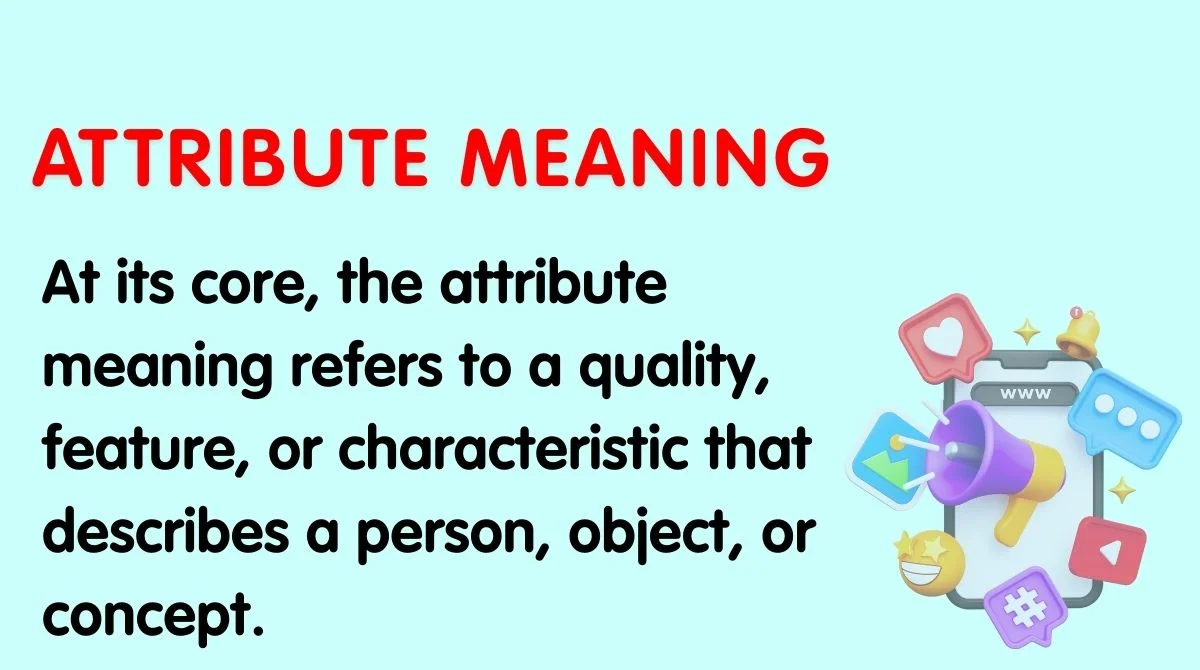
At its core, the attribute meaning refers to a quality, feature, or characteristic that describes a person, object, or concept.
Instead of saying “She’s amazing,” you might say:
- She has the attribute of kindness.
- His strongest attribute is patience.
- This phone’s best attribute is its battery life.
See the difference? Attributes help turn vague impressions into clear descriptions.
Let’s look at a few real-life examples:
- A teacher might say, “Curiosity is one of your strongest attributes.”
- A product review might highlight the durability of a backpack as its main attribute.
- A manager might praise an employee’s reliability as a valuable attribute.
So instead of being abstract, attributes make things specific, meaningful, and actionable — especially in communication.
Origin and Background of the Term
The word attribute comes from the Latin word attribuere, which means “to assign” or “to give.” In ancient times, people used it when talking about assigning qualities or responsibilities to someone — almost like saying, “This trait belongs to you.”
In medieval philosophy, scholars talked about the “attributes of God,” meaning qualities like wisdom, power, and mercy. These weren’t just words — they were ways to understand deeper truths.
Fast forward to modern times, and the word has expanded into many fields:
- In language, attributes describe nouns.
- In technology, attributes describe data fields.
- In psychology, attributes explain personality traits.
Yet, despite its technical uses, the heart of the word remains the same:
An attribute is something that defines, describes, or gives identity.
It’s fascinating how a word rooted in ancient thought now shapes modern resumes, coding systems, and conversations — proof that language evolves, but meaning endures.
How Attribute Is Used in Daily Life
You may not realize it, but you use the concept of attributes every single day — even if you don’t use the word itself.
Here are some everyday examples:
- Job interviews:
“My strongest attribute is adaptability.” - Parenting:
“Kindness is an important attribute to teach children.” - Shopping online:
“The main attribute of this laptop is speed.” - School reports:
“Her best attribute is her curiosity.” - Friendship:
“Loyalty is one of his core attributes.” - Technology:
“This app allows you to edit image attributes like size and color.”
In each case, an attribute helps you focus on what makes something special or valuable. It turns general opinions into clear, useful insights.
Emotional or Practical Meaning of Attribute
Beyond grammar and definitions, the attribute meaning carries emotional weight — especially when used to describe people.
Think about the last compliment that really stuck with you. Maybe someone said:
- “Your honesty is refreshing.”
- “Your resilience inspires me.”
Those weren’t just compliments. They were acknowledgments of your attributes — qualities that define who you are.
Emotionally, attributes:
- Shape self-esteem
- Influence relationships
- Build trust and respect
Practically, they:
- Help employers choose candidates
- Guide teachers in student development
- Allow designers to improve products
- Help writers create believable characters
In a world obsessed with labels and quick judgments, focusing on attributes helps us see people more deeply and compassionately. It reminds us that behind every role or title is a set of human qualities worth understanding.
Similar or Related Terms
Here are some words closely related to attribute, along with how they differ:
- Trait – A natural or habitual quality, often related to personality
(Kindness is a personality trait.) - Characteristic – A distinguishing feature of something
(Curly hair is one of her characteristics.) - Quality – A general standard or feature
(Honesty is a good quality.) - Feature – A noticeable part of something, especially a product
(The camera is the phone’s best feature.) - Property – Often used scientifically or technically
(Water’s boiling point is a physical property.)
While these words overlap, attribute feels more intentional — as if you’re identifying something meaningful rather than just observing it.
Common Misunderstandings About Attribute
Let’s clear up some confusion around the attribute meaning.
❌ Misconception 1: Attributes are always positive
Not true. Attributes can be positive (kindness) or negative (stubbornness).
❌ Misconception 2: Attributes only apply to people
Wrong again. Objects, systems, data, and ideas all have attributes too.
❌ Misconception 3: Attribute means achievement
An achievement is something you’ve done. An attribute is something you are.
❌ Misconception 4: Attribute is just another word for “adjective”
Not exactly. Adjectives describe nouns, but attributes refer to deeper qualities or features, not just grammar.
❌ Misconception 5: Attributes are fixed forever
Many attributes change with experience — confidence, patience, or resilience can grow over time.
Understanding these distinctions helps you use the word more accurately and confidently.
Examples of Attribute in Sentences
Here are some natural, everyday examples:
- Patience is one of her strongest attributes as a teacher.
- The phone’s best attribute is its long battery life.
- Kindness is an attribute that never goes out of style.
- His honesty is an attribute people admire most.
- Creativity is an essential attribute in today’s job market.
- The house’s main attribute is its spacious garden.
- One attribute I value in friends is loyalty.
- Confidence became her strongest attribute after years of self-work.
Each sentence shows how the word fits comfortably into real conversation.
Why Understanding Attribute Meaning Matters Today
In today’s world — driven by resumes, profiles, branding, and digital identities — understanding the attribute meaning has never been more important.
Let’s start with careers. Employers don’t just want skills. They want attributes like:
- Reliability
- Communication
- Adaptability
- Emotional intelligence
These traits often matter more than technical expertise because they define how you work, not just what you know.
In relationships, attributes like trust, empathy, and respect form the foundation of lasting connections. Knowing how to recognize and express these qualities improves communication and emotional intimacy.
In education, teachers focus on student attributes such as curiosity, perseverance, and collaboration — not just grades.
In technology and data science, attributes define how systems categorize and understand information. Every profile, database, and algorithm relies on attributes to function properly.
Ultimately, understanding attributes helps us:
- Describe ourselves honestly
- Appreciate others more deeply
- Make better decisions
- Build stronger personal and professional identities
In a noisy world full of labels, attributes bring clarity, depth, and meaning.
Frequently Asked Questions
What does attribute meaning in simple words?
An attribute is a quality or feature that describes something or someone, like kindness, speed, or color.
Is attribute positive or negative?
It can be either. Attributes can describe strengths like honesty or weaknesses like impatience — it depends on context.
Where is attribute commonly used?
You’ll see it in education, psychology, resumes, technology, grammar, and everyday conversations.
Is attribute formal or informal?
It’s mostly neutral to formal, but it fits comfortably in both professional and casual speech.
Why do people search for attribute meaning?
Because it appears in school lessons, job applications, tech terms, and writing — and people want to understand it clearly and correctly.
Conclusion
Understanding the attribute meaning goes far beyond vocabulary. It’s about recognizing what truly defines people, objects, and experiences.
Whether you’re describing yourself in a job interview, complimenting a friend, analyzing data, or writing creatively, knowing how to identify and express attributes helps you communicate with clarity, confidence, and authenticity.
More importantly, it reminds us that behind every title, role, or label is a human being made up of qualities that evolve, grow, and shine over time.
And when we learn to see those attributes — in ourselves and others — we create space for empathy, connection, and growth.
✨ Never underestimate the power of your attributes — they’re the quiet strengths shaping your story every single day.