Have you ever said, “I just had a breakdown,” or heard someone else use that phrase and wondered what they truly meant? You’re not alone.
The breakdown meaning goes far beyond a dictionary definition — it touches emotions, situations, and moments where things stop working the way they’re supposed to.
Imagine your car refusing to start on a busy road. Or your laptop crashing right before an important deadline.
Or even worse — feeling mentally overwhelmed and unable to cope anymore. In all these moments, the word breakdown fits perfectly.
Understanding this word matters more than we realize because language shapes how we express stress, failure, emotion, and recovery.
When we grasp the real meaning behind words, we communicate better — and empathize more deeply with others.
In this article, we’ll explore the true meaning of breakdown, how people use it in real life, its emotional impact, common misunderstandings, and why it’s such a powerful word in today’s world. Let’s break it down — literally. 😊
What Does Breakdown Meaning Mean?
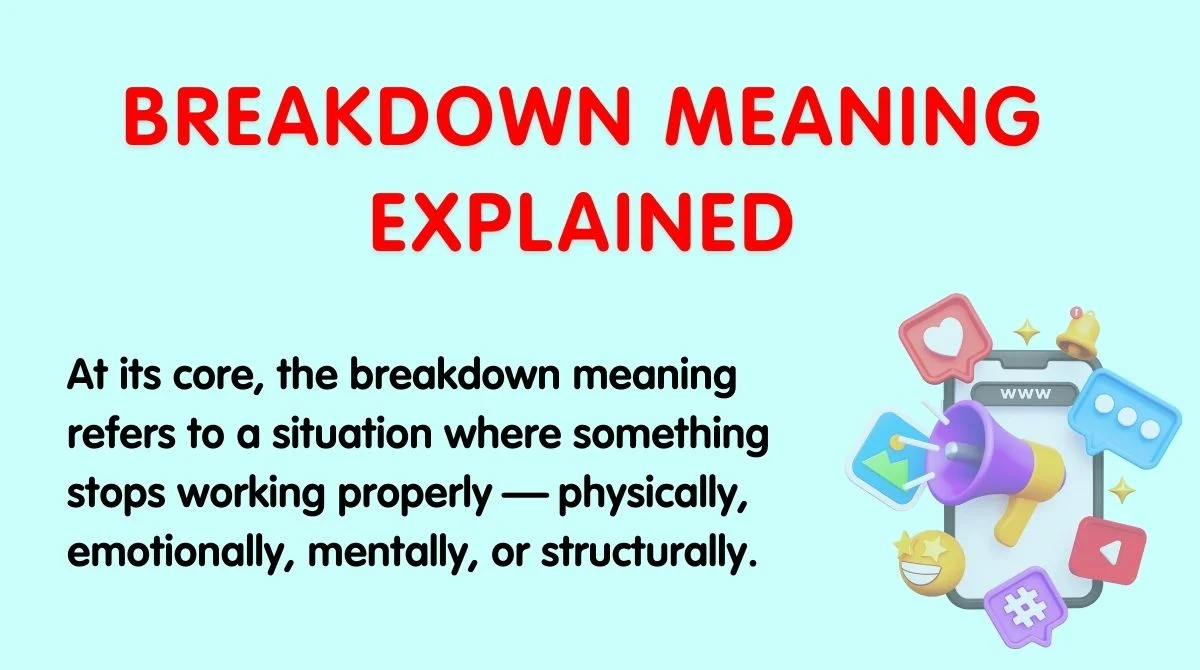
At its core, the breakdown meaning refers to a situation where something stops working properly — physically, emotionally, mentally, or structurally.
But it’s not just about machines. People use breakdown for moments when life feels overwhelming or when systems fail.
Here are a few everyday examples:
- Your car stalls on the highway — that’s a mechanical breakdown.
- You feel emotionally exhausted and start crying uncontrollably — that’s an emotional breakdown.
- A company’s internal communication collapses — that’s an organizational breakdown.
So instead of seeing breakdown as just failure, it’s more accurate to see it as a pause point — a moment where something needs repair, rest, or rethinking.
And honestly? Breakdowns don’t always mean the end. Sometimes, they’re the beginning of something better.
Origin and Background of the Term
The word breakdown comes from Old English roots — break meaning “to shatter or destroy,” and down meaning “completely.” Together, they formed a powerful idea: something breaking apart entirely.
Originally, the term was mostly used in physical contexts — broken carts, damaged tools, or collapsed structures. During the Industrial Revolution, when machines became central to life, breakdown gained popularity as a way to describe mechanical failure.
But language evolves with society.
In the 20th century, psychologists and medical professionals began using breakdown to describe emotional and mental exhaustion — what people called a “nervous breakdown.” Although that term isn’t used clinically today, it shaped how everyday people talk about stress and burnout.
Now, breakdown applies to everything from technology to emotions to relationships, making it one of the most versatile words in modern English.
How Breakdown Is Used in Daily Life
You probably hear or use this word more often than you realize. Let’s look at how breakdown shows up in real conversations:
- “My car had a breakdown on the highway.”
Mechanical failure — simple and literal. - “She had a breakdown after months of stress.”
Emotional overload — human and relatable. - “There was a breakdown in communication between teams.”
Organizational or system failure. - “Let’s do a cost breakdown of this project.”
Analytical breakdown — dividing something into parts. - “The relationship broke down over time.”
Emotional or relational collapse. - “The software had a breakdown during the update.”
Technical malfunction.
As you can see, breakdown meaning changes depending on context — but the core idea remains: something stopped working the way it should.
Emotional or Practical Meaning of Breakdown
Here’s where breakdown becomes more than just a word.
Emotionally, a breakdown often represents overload, burnout, or deep exhaustion. It’s that moment when your mind or heart says, “I can’t carry this anymore.”
And honestly? That moment isn’t weakness — it’s human.
I once spoke to a friend who worked nonstop for months without rest. One day, she burst into tears during a meeting and couldn’t stop shaking. Later, she told me, “That breakdown saved me. It forced me to slow down.”
Practically, breakdowns serve as signals:
- Your body signals rest.
- Your system signals repair.
- Your emotions signal healing.
Culturally, society is slowly shifting from viewing breakdowns as shameful to seeing them as wake-up calls — moments that invite care, support, and growth.
In today’s fast-paced world, understanding breakdown meaning helps us respond with empathy instead of judgment.
Similar or Related Terms
Here are some commonly confused or related words, with simple explanations:
- Collapse – Sudden and complete failure, often physical or structural.
- Burnout – Long-term emotional or mental exhaustion.
- Meltdown – Emotional outburst, often intense and immediate.
- Failure – Not achieving an expected outcome.
- Crash – Sudden stop or malfunction, especially with machines or systems.
- Crisis – A turning point or emergency situation.
Each term overlaps with breakdown but carries its own emotional and situational tone.
Common Misunderstandings About Breakdown
Let’s clear up some myths around the breakdown meaning:
- “Breakdown means you’re weak.”
Not true. It often means you’ve been strong for too long. - “Breakdowns only happen mentally.”
Nope — machines, systems, relationships, and processes break down too. - “Once something breaks down, it’s over.”
Actually, many breakdowns lead to repair, growth, and improvement. - “Only stressed people have breakdowns.”
Anyone can experience one — even happy, successful people. - “Breakdowns happen suddenly without warning.”
Most are gradual. The signs are just often ignored. - “A breakdown is the same as a breakdown disorder.”
No — everyday breakdowns aren’t medical diagnoses.
Understanding these differences helps reduce stigma and encourages healthier conversations.
Examples of Breakdown in Sentences
Here are natural, everyday examples you might actually hear:
- “My phone had a breakdown right before the presentation.”
- “After weeks of pressure, he finally had a breakdown.”
- “There was a breakdown in communication between departments.”
- “Let’s do a breakdown of the monthly expenses.”
- “The relationship broke down after years of misunderstanding.”
- “Her emotional breakdown helped her realize she needed help.”
- “The engine breakdown delayed our trip.”
- “That breakdown moment changed my entire life.”
Each sentence reflects a different shade of meaning — emotional, technical, relational, or analytical.
Why Understanding Breakdown Meaning Matters Today
We live in a world that glorifies hustle, speed, and productivity. But rarely do we talk about the cost of constant pressure — emotionally, mentally, and physically.
Understanding the breakdown meaning helps us:
- Recognize early warning signs of burnout.
- Respond to others with empathy instead of judgment.
- Communicate problems clearly in work, relationships, and life.
- Normalize asking for help instead of hiding struggles.
- See breakdowns as turning points, not failures.
In workplaces, breakdown understanding prevents system failures. In families, it improves emotional communication. In personal life, it encourages healing instead of shame.
Most importantly, it reminds us that breaking down doesn’t mean breaking forever — it often means breaking open, so something better can grow.
Frequently Asked Questions
What does breakdown mean in simple words?
Breakdown means when something stops working properly — whether it’s a machine, system, emotion, or situation. It can be physical, emotional, or structural.
Is breakdown positive or negative?
It’s usually seen as negative, but it can also be positive when it leads to healing, awareness, growth, or improvement.
Where is breakdown commonly used?
Breakdown is used in daily conversation, workplaces, psychology, technology, mechanics, relationships, and education — almost everywhere.
Is breakdown formal or informal?
It works in both. It’s common in casual speech (“I had a breakdown”) and professional contexts (“system breakdown detected”).
Why do people search for breakdown meaning?
People search it to understand emotional experiences, workplace terminology, system errors, or language usage — especially when facing stress or confusion.
Conclusion
So now you know — the breakdown meaning isn’t just about things falling apart.
It’s about moments when life pauses, systems fail, emotions overflow, or clarity finally arrives.
Sometimes breakdowns hurt. Sometimes they scare us. But sometimes — just sometimes — they save us.
They remind us we’re human. They show us where we need care. And they often lead us to stronger foundations than before.
If you’re going through a breakdown right now, remember this: breaking down doesn’t mean you’re broken — it means you’re human, healing, and becoming stronger than before. 🌱

Thomas Reed helps learners master English words through simple explanations and real-life usage.