Have you ever noticed how everything feels lighter when someone says,
“Just stay calm”? Suddenly, your breathing slows, your shoulders drop, and the world doesn’t seem quite so loud.
That one word — calm — carries more power than we often realize.
In simple terms, calm meaning goes beyond just “not angry” or “not loud.”
It reflects a peaceful state of mind, emotional balance, and inner steadiness — even when life feels chaotic.
Whether you’re waiting for exam results, dealing with family stress, or stuck in traffic, calm becomes your invisible anchor.
We live in a world that celebrates speed, urgency, and hustle.
But understanding the calm meaning reminds us that slowing down isn’t weakness — it’s wisdom.
In fact, calm is often what helps us make better decisions, communicate kindly, and protect our mental well-being.
In this article, we’ll explore what calm truly means, where the word comes from, how people use it daily, and why it matters more than ever today. Let’s take a deep breath and dive in. 🌿
What Does Calm Meaning Mean?
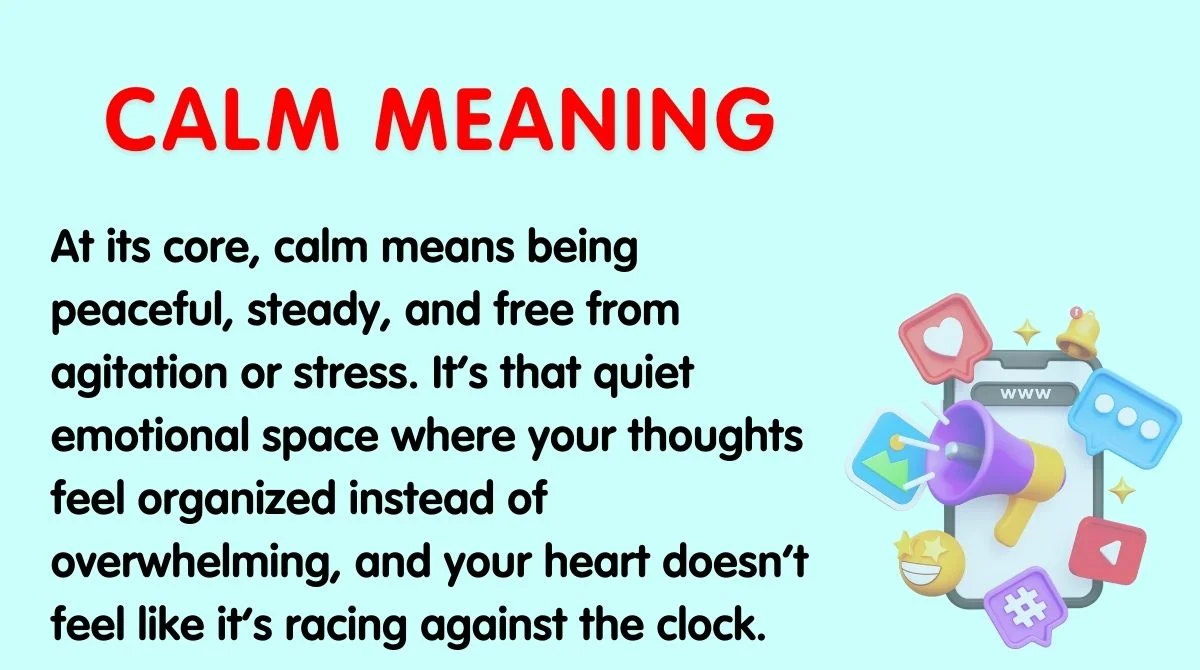
At its core, calm means being peaceful, steady, and free from agitation or stress. It’s that quiet emotional space where your thoughts feel organized instead of overwhelming, and your heart doesn’t feel like it’s racing against the clock.
But calm isn’t just about silence or stillness. It’s about inner balance, even when the outside world is noisy.
Let’s look at a few real-life examples:
- A teacher staying calm while managing a noisy classroom.
- A doctor calmly explaining a diagnosis to a worried patient.
- A parent remaining calm during a child’s emotional meltdown.
In each case, calm doesn’t mean ignoring problems. It means responding with clarity instead of chaos, patience instead of panic. That’s the true calm meaning — emotional control paired with mental clarity.
Origin and Background of the Term
The word calm comes from the Latin word cauma, meaning “heat of the day,” and later from the French calme, which referred to still weather — especially when the sea had no waves. Sailors once used “calm seas” to describe moments when the ocean felt like glass.
Over time, the word traveled beyond weather and into emotional language. By the 16th century, calm began describing human emotions, especially states of peace, steadiness, and composure.
There’s something poetic about that journey.
Just like a calm sea reflects the sky clearly, a calm mind reflects thoughts more honestly. And just as sailors valued calm waters for safe travel, humans learned that calm emotions help navigate life’s challenges.
Across cultures, calm has always been admired — from Buddhist mindfulness teachings to Stoic philosophy in ancient Greece. Calm wasn’t weakness. It was strength under control, wisdom in motion, and peace in action.
How Calm Is Used in Daily Life
You probably use the word calm more often than you realize. It slips naturally into conversations because it’s deeply connected to how humans experience emotions.
Here are some everyday examples:
- “Try to stay calm, everything will work out.”
- “She spoke in a calm voice, even though she was upset.”
- “The ocean looked calm this morning.”
- “He remained calm under pressure.”
- “That music makes me feel calm.”
- “Let’s handle this calmly instead of arguing.”
In daily life, calm describes:
- Emotions – calm mind, calm reaction
- Behavior – calm response, calm attitude
- Environment – calm weather, calm room
- Communication – calm tone, calm explanation
It’s one of those words that fits almost anywhere — because peace, balance, and steadiness are universal human needs.
Emotional or Practical Meaning of Calm
Emotionally, calm means feeling safe within yourself, even when circumstances feel uncertain. It’s that grounded feeling when your thoughts aren’t racing and your emotions aren’t spiraling.
Practically, calm helps people:
- Make better decisions
- Resolve conflicts peacefully
- Communicate clearly
- Manage stress and anxiety
- Think rationally under pressure
Imagine this scenario:
Two coworkers receive harsh feedback from their manager. One reacts angrily and defensively. The other pauses, breathes, and calmly asks for clarification. Who walks away stronger? Almost always, the calm one.
In many cultures, calm is associated with wisdom, maturity, and emotional intelligence. Children are taught to “calm down” not because emotions are bad, but because emotional control leads to better outcomes.
In today’s fast-paced digital world — filled with notifications, deadlines, and noise — calm has become more than a personality trait. It’s now a life skill.
Similar or Related Terms
Here are words closely related to calm, along with how they differ:
- Peaceful – Free from conflict or disturbance, often external
- Relaxed – Physically or mentally loose and comfortable
- Serene – Deeply peaceful, often spiritual or emotional
- Composed – Emotionally controlled, especially under pressure
- Tranquil – Quiet and still, often describing nature
- Cool-headed – Calm when others panic
While these words overlap, calm uniquely combines emotional stability + mental clarity + behavioral control. That’s what makes it so powerful.
Common Misunderstandings About Calm
Despite how simple the word seems, calm is often misunderstood. Let’s clear up some common myths:
- Calm means emotionless
Not true. Calm people still feel emotions — they just manage them well. - Calm people don’t care
Actually, calm often shows deep care, just without panic or aggression. - Calm is weakness
In reality, staying calm during chaos takes great strength. - Calm means slow or lazy
You can be calm and highly productive at the same time. - Calm only comes naturally
Calm can be learned, practiced, and strengthened through habits like breathing, reflection, and mindfulness. - Calm equals silence
You can speak passionately and still remain calm in tone and intention.
Understanding these differences helps us appreciate calm as a powerful emotional tool, not a passive state.
Examples of Calm in Sentences
Here are some natural, everyday uses of calm:
- She stayed calm during the interview, even when the questions got tough.
- His calm voice helped everyone relax.
- The lake looked calm at sunrise.
- Try to remain calm — we’ll solve this together.
- Her calm response prevented the argument from escalating.
- I feel calm whenever I walk in nature.
- The doctor spoke calmly to reassure the patient.
- He handled the crisis with calm confidence.
Notice how calm fits naturally into emotional, physical, and social situations.
Why Understanding Calm Meaning Matters Today
We live in an age of speed — fast news, fast replies, fast reactions. Social media rewards outrage more than reflection. Stress feels constant. Anxiety feels normal.
That’s exactly why understanding calm meaning matters now more than ever.
Calm helps people:
- Respond thoughtfully instead of reacting emotionally
- Build healthier relationships
- Improve mental clarity and focus
- Protect their mental health
- Navigate uncertainty with confidence
Think about leaders you admire. Teachers who inspired you. Doctors who reassured you. Friends who supported you during hard times. Chances are, what stood out wasn’t their loudness — it was their calm presence.
Calm doesn’t erase problems. It simply gives you the mental space to solve them wisely.
In workplaces, calm communication reduces conflict. In families, calm parenting builds trust. In friendships, calm conversations deepen understanding. In personal life, calm thinking improves decision-making.
In today’s overstimulated world, calm has become a superpower — quiet, steady, and incredibly effective.
Frequently Asked Questions
What does calm mean in simple words?
Calm means feeling peaceful, steady, and relaxed, without anger, panic, or stress. It’s when your mind and emotions feel balanced.
Is calm positive or negative?
Calm is strongly positive. It’s associated with emotional maturity, clear thinking, healthy communication, and inner peace.
Where is calm commonly used?
Calm is used in:
- Everyday conversations
- Mental health discussions
- Education and parenting
- Weather descriptions
- Workplace communication
It fits both emotional and physical contexts naturally.
Is calm formal or informal?
Calm works in both formal and informal settings. You can use it in professional writing, casual conversations, and emotional discussions alike.
Why do people search for calm meaning?
People search for calm meaning because:
- They want emotional clarity
- They’re learning English
- They’re exploring mental wellness
- They want better communication skills
As society evolves, calm has become more relevant than ever — emotionally and practically.
Conclusion
Calm isn’t just a word — it’s a way of living.
The true calm meaning goes far beyond silence or softness. It represents emotional strength, mental clarity, and inner stability, even when life feels overwhelming.
Calm helps us listen better, think clearer, speak kinder, and live wiser.
In a world that constantly pushes urgency, choosing calm becomes an act of courage.
It means pausing instead of panicking, understanding instead of arguing, breathing instead of breaking.
And here’s the beautiful truth: calm isn’t something you’re born with — it’s something you build.
One breath at a time. One choice at a time. One moment at a time.
So next time life feels heavy, remember — your calm is your power. 🌿

Thomas Reed helps learners master English words through simple explanations and real-life usage.