Have you ever scrolled through Instagram, TikTok, or Facebook and paused at a post thinking, “That caption hits different”? You’re not alone.
A simple line of text beneath a photo or video can completely change how we understand and feel about what we’re seeing. That’s the power behind caption meaning.
In today’s digital world, captions aren’t just decorations — they’re mini stories, emotional cues, and sometimes even silent conversations between people.
Whether it’s a funny one-liner, a motivational quote, or a subtle emotional message, captions guide interpretation more than we realize.
Understanding caption meaning helps you communicate better online, avoid misunderstandings, and express yourself more confidently. It’s not just about words — it’s about tone, context, and intent.
In this guide, we’ll explore what caption meaning truly is, where it comes from, how people use it today, and why it matters more than ever in the age of social media and digital communication.
Let’s break it down in a way that feels real, relatable, and useful. 🌟
What Does Caption Meaning Mean?
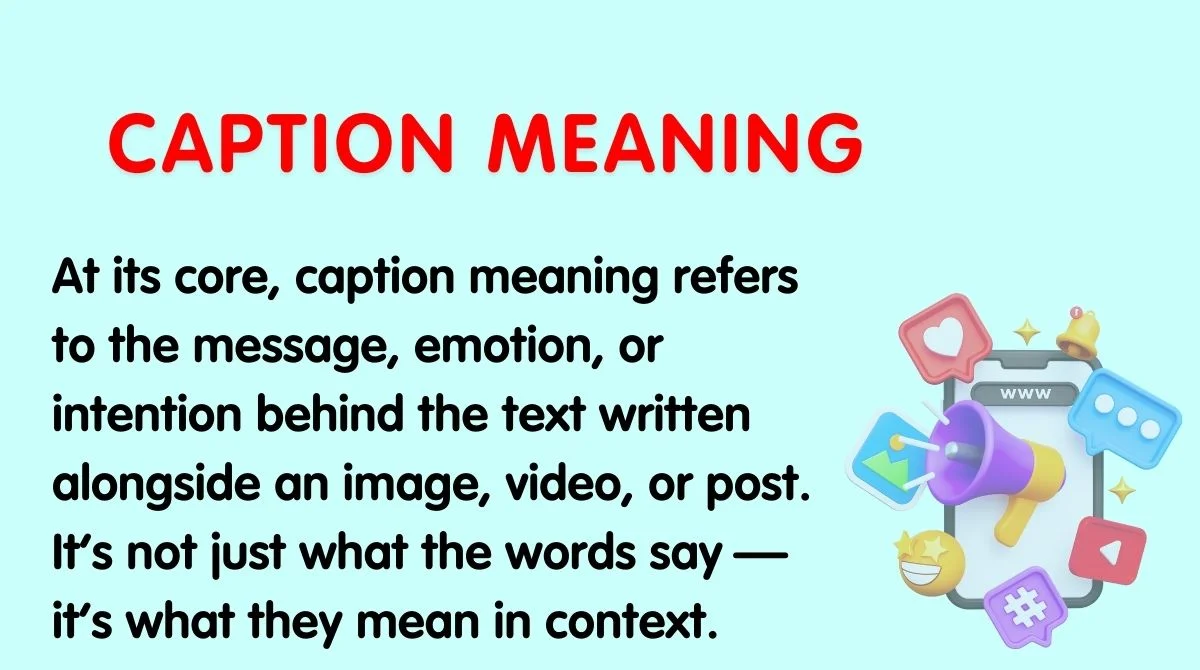
At its core, caption meaning refers to the message, emotion, or intention behind the text written alongside an image, video, or post. It’s not just what the words say — it’s what they mean in context.
Think of a caption as the voice behind a picture.
For example:
- A photo of friends laughing with the caption “Golden days” suggests nostalgia and happiness.
- A sunset picture with “Healing quietly” carries emotional depth and personal reflection.
- A gym selfie with “No excuses today” communicates motivation and discipline.
In real life, captions help viewers understand what the creator wants to express — joy, sadness, sarcasm, motivation, love, or even humor. Without captions, images can feel incomplete or confusing. With the right caption, the same photo can tell a thousand different stories.
So when people search for caption meaning, they’re really asking:
👉 “What is this caption trying to say?”
👉 “What emotion or message is behind these words?”
Origin and Background of the Term
The word caption comes from the Latin word “captio”, meaning “a taking” or “understanding”. Historically, captions were short explanations under illustrations in books, newspapers, and magazines.
Back in the days of printed media, captions served a simple purpose — to explain what was happening in a photo. A newspaper image of a protest might have a caption explaining the location, date, and people involved. Straightforward. Informational. No emotions attached.
But as communication evolved, so did captions.
With the rise of social media platforms like Instagram, Twitter (now X), Facebook, and TikTok, captions transformed into expressive tools. They stopped being just descriptions and became:
- Emotional outlets
- Branding tools
- Storytelling devices
- Personality reflections
Now, a caption isn’t just what’s happening — it’s how the person feels about what’s happening. That shift is what gave birth to the modern concept of caption meaning.
Today, captions carry tone, mood, sarcasm, humor, vulnerability, and sometimes even hidden messages. They’ve become digital body language.
How Caption Meaning Is Used in Daily Life
You might not realize it, but you interact with caption meaning almost every day. Here’s how it shows up naturally:
- On social media posts
A travel photo with “Collecting moments, not things” signals values and lifestyle. - In memes
The same image becomes hilarious or emotional depending on the caption. - In professional branding
Businesses use captions to build trust and connect with customers. - In friendships
Friends often write inside jokes or subtle emotional captions that only close people understand. - In relationships
A caption like “My safe place ❤️” under a partner’s photo sends a strong emotional message. - In motivation content
Fitness pages use captions to inspire action and discipline.
Captions aren’t random — they’re intentional communication tools, even when they seem casual.
Emotional or Practical Meaning of Caption Meaning
Here’s where things get deep.
Captions often say what people can’t or won’t say directly. They become emotional bridges between inner feelings and public expression.
For example:
A person posting a smiling selfie with the caption:
“Trying my best these days.”
On the surface, it sounds casual. But emotionally, it could signal exhaustion, resilience, vulnerability, or quiet strength.
That’s why caption meaning matters — because captions often carry unspoken emotions.
On a practical level, captions:
- Clarify intent
- Prevent misunderstanding
- Add personality
- Improve engagement
- Build personal or brand identity
Culturally, captions reflect modern communication habits — where people express feelings subtly instead of directly. They allow people to be vulnerable without oversharing, confident without bragging, and humorous without explaining.
In short, captions are emotional shortcuts in the digital world.
Similar or Related Terms
Here are some closely related terms and how they differ:
- Tagline – A short branding phrase, usually for businesses or products.
- Quote – A borrowed or original statement, often inspirational or emotional.
- Status – A general life update, especially on messaging apps.
- Subtitle – Text that explains spoken content in videos or films.
- Description – A factual explanation of content without emotional intent.
Each serves a purpose, but caption meaning focuses on emotional tone, context, and interpretation — not just explanation.
Common Misunderstandings About Caption Meaning
Let’s clear up some common myths:
- “Captions are just decorations.”
Not true. Captions guide perception and emotional response. - “Short captions have no depth.”
Some of the most powerful captions are just two or three words. - “Captions must explain the image.”
Nope. Sometimes captions intentionally contrast the image to add humor or emotion. - “Only influencers need good captions.”
Everyone benefits from clear and meaningful communication. - “Captions must be serious.”
Humor, sarcasm, playfulness — all are valid forms of caption meaning. - “There’s always only one meaning.”
Captions are subjective. Different people interpret them differently.
Understanding these misconceptions helps you write captions more intentionally and read others more accurately.
Examples of Caption Meaning in Sentences
Here are some natural, everyday examples:
- “Soft days, strong heart.”
→ Meaning: Emotional resilience during peaceful times. - “Still growing, still learning.”
→ Meaning: Personal development and humility. - “Same smile, different story.”
→ Meaning: Things look fine on the outside, but life has changed inside. - “No filter, just vibes.”
→ Meaning: Authenticity and confidence. - “Some chapters don’t need titles.”
→ Meaning: Private life experiences. - “Peace looks good on me.”
→ Meaning: Emotional healing and growth. - “Not perfect, just real.”
→ Meaning: Embracing authenticity over perfection. - “Dreaming quietly, working loudly.”
→ Meaning: Ambition paired with action.
Each of these captions carries emotional depth beyond the words themselves — that’s caption meaning in action.
Why Understanding Caption Meaning Matters Today
We live in a world where communication is increasingly visual and digital. Photos, videos, memes, and reels dominate how we express ourselves — and captions are the emotional translators of that content.
Understanding caption meaning helps you:
- Avoid misinterpretation
A sarcastic caption can be mistaken for seriousness without context. - Communicate more clearly
Your words align better with your intention. - Build stronger connections
People feel understood when captions resonate emotionally. - Improve personal branding
Whether you’re a creator, entrepreneur, or student, captions shape perception. - Express emotions safely
Many people use captions to process feelings without oversharing.
In today’s attention-driven culture, captions often decide whether someone scrolls past your post or stops to engage. They’re small — but powerful.
More importantly, captions reflect human emotion in digital form. And learning to read or write them well makes you a better communicator in the modern world.
Frequently Asked Questions
What does caption meaning mean in simple words?
Caption meaning refers to the message, emotion, or intention behind the text written under a photo, video, or post. It’s what the caption is trying to say, not just what it literally says.
Is caption meaning positive or negative?
It can be either — or both. Some captions express joy, love, or motivation, while others convey sadness, sarcasm, or reflection. The meaning depends on tone, context, and intention.
Where is caption meaning commonly used?
It’s most commonly used on social media platforms like Instagram, Facebook, TikTok, Twitter (X), blogs, websites, and even in marketing campaigns and digital storytelling.
Is caption meaning formal or informal?
Most captions today are informal, conversational, and emotional. However, professional brands may use more polished tones depending on audience and purpose.
Why do people search for caption meaning?
People search for caption meaning to understand emotional expressions, hidden messages, social media trends, or how to interpret or write better captions themselves.
Conclusion
In a world full of images, videos, and fast-scrolling feeds, captions give content its soul. They turn pictures into stories, moments into emotions, and posts into connections.
Understanding caption meaning isn’t just about better social media — it’s about better communication.
Whether you’re expressing love, healing, humor, ambition, or growth, your captions shape how others see you — and sometimes, how you see yourself. They become tiny reflections of your inner world.
So next time you write or read a caption, pause for a moment. Ask yourself not just “What does it say?” — but “What does it mean?”
Because sometimes, a few simple words can carry a thousand feelings. 💛

Thomas Reed helps learners master English words through simple explanations and real-life usage.