Have you ever read the same paragraph three times and still had no idea what it said? Or sat in a meeting while your mind wandered off to dinner plans?
If so, you’ve experienced what happens when concentration fades — and suddenly, even simple tasks feel harder than they should.
In simple terms, concentration meaning refers to your ability to focus your attention on one thing at a time without getting distracted.
It’s not about being smart or talented.
It’s about being present. And in today’s noisy, notification-filled world, that skill has become more valuable than ever.
Whether you’re a student trying to study, a professional managing deadlines, or a parent juggling
responsibilities, understanding concentration can transform how you work, learn, and live. In fact, improving it can lead to better productivity, stronger memory, and even greater emotional calm.
Let’s break down what concentration really means, where it comes from, and why it plays such a powerful role in your daily life — in a way that feels human, relatable, and useful.
What Does Concentration Meaning Actually Mean?
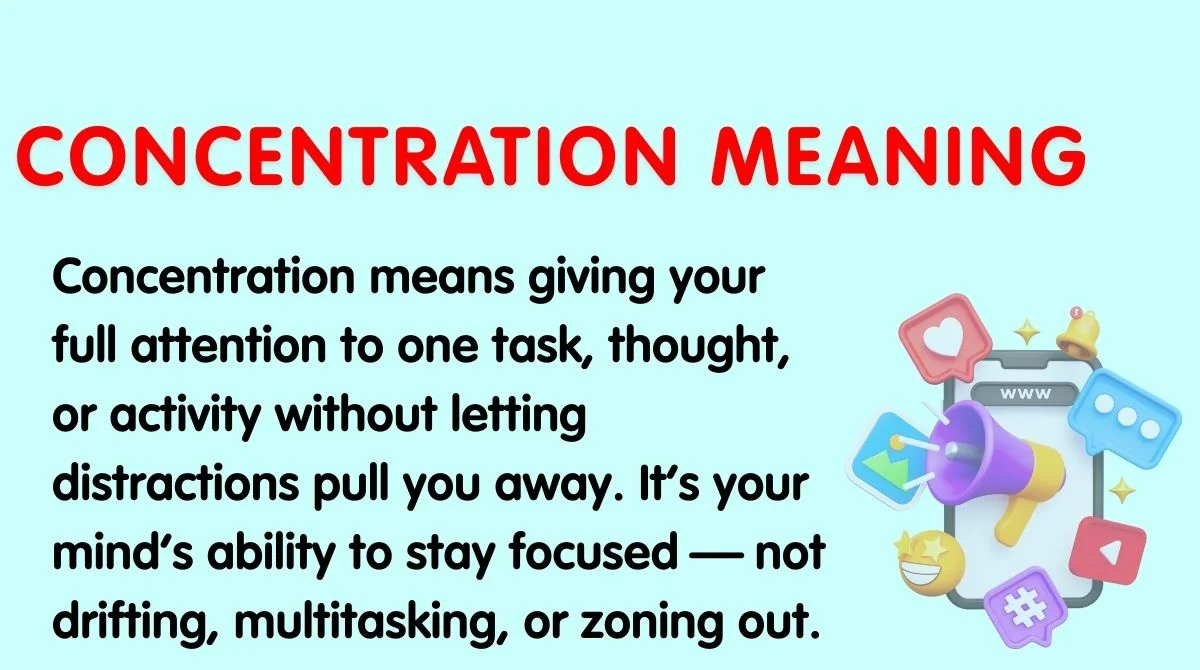
Concentration means giving your full attention to one task, thought, or activity without letting distractions pull you away. It’s your mind’s ability to stay focused — not drifting, multitasking, or zoning out.
Think of it like a flashlight in a dark room. Wherever you point it, that area becomes clear while everything else fades into the background. Concentration works the same way with your mind.
Here are a few everyday examples:
- A student solving math problems without checking their phone every minute.
- A driver staying alert on the road despite loud music or traffic noise.
- A writer finishing an article while ignoring social media tabs.
In all these moments, concentration means choosing depth over distraction — staying mentally present with what you’re doing.
And no, it’s not something you’re either born with or not. Concentration is a skill, and like any skill, it can be strengthened with practice.
Origin and Background of the Term
The word concentration comes from the Latin word concentrare, which means “to bring together” or “to focus toward a center.” Originally, it wasn’t about attention — it described physical things being gathered into one place.
Over time, thinkers and philosophers began using the word to describe mental focus. Ancient scholars believed the mind worked best when thoughts weren’t scattered. Eastern meditation traditions talked about “single-pointed awareness” thousands of years before neuroscience existed.
In the 19th and 20th centuries, psychologists began studying attention scientifically. Researchers discovered that the brain performs better when it focuses on one thing at a time instead of multitasking — something modern science continues to confirm today.
So when we talk about concentration now, we’re really talking about an age-old human ability: the power to direct your mind intentionally instead of letting it wander wherever it wants.
How Concentration Is Used in Daily Life
You may not think about it much, but concentration shows up everywhere — even in moments you take for granted.
Here are some real-life examples:
- Studying for exams
When a student focuses on one subject without distractions, learning becomes faster and deeper. - Driving safely
Concentration keeps drivers alert, helping them respond quickly to sudden changes. - Listening to someone speak
Real connection happens when you listen fully instead of mentally preparing your reply. - Cooking a meal
Following a recipe requires attention to timing, measurements, and steps. - Working on a deadline
Focused work often gets done in half the time compared to distracted effort. - Playing sports or games
Athletes rely on intense concentration to perform under pressure.
In every case, concentration isn’t just mental — it shapes outcomes, safety, relationships, and success.
Emotional and Practical Meaning of Concentration
Concentration isn’t only about productivity. It also carries emotional and psychological value.
When your mind is scattered, you often feel:
- Overwhelmed
- Anxious
- Frustrated
- Mentally exhausted
But when you’re focused, something changes. You feel:
- Calm
- In control
- Engaged
- Satisfied
That’s because concentration allows your brain to work efficiently instead of jumping between tasks. It reduces mental clutter and creates a sense of flow — that beautiful state where time seems to disappear because you’re so immersed.
Culturally, concentration is also associated with wisdom, discipline, and mastery. Monks meditate to strengthen it. Artists use it to create. Scientists rely on it to discover. Even athletes talk about “being in the zone,” which is essentially deep concentration.
In today’s world of endless scrolling and instant notifications, concentration has become more than a skill — it’s a form of mental self-respect.
Similar or Related Terms
Here are some words closely related to concentration — and how they differ:
- Focus – Directing attention to one thing (often used interchangeably).
- Attention – The act of noticing or observing something.
- Mindfulness – Being fully present in the current moment without judgment.
- Absorption – Being deeply engaged or immersed in something.
- Alertness – Mental readiness and awareness.
- Dedication – Commitment to a task or goal over time.
While these terms overlap, concentration specifically emphasizes sustained mental effort on one activity without distraction.
Common Misunderstandings About Concentration
Let’s clear up some myths that confuse people about what concentration really means.
1. “Concentration means working nonstop.”
Not true. Healthy concentration includes breaks. The brain needs rest to stay sharp.
2. “Some people are born focused — others aren’t.”
False. Concentration is a trainable skill, not a fixed trait.
3. “Multitasking improves productivity.”
Actually, multitasking often reduces performance and increases mistakes.
4. “If I lose focus, I’m lazy.”
Nope. Distraction is human. What matters is gently bringing your attention back.
5. “Concentration requires silence.”
While quiet helps, many people concentrate well with background noise or music.
6. “Long concentration spans mean better intelligence.”
Not necessarily. Focus duration varies by task, interest, and mental state.
Understanding these misconceptions helps remove guilt and replaces it with practical strategies and self-compassion.
Examples of Concentration in Sentences
Here are some natural, everyday ways the word is used:
- “I need complete concentration to finish this report before lunch.”
- “Her concentration broke when her phone buzzed.”
- “Meditation helped improve his concentration at work.”
- “The teacher noticed the students’ concentration improved after short breaks.”
- “Driving in heavy rain requires intense concentration.”
- “Music without lyrics helps my concentration while studying.”
- “Children often struggle with concentration during long lectures.”
- “With better concentration, she finished tasks in half the time.”
Why Understanding Concentration Matters Today
We live in an age of interruptions.
Notifications.
Emails.
Pop-ups.
Scrolling feeds.
Multitasking expectations.
According to cognitive research, the average person switches tasks every few minutes — sometimes every few seconds. Each switch drains mental energy and reduces efficiency. Over time, this leads to stress, fatigue, and shallow thinking.
Understanding concentration meaning helps you reclaim control over your attention — which is one of your most valuable resources.
Here’s why it matters more than ever:
- In education, focus improves learning speed and memory retention.
- In careers, deep work leads to better output and creativity.
- In relationships, attentive listening builds trust and connection.
- In mental health, focused awareness reduces anxiety and overwhelm.
- In personal growth, concentration allows reflection, planning, and goal achievement.
In a distracted world, the ability to focus deeply has become a superpower. It’s no longer just about getting things done — it’s about living intentionally instead of reactively.
And the best part? You don’t need perfection. Even small improvements in concentration can lead to massive changes in productivity, confidence, and peace of mind.
Frequently Asked Questions
What does concentration mean in simple words?
Concentration means paying full attention to one thing without getting distracted. It’s when your mind stays focused on a task instead of jumping to other thoughts.
Is concentration positive or negative?
Concentration is positive. It helps improve learning, productivity, safety, and emotional balance. However, too much intense focus without breaks can cause burnout, so balance matters.
Where is concentration commonly used?
Concentration is commonly used in education, psychology, work environments, sports, meditation, driving, and everyday tasks that require attention and accuracy.
Is concentration formal or informal?
The word concentration is neutral. It works well in both formal writing (academic, professional) and casual conversation.
Why do people search for concentration meaning?
People search for concentration meaning to improve focus, understand attention problems, boost productivity, support learning, or manage distractions in modern life.
Conclusion
Understanding concentration meaning isn’t just about vocabulary — it’s about mastering one of the most powerful tools your mind possesses.
In a world designed to distract you, choosing to focus is an act of strength. It helps you learn faster, work smarter, connect deeper, and live more intentionally.
Whether you’re studying, building a career, raising a family, or pursuing personal goals, concentration shapes the quality of your outcomes — and your experiences.
Remember this: You don’t need more time. You need better attention.
And every moment you practice focus — even for a few minutes — you’re building a stronger, calmer, more capable mind.
✨ Your attention is your life. Wherever you place it, your future follows.