Have you ever come across a word that looks tiny but somehow feels powerful?
That’s exactly what happens when people search for mot meaning.
Maybe you saw it in a book, heard it in conversation, or noticed it in a quote and thought, Wait… what does that actually mean?
You’re not alone. Language is full of short words that carry deep emotional, cultural, or intellectual weight — and mot is one of them.
It may look simple, but its meaning changes depending on where and how it’s used.
In this article, we’ll explore what “mot” really means, where it comes from, and why it still matters today.
You’ll get clear explanations, real-life examples, and even a few stories along the way — no boring dictionary definitions here.
By the end, you’ll not only understand the true meaning of mot, but you’ll also feel confident using it naturally in everyday conversation.
Let’s dive in and uncover the magic behind this small but meaningful word.
What Does Mot Mean?
At its core, mot means word — but that’s just the surface.
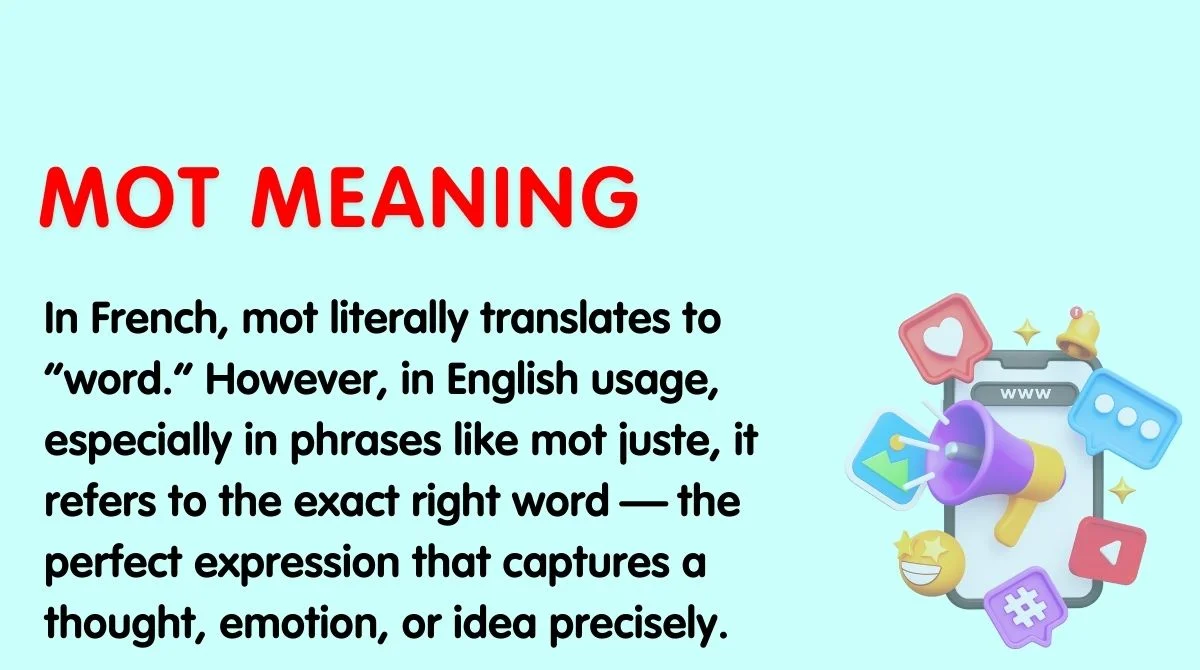
In French, mot literally translates to “word.” However, in English usage, especially in phrases like mot juste, it refers to the exact right word — the perfect expression that captures a thought, emotion, or idea precisely.
Think about that moment when you’re trying to explain how you feel, and nothing seems to fit. Then suddenly, one word clicks. That’s a mot moment.
Real-life examples:
- A writer searching for the mot juste to describe heartbreak.
- A speaker choosing a single powerful word that changes the tone of a speech.
- A friend saying exactly what you needed to hear at the right time.
So while mot technically means “word,” emotionally, it means the right word at the right time — and that’s powerful.
Origin and Background of the Term
The word mot comes from Old French, where it meant “spoken sound” or “utterance.” Over time, it became the standard French word for “word.” But its journey into English is what makes it truly interesting.
In the 18th and 19th centuries, English writers and scholars often borrowed French expressions to sound more refined or precise. One of those phrases was mot juste, meaning the exact word. Famous writers like Gustave Flaubert were obsessed with finding the perfect word — the mot juste — believing that precision in language created beauty in writing.
There’s even a story about Flaubert spending days crafting a single sentence, refusing to move on until he found the perfect word. That dedication turned mot into a symbol of linguistic excellence rather than just vocabulary.
Over time, English speakers adopted mot mainly through literary and intellectual contexts, where it became associated with clarity, precision, and emotional accuracy — not just communication, but meaningful communication.
How Mot Is Used in Daily Life
You might not realize it, but mot shows up in everyday situations more than you think — especially in writing, education, and thoughtful conversation.
Here’s how people commonly use it:
- In writing and storytelling
Writers talk about finding the mot juste — the perfect word that makes a sentence come alive. - In speeches and presentations
Speakers aim for words that resonate emotionally, not just logically. - In emotional conversations
Sometimes, one word can comfort someone more than a long explanation. - In language learning
Students studying French encounter mot early on since it simply means “word.” - In academic or literary discussions
Professors and critics use mot when discussing style, tone, and precision. - In branding and marketing
Copywriters obsess over the right word because one mot can influence decisions.
In short, mot isn’t just about vocabulary — it’s about impact. The right word can inspire, heal, persuade, or connect.
Emotional or Practical Meaning of Mot
This is where mot becomes truly meaningful.
Emotionally, mot represents the idea that words shape reality. A single word can:
- Change how someone feels about themselves
- Turn a bad day into a hopeful one
- Break or build relationships
- Spark movements, ideas, and revolutions
Think about the difference between these two sentences:
- “You tried.”
- “I’m proud of you.”
Both are simple. But emotionally? Worlds apart. That second sentence contains the right mot.
Practically, mot reminds us to be intentional with language. Instead of speaking carelessly, it encourages us to:
- Choose clarity over confusion
- Empathy over indifference
- Truth over exaggeration
In today’s world of fast messages, social media posts, and instant replies, mot teaches us something timeless: words still matter — maybe more than ever.
Similar or Related Terms
Here are some words and phrases closely connected to mot, along with how they differ:
- Word – A basic unit of language; general and neutral.
- Phrase – A group of words expressing an idea.
- Expression – A way of saying something, often emotional or idiomatic.
- Mot juste – The perfect or exact word for a situation.
- Vocabulary – The collection of words someone knows or uses.
- Diction – A person’s choice and style of words in speech or writing.
While all of these relate to language, mot stands out because it emphasizes precision and emotional accuracy, not just communication.
Common Misunderstandings About Mot
Even though it’s a simple word, people often misunderstand mot. Let’s clear up the most common confusion.
- “Mot only means ‘word’ in French.”
True, but in English usage, it often carries deeper meaning — especially in literary contexts. - “Mot is outdated or formal.”
Not really. While it’s more common in writing or academic speech, it’s still relevant today. - “Mot juste just means ‘good word.’”
No — it means the perfect word. Not good enough. Exact. - “Mot is only used by writers.”
Anyone who cares about communication — teachers, speakers, leaders — uses the concept of mot, even if unconsciously. - “Mot is a complicated term.”
Actually, it’s simple. It just reminds us that every word counts. - “Mot doesn’t apply to casual speech.”
It absolutely does. Choosing the right word in a text or conversation can prevent misunderstandings and strengthen relationships.
Examples of Mot in Sentences
Here are some natural, everyday examples so you can see how mot fits into real life:
- “She searched for the mot juste, but nothing felt strong enough to describe her emotions.”
- “That one word was the perfect mot to end the speech.”
- “Sometimes a single mot can say more than a whole paragraph.”
- “He finally found the mot that captured what everyone was thinking.”
- “Writers know the power of choosing the right mot.”
- “Her apology had the right mot, and it made all the difference.”
- “That quote uses the perfect mot to express hope.”
- “In tough moments, the right mot can feel like a lifeline.”
Why Understanding Mot Matters Today
In today’s fast-paced digital world, communication happens instantly — texts, emails, tweets, comments, and captions fly around constantly. But speed often comes at the cost of meaning.
That’s where mot becomes more important than ever.
When people misunderstand each other online, it’s often not because of bad intentions — it’s because the wrong word was used. One poorly chosen phrase can spark arguments, confusion, or hurt feelings. On the other hand, one well-chosen word can:
- Calm tension
- Inspire confidence
- Build trust
- Strengthen relationships
Professionally, understanding mot helps in:
- Writing better resumes and cover letters
- Communicating clearly at work
- Delivering persuasive presentations
- Building strong brands and messages
Emotionally, it helps in:
- Expressing feelings honestly
- Apologizing sincerely
- Encouraging others effectively
- Saying what truly matters before it’s too late
In a world full of noise, mot teaches us to value clarity over clutter — and meaning over volume.
Frequently Asked Questions
What does mot mean in simple words?
Mot means “word,” but it often refers to the right word — the one that perfectly expresses a thought or feeling.
Is mot positive or negative?
It’s neutral, but usually used in a positive sense, especially when talking about clarity, expression, and precision.
Where is mot commonly used?
You’ll see it in literature, education, language learning, speeches, writing discussions, and phrases like mot juste.
Is mot formal or informal?
It leans slightly formal, especially in English, but it’s not stiff or outdated. It fits naturally in thoughtful conversation and writing.
Why do people search for mot meaning?
People often encounter the word in books, quotes, or academic writing and want a clear, human explanation — not just a dictionary definition.
Conclusion
At first glance, mot might seem like just another word — small, simple, and easy to overlook.
But as you’ve seen, it carries something much deeper: the idea that the right word can change everything.
From emotional conversations to powerful speeches, from storytelling to everyday texts, mot reminds us that language isn’t just about talking — it’s about connecting.
It’s about choosing words that heal instead of harm, clarify instead of confuse, and inspire instead of discourage.
So the next time you pause before speaking or writing, remember this:
Sometimes, one mot can do what a thousand words can’t.
And honestly? That’s the beauty of language — small sounds creating big meaning. 💛

Thomas Reed helps learners master English words through simple explanations and real-life usage.