Have you ever been invited to something and heard someone say, “Would you like to partake?” It sounds polite, maybe even a little formal — but what does it really mean?
Most people nod along, but secretly wonder if it just means join, eat, or participate.
Understanding the partake meaning isn’t just about vocabulary.
It’s about communication, confidence, and connection.
When you truly grasp a word, you don’t just use it — you own it.
And that ownership makes conversations smoother, writing clearer, and even social moments less awkward.
In today’s fast-moving world, where texts are short and attention spans shorter, knowing how to use meaningful words like partake helps you sound thoughtful without sounding stiff.
Plus, it’s one of those words that quietly adds warmth and politeness to any situation.
In this article, we’ll explore the meaning of partake in simple human terms, look at how people really use it, and uncover why it still matters today.
Let’s dive in 😊
What Does Partake Mean?
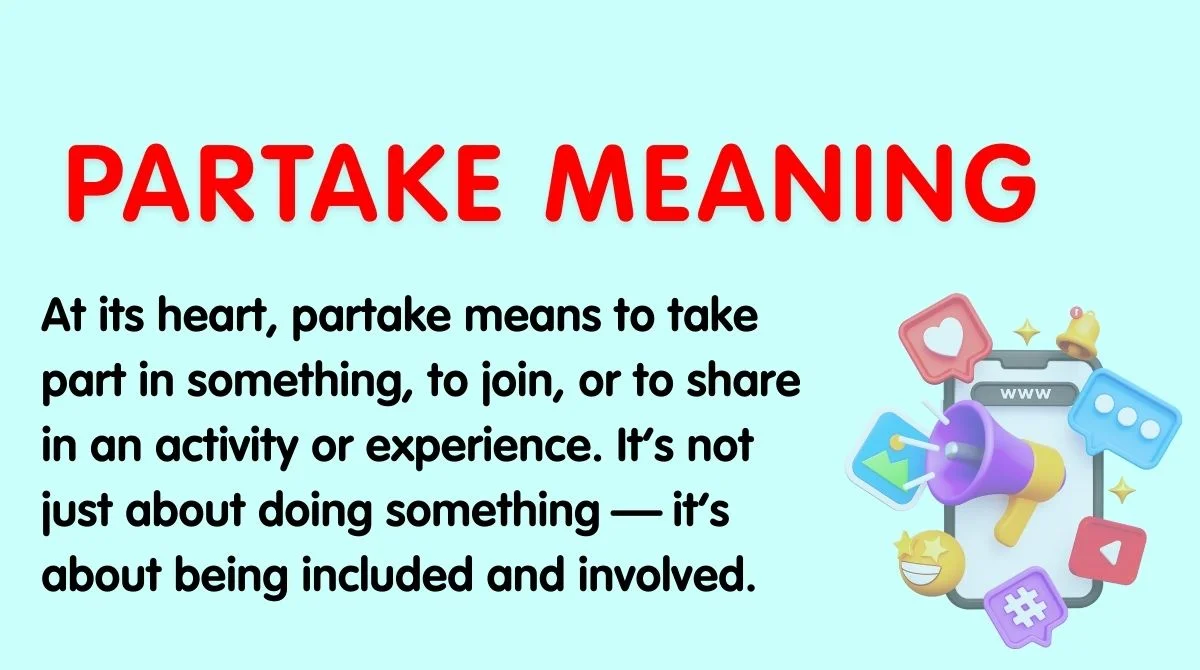
At its heart, partake means to take part in something, to join, or to share in an activity or experience. It’s not just about doing something — it’s about being included and involved.
Instead of sounding technical, think of it like this:
When you partake, you’re saying yes to participation, connection, and experience.
Here are a few real-life examples:
- You partake in a family dinner when you sit down and enjoy the meal with everyone.
- You partake in a discussion when you share your thoughts instead of staying silent.
- You partake in celebrations when you dance, laugh, and enjoy the moment.
So, the partake meaning isn’t just action — it’s presence. It suggests that you’re not just physically there, but mentally and emotionally involved too.
Origin and Background of the Term
The word partake has a surprisingly warm history.
It comes from Middle English partaken, which itself came from Old English words meaning “to take a part of something.” Originally, it literally meant to take a portion — often food — from a shared meal.
Picture a medieval dinner table. A loaf of bread in the center. No individual plates, no fancy cutlery. Everyone reaches in and takes a piece. That simple act of sharing food? That was partaking.
Over time, the meaning grew beyond food. It started to include:
- Sharing in ideas
- Participating in events
- Being part of emotions or experiences
So today, when someone says, “I partook in the ceremony,” it carries that same old sense of shared experience and togetherness — just in modern language.
That history is why the word still feels warm, polite, and inclusive, even centuries later.
How Partake Is Used in Daily Life
You might think partake is only for formal writing, but it quietly shows up in everyday life more than you realize.
Here’s how people naturally use it:
- At meals:
“Would you like to partake in dessert?”
Sounds nicer than just “Do you want cake?” - At events:
“She was excited to partake in the school festival.” - At work:
“Everyone is encouraged to partake in the discussion.” - In friendships:
“He didn’t want to partake in the gossip.” - In traditions:
“They partake in this ceremony every year.” - In invitations:
“Please partake in our celebration tonight.”
Notice something? The word partake often adds politeness, warmth, and respect. It feels welcoming rather than demanding.
Instead of “You must join,” it gently says, “You’re invited.”
Emotional or Practical Meaning of Partake
Beyond grammar, the partake meaning carries emotional weight.
When someone invites you to partake, they’re not just offering an activity — they’re offering belonging.
Think about it:
- Being asked to partake in a family tradition means you’re accepted.
- Being invited to partake in a discussion means your voice matters.
- Choosing not to partake sometimes means setting boundaries.
So the word works both emotionally and practically. It represents:
- Inclusion
- Sharing
- Participation
- Connection
In today’s world, where people often feel isolated, even small invitations to partake — in a meal, a conversation, or a celebration — can make someone feel seen.
That’s powerful for a single word.
Similar or Related Terms
Here are some words that are close to partake, along with how they differ:
- Participate – More formal and structured, often used in events or work.
- Join – Casual and direct; less emotional depth.
- Engage – Suggests active involvement or interest.
- Share – Focuses on giving or experiencing together.
- Take part – The most neutral phrase, common in daily speech.
- Contribute – Focuses on giving something, not just being present.
Each word works differently, but partake stands out because it blends politeness, warmth, and participation into one simple term.
Common Misunderstandings About Partake
Even though it’s a simple word, people often misunderstand it. Let’s clear a few things up.
- “Partake only means eating.”
Not true. While it often refers to food, it also means participating in events, conversations, or experiences. - “Partake sounds old-fashioned.”
It’s classic, yes — but still very much alive in modern speech and writing. - “It’s only used in formal situations.”
Nope. You’ll hear it in friendly invitations and casual conversations too. - “Partake always means something positive.”
Not necessarily. You can also choose not to partake in something harmful or negative. - “It means the same as join.”
Close, but not identical. Partake often suggests emotional or meaningful involvement, not just physical presence.
Understanding these nuances helps you use the word more confidently and naturally.
Examples of Partake in Sentences
Here are some friendly, everyday examples that show how the word fits naturally into real life:
- “She decided to partake in the charity walk despite the rain.”
- “Would you like to partake in some tea?”
- “He chose not to partake in the argument.”
- “We all partook in the celebration after the exams.”
- “They invited neighbors to partake in the holiday feast.”
- “I’m grateful I got to partake in such a meaningful experience.”
- “She nervously but proudly partook in her first debate.”
- “He didn’t feel ready to partake in that decision.”
Notice how natural it feels once you get used to it?
Why Understanding Partake Meaning Matters Today
In a world full of quick texts, emojis, and shortened phrases, meaningful words stand out. Knowing the partake meaning gives you a way to sound thoughtful without sounding complicated.
It helps you:
- Communicate more politely
- Write more professionally
- Express inclusion and respect
- Sound confident in conversations
But more than that, understanding this word connects you to something deeper — the idea of shared experience. Whether it’s a meal, a moment, or a memory, partake reminds us that life isn’t meant to be lived alone.
In workplaces, classrooms, friendships, and families, language shapes connection. And sometimes, one thoughtful word can make someone feel welcome instead of invisible.
That’s why this word still matters.
Frequently Asked Questions
What does partake mean in simple words?
In simple terms, partake means to join or take part in something, like an activity, event, meal, or experience.
Is partake positive or negative?
Most of the time, partake has a positive tone, suggesting inclusion and participation. However, it can also be neutral when someone chooses not to partake.
Where is partake commonly used?
You’ll hear partake in:
- Invitations
- Formal writing
- Conversations about events, meals, or discussions
- Ceremonies and traditions
It works in both professional and casual settings.
Is partake formal or informal?
It leans slightly formal, but it’s still very usable in friendly, everyday speech — especially when offering or inviting politely.
Why do people search for partake meaning?
People often search for the partake meaning because:
- They see it in books or articles
- They hear it in formal speech
- They want to use it correctly in writing or conversation
As language evolves, curiosity about classic words grows — and partake is one of them.
Conclusion
So now you know — the partake meaning isn’t complicated, stiff, or outdated.
It simply means to join, share, or take part, but with a touch of warmth and respect that many words lack.
From family dinners to professional meetings, from celebrations to quiet moments of connection, partake shows up wherever people come together.
And when you understand it fully, you don’t just use the word — you use it with confidence and heart.
Language isn’t just about words.
It’s about belonging, expression, and understanding.
And sometimes, learning one meaningful word can make you feel a little more connected to the world around you.
✨ Keep learning, keep growing — because every word you master brings you one step closer to your best self. ✨