Have you ever heard someone say, “This country lives under a strict regime,” or “I’m on a new fitness regime,” and wondered — wait, how can the same word fit politics and health? 🤔
That’s the beauty of language. Words evolve, stretch, and take on multiple meanings depending on context.
One such fascinating word is regime — a term that sounds serious but actually shows up in many everyday conversations.
In simple terms, regime meaning refers to a system, method, or way of doing things, especially when it’s structured or controlled.
Whether it’s a political system, a diet plan, or even a work routine, the word regime quietly shapes how we talk about order and organization.
Understanding this word matters more than you think. It helps you read news better, communicate clearly, and even express your own routines more confidently.
Let’s unpack what “regime” really means — in real life, not textbook language — and explore why it’s still so relevant today.
What Does Regime Mean?
At its core, a regime is a system or method of managing things, especially when rules, routines, or authority are involved.
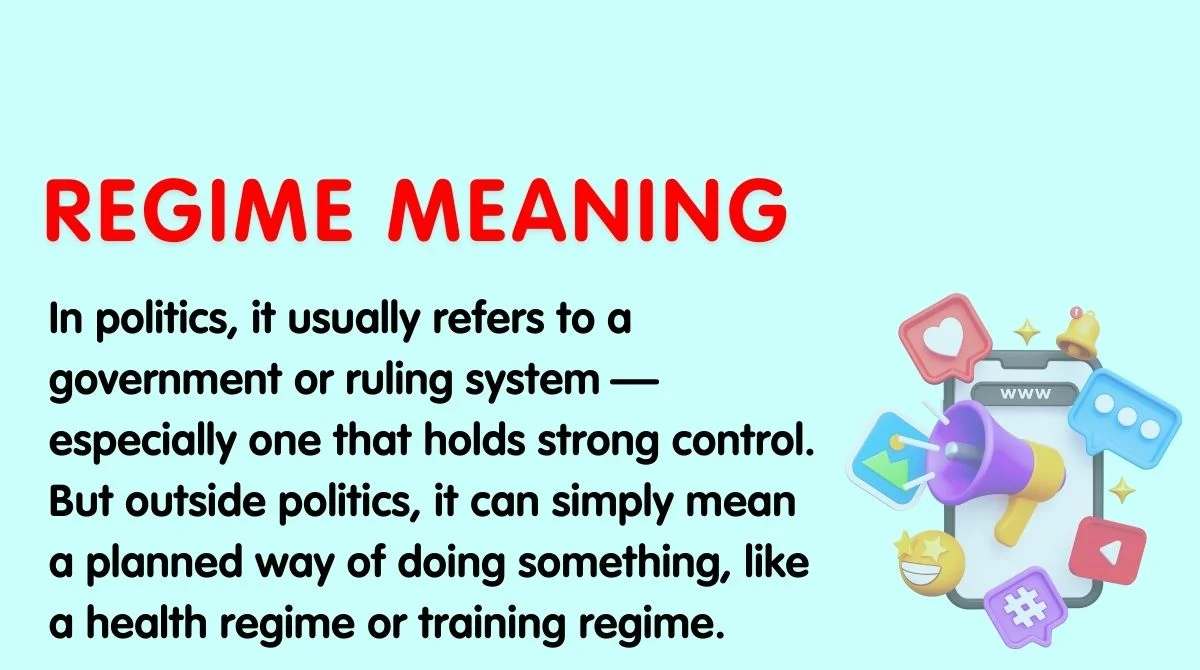
In politics, it usually refers to a government or ruling system — especially one that holds strong control. But outside politics, it can simply mean a planned way of doing something, like a health regime or training regime.
Here are a few real-life examples:
- Political:
“The country shifted to a democratic regime after years of military rule.” - Health:
“After his diagnosis, the doctor put him on a strict fitness regime.” - Work life:
“She follows a morning regime that includes meditation, journaling, and exercise.”
So, while the word often sounds serious, it’s really just about structure, control, and consistency — in any area of life.
Origin and Background of the Term
The word regime comes from the Latin word regimen, which means “guidance,” “rule,” or “direction.” Later, it passed into French as régime, keeping its meaning connected to governing or managing systems.
Originally, the word wasn’t political at all. It was more about orderly living — how people structured their lives, diets, and habits. Over time, as societies became more complex, the word naturally expanded into the political world.
Here’s a fun historical twist:
In medieval Europe, doctors often prescribed a regimen of life — a daily routine involving food, sleep, exercise, and hygiene. It wasn’t medicine in the pill sense but more like lifestyle management.
Fast forward to modern times, and now we talk about political regimes, skincare regimes, fitness regimes, and even productivity regimes. Same word — different worlds.
That’s language evolution in action. 😊
How Regime Is Used in Daily Life
You might not realize it, but you probably encounter this word more often than you think. Let’s look at how regime meaning shows up in everyday situations:
- Politics & News:
“The regime was accused of limiting press freedom.” - Health & Fitness:
“She stuck to her workout regime and saw great results.” - Skincare & Beauty:
“My nighttime skincare regime includes cleansing, toning, and moisturizing.” - Education:
“The school introduced a new learning regime to improve discipline.” - Work & Productivity:
“His morning regime helps him stay focused all day.” - Parenting:
“Kids thrive on a bedtime regime that gives them stability.”
In all these cases, regime means a structured system or routine — not chaos, not randomness, but organized effort.
Emotional or Practical Meaning of Regime
Words aren’t just about definitions — they carry emotional weight too. And “regime” is one of those words that can feel either empowering or intimidating, depending on how it’s used.
In personal life, a regime often feels positive:
- A fitness regime gives structure.
- A skincare regime builds confidence.
- A study regime creates discipline.
In politics, though, the word often feels heavy:
- Authoritarian regime.
- Military regime.
- Oppressive regime.
Why? Because when people hear “regime” in political terms, they associate it with control, restriction, and power imbalance. In contrast, personal regimes usually mean self-improvement and growth.
Emotionally, the word represents this balance:
👉 Control vs. freedom
👉 Structure vs. flexibility
👉 Authority vs. self-discipline
In today’s fast-paced world, people crave routines that ground them. That’s why words like “morning regime” or “wellness regime” feel comforting. They signal stability in chaos.
Similar or Related Terms
Here are some words closely related to regime meaning, along with how they differ:
- System – A broader structure of how things work together.
- Government – Specifically refers to political authority.
- Administration – Focuses on management rather than control.
- Routine – More casual and personal than regime.
- Discipline – Emphasizes self-control rather than structure.
- Order – Suggests organization but not necessarily authority.
Each word overlaps with “regime,” but regime uniquely blends structure, authority, and consistency — especially when rules are involved.
Common Misunderstandings About Regime
Let’s clear up some confusion. Many people misunderstand this word, mostly because of how it’s portrayed in news and films.
❌ Misconception 1: Regime always means dictatorship
Not true. While it’s often used in political contexts involving control, regime simply means a system of governance — democratic, military, or otherwise.
❌ Misconception 2: Regime is always negative
Nope. A fitness regime or skincare regime is usually positive and intentional.
❌ Misconception 3: Only governments have regimes
Actually, individuals, schools, hospitals, and even families can follow regimes.
❌ Misconception 4: Regime and government mean exactly the same
A government is the ruling body; a regime is the style or system of that rule.
❌ Misconception 5: Regime sounds too formal for daily use
Not at all. People casually say, “I’m on a new workout regime” all the time.
❌ Misconception 6: Regime implies punishment
While strict regimes can feel harsh, many regimes are designed for growth, health, and success.
Understanding these nuances helps you use the word naturally and confidently.
Examples of Regime in Sentences
Here are some everyday, natural sentences to help you see regime meaning in action:
- “After struggling with sleep, she created a relaxing nighttime regime.”
- “The country experienced major changes after the old regime collapsed.”
- “His fitness regime includes yoga, cardio, and strength training.”
- “The new school regime focuses on discipline and creativity.”
- “Doctors adjusted her treatment regime to improve recovery.”
- “Living under a harsh regime can affect people’s mental health.”
- “My morning regime sets the tone for the entire day.”
- “The environmental regime aims to reduce pollution nationwide.”
Notice how smoothly the word fits into both personal and political contexts.
Why Understanding Regime Matters Today
In today’s world, information moves fast. Headlines talk about political regimes, influencers promote wellness regimes, and professionals discuss work regimes — all using the same word.
Understanding regime meaning helps you:
- 🧠 Read news intelligently without misinterpreting tone
- 💬 Communicate clearly in both formal and casual settings
- 📚 Expand your vocabulary naturally and confidently
- 🌱 Reflect on your own habits and systems
Let me share a quick story.
A friend once said, “I hate regimes. They’re too controlling.” But when I asked about her morning routine, she described her coffee ritual, journaling habit, and evening skincare routine — all structured systems. She laughed and said, “Wait… I guess I love regimes — just not political ones!”
That’s the power of understanding words deeply. You stop reacting emotionally and start using language intentionally.
In education, journalism, wellness, leadership, and even self-growth — this word quietly plays a role. Knowing how and when to use it gives you linguistic confidence that genuinely matters.
Frequently Asked Questions
What does regime mean in simple words?
A regime means a system, method, or structured way of doing things, especially when rules or routines are involved.
Is regime positive or negative?
It depends on context. In health or personal life, it’s often positive. In politics, it can sound negative, especially if it implies control or oppression.
Where is regime commonly used?
It’s used in politics, health, fitness, education, medicine, skincare, and daily routines.
Is regime formal or informal?
It works in both. It’s common in news and academic writing but also natural in everyday speech like, “I’m on a new workout regime.”
Why do people search for regime meaning?
Because the word appears in many contexts, and people want to understand its true meaning without confusion — especially in news or health-related topics.
Conclusion
So now you know — regime meaning isn’t just about governments and power.
It’s about systems, structure, and intentional living. From your morning routine to national leadership styles, this one word quietly connects order and direction across every part of life.
Language is powerful, but understanding language is empowering.
When you grasp the deeper meaning of words like “regime,” you don’t just improve your vocabulary — you improve your thinking, communication, and clarity.
And here’s something worth remembering:
✨ A strong regime in life isn’t about control — it’s about consistency, growth, and becoming your best self. ✨

Thomas Reed helps learners master English words through simple explanations and real-life usage.