Have you ever split a pizza with friends and wondered why someone always ends up with the extra slice?
Or divided money, time, or snacks and thought, “What happens to what’s left over?” That leftover part — the part that doesn’t divide evenly — is what we call the remainder.
The remainder meaning isn’t just about math. It shows up in daily life, conversations, finances, emotions, and even relationships.
Understanding it helps you think more clearly, make smarter decisions, and communicate better.
In simple words, a remainder is what’s left when something can’t be shared evenly.
But there’s more to it than that — and that’s what this article will unpack.
By the end of this guide, you’ll understand the remainder meaning deeply, see how it applies in real life, avoid common misunderstandings, and feel confident using it naturally in speech and writing.
Let’s break it down together — no boring definitions, just real talk and useful examples. 😊
What Does Remainder Mean?
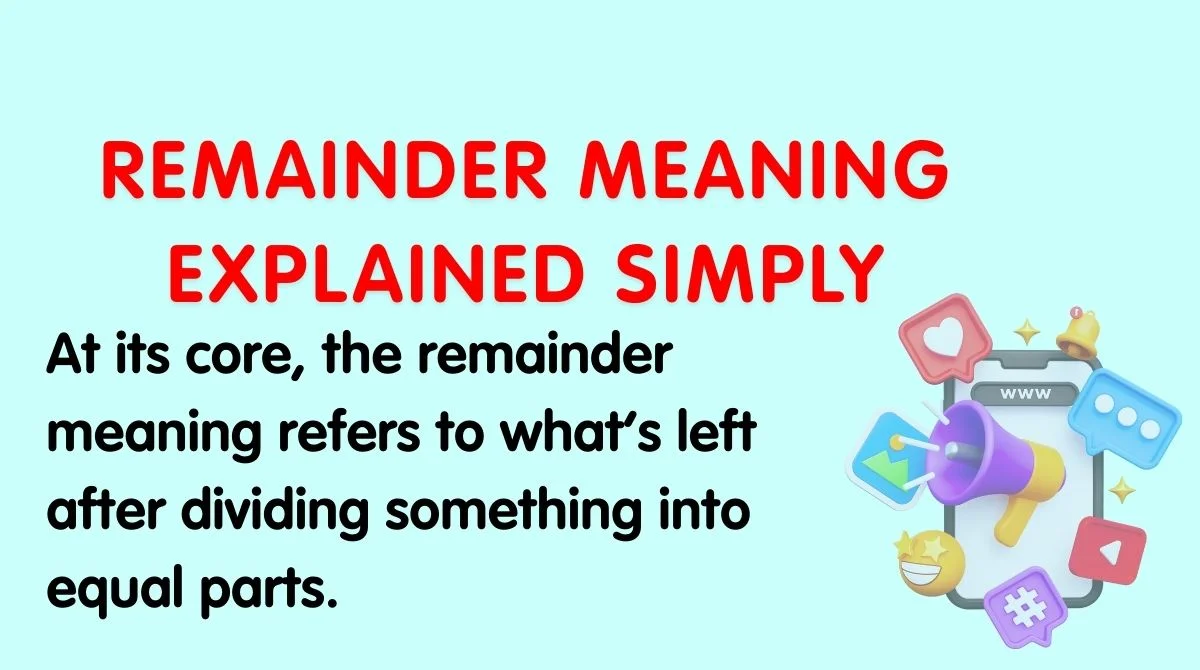
At its core, the remainder meaning refers to what’s left after dividing something into equal parts.
Let’s say you have 10 chocolates and 3 friends. You give everyone 3 chocolates. That uses 9.
The remainder is 1 chocolate — the leftover piece that couldn’t be evenly shared.
But the word isn’t limited to math. It also appears in everyday language:
- If you finish most of your food but leave some on the plate, that’s the remainder.
- If you use most of your salary but save a little, that saved amount is the remainder.
- If most people leave a room and a few stay behind, those people are the remainder.
So whether you’re dividing numbers, money, time, or effort, the remainder is simply what stays behind after the main part is taken.
Origin and Background of the Term
The word remainder comes from the Old French word remaindre, meaning “to remain” or “to stay behind.” That itself traces back to the Latin word remanere — re (back) + manere (to stay).
In medieval times, the word wasn’t mathematical at all. It was used in legal documents and storytelling to describe:
- The remaining land after inheritance
- The remaining people after a battle
- The remaining time after an event
Later, when mathematics became more formalized, scholars adopted the word to describe what’s left after division. And honestly, it fits perfectly.
There’s something poetic about it — the idea that after everything is distributed, shared, spent, or used, something always remains. That small leftover piece often carries more meaning than we realize.
How Remainder Is Used in Daily Life
You probably use the idea of “remainder” without realizing it. Let’s look at how naturally it shows up in real life.
1. Money & Budgeting
You pay rent, bills, groceries, and transport.
What’s left in your account? That’s your remainder — and sometimes, your peace of mind.
2. Food & Sharing
You cook for five people but seven show up.
After dividing, the small leftover portions? Yep — the remainder.
3. Time Management
You plan an 8-hour workday. Meetings take 6 hours.
The remainder is the time you have left for deep work or rest.
4. School & Learning
You solve 17 ÷ 5 in math class. The answer is 3 with a remainder of 2.
That leftover part helps you understand division better.
5. Emotional Energy
You give most of your energy to work, family, and responsibilities.
What’s left for yourself? That emotional remainder matters more than we think.
6. Life Situations
After a breakup, job change, or move, what stays with you — lessons, habits, memories — becomes the remainder of that experience.
See? This word isn’t technical. It’s deeply human.
Emotional or Practical Meaning of Remainder
Here’s where the concept gets powerful.
The remainder meaning isn’t just about leftovers — it’s about what remains after effort, struggle, sharing, or loss. Sometimes the remainder is small. Sometimes it’s everything.
Emotionally, remainder can represent:
- What you keep after giving
- What stays after change
- What’s left when things don’t go perfectly
Imagine someone working long hours to support family. At the end of the day, their energy remainder is tiny — but that tiny piece might go to their child’s homework, a phone call to a friend, or a moment of peace. That remainder carries weight.
Culturally, many traditions emphasize valuing leftovers — food, time, resources — not wasting them. The remainder isn’t useless. It’s potential.
Practically, remainders help us:
- Budget better
- Plan more accurately
- Understand limitations
- Make fair decisions
In life, we often focus on what’s used or lost. But the remainder shows us what’s still available — and that’s powerful.
Similar or Related Terms
Here are some closely related words — and how they differ:
- Leftover – Informal word for something remaining after use (usually food).
- Balance – What remains in an account after spending.
- Residue – What’s left after a chemical or physical process.
- Surplus – More than what’s needed (positive excess).
- Remnant – A small remaining part, often from something larger.
- Excess – Extra amount beyond what’s required.
👉 Remainder is neutral and flexible — it works in math, daily life, business, and conversation.
Common Misunderstandings About Remainder
Let’s clear up some confusion people often have.
❌ 1. “Remainder means something useless.”
Not true. A remainder can be valuable — like leftover savings or spare time.
❌ 2. “Remainder only applies to math.”
Nope. It applies to money, food, people, energy, time — almost everything.
❌ 3. “Remainder is always small.”
Not necessarily. Sometimes the remainder is larger than what’s used.
❌ 4. “Remainder equals waste.”
Wrong again. Waste is what’s thrown away. Remainder is simply what’s left — and often reusable.
❌ 5. “Remainders don’t matter.”
Actually, remainders often matter most, especially in budgeting, planning, and decision-making.
❌ 6. “Remainder is a negative word.”
It’s emotionally neutral. It can represent opportunity, savings, reflection, or even hope.
Examples of Remainder in Sentences
Here are natural, everyday ways people use the word:
- After paying all my bills, the remainder went into savings.
- Divide the candy equally, and I’ll take the remainder.
- The teacher explained the problem using division and remainders.
- Most guests left early, but a small remainder stayed behind.
- I ate most of the cake — the remainder is in the fridge.
- After the storm, the remainder of the town slowly rebuilt.
- He spent his paycheck but saved the remainder for emergencies.
- The remainder of her energy went into helping others.
Why Understanding Remainder Matters Today
In today’s fast-paced world, understanding the remainder meaning helps more than you might expect.
📌 Financial Awareness
Knowing what remains after expenses helps you budget smarter, avoid debt, and plan for emergencies.
📌 Time Management
When you understand how much time remains after tasks, meetings, or obligations, you regain control of your day.
📌 Emotional Balance
Recognizing your emotional remainder — what energy you still have left — helps prevent burnout.
📌 Academic Success
In math, understanding remainders strengthens division skills, problem-solving, and logical thinking.
📌 Communication Skills
Using words like “remainder” correctly improves clarity in writing, business discussions, and daily conversations.
In short, remainders teach us limits, fairness, and awareness — three things modern life desperately needs.
Frequently Asked Questions
What does remainder mean in simple words?
A remainder means what’s left after something is divided or used. It’s the leftover part that doesn’t fit evenly.
Is remainder positive or negative?
Neither. It’s emotionally neutral. A remainder can be good (extra money), bad (unfinished work), or simply factual.
Where is remainder commonly used?
It’s used in math, finance, daily conversation, education, and even emotional discussions.
Is remainder formal or informal?
It’s both. It works in formal writing (math, business, academics) and casual conversation.
Why do people search for remainder meaning?
Because it’s used in school, finances, conversations, and writing — and people want clarity on how to use it correctly as language evolves with time.
Conclusion
The remainder meaning might seem simple at first — just what’s left over. But when you look deeper,
it’s about balance, fairness, awareness, and even hope.
It reminds us that after every division — of time, money, effort, or energy — something remains.
And that remainder isn’t meaningless. It’s opportunity. It’s choice. It’s possibility.
Whether you’re solving math problems, budgeting your income, managing your energy, or navigating life itself, understanding remainders helps you move forward more thoughtfully.
So next time something doesn’t divide evenly — don’t stress. Look at what remains.
Sometimes, the remainder holds the most powerful part of the story. 🌟

Thomas Reed helps learners master English words through simple explanations and real-life usage.