Have you ever stood at a crossroads, heart beating fast, wondering whether to take a chance or play it safe? That moment — the pause, the doubt, the excitement — is where risk meaning truly lives.
Most people hear the word “risk” and instantly think of danger or loss. But risk isn’t always bad. Sometimes, it’s the reason we grow, change careers, fall in love, or chase dreams.
Understanding the real meaning of risk helps us make smarter choices instead of reacting out of fear.
In simple terms, risk is about uncertainty — not knowing exactly what will happen but choosing to act anyway.
And in today’s fast-moving world, learning how to think about risk wisely is a powerful life skill.
In this article, we’ll explore what risk truly means, where the word came from, how it shows up in everyday life, and why understanding it matters more than ever.
By the end, you won’t just know the definition — you’ll feel confident navigating risk in your own life.
Let’s dive in.
What Does Risk Mean?
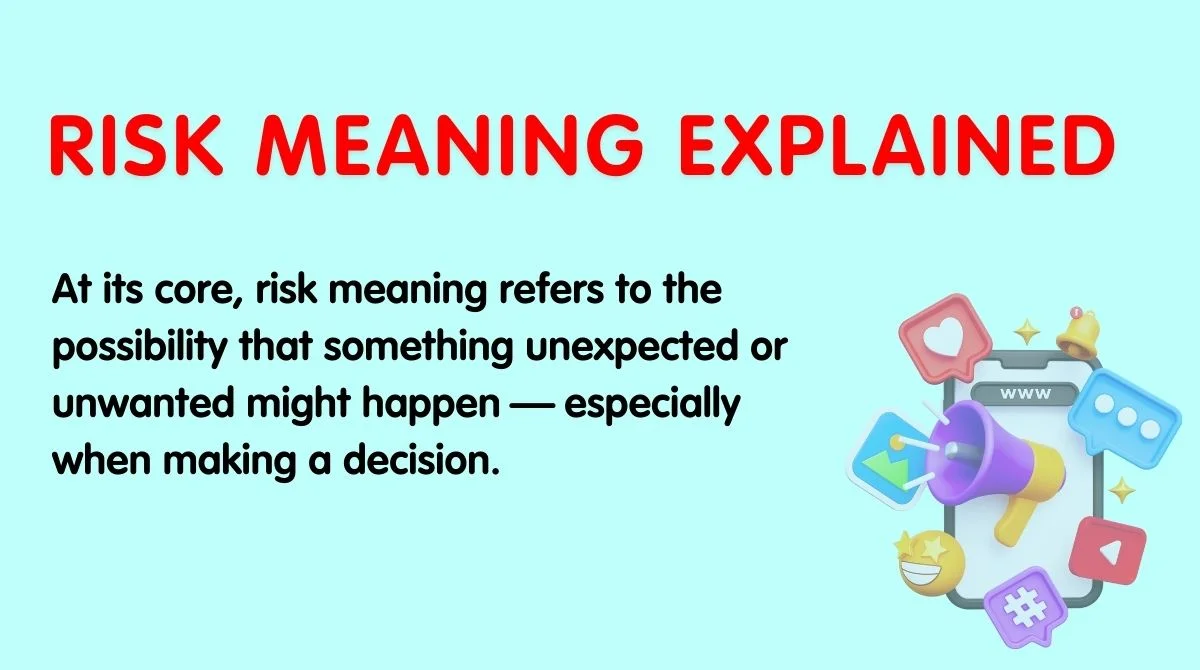
At its core, risk meaning refers to the possibility that something unexpected or unwanted might happen — especially when making a decision.
But here’s the human side of it:
Risk is simply the space between what you know and what could happen.
It’s not just about danger. It’s about uncertainty mixed with opportunity.
Real-life examples:
- Starting a new job
You risk leaving stability behind, but you might gain growth, happiness, and higher income. - Investing money
There’s a chance you’ll lose some, but there’s also a chance your money grows. - Speaking up in a meeting
You risk embarrassment, but you might earn respect or recognition.
So, risk isn’t just about what you might lose — it’s also about what you could gain. That balance is what gives the word its true meaning.
Origin and Background of the Term
The word “risk” has a fascinating history.
It comes from the old Italian word “risco” or “rischio,” which meant danger or chance. Even earlier, some linguists trace it to a Latin root that suggested “cutting into something” — like navigating sharp rocks while sailing.
Imagine sailors hundreds of years ago steering wooden ships through rough waters. One wrong move could wreck everything. Yet without taking that risk, they’d never discover new lands.
Over time, the meaning expanded. Risk stopped being only about physical danger and started applying to money, relationships, careers, health — basically, life itself.
Today, risk doesn’t just mean “something bad might happen.” It means you’re stepping into the unknown, and that’s both scary and powerful.
How Risk Is Used in Daily Life
You might not realize it, but you use the concept of risk almost every day — even when brushing your teeth or crossing the street.
Here’s how risk meaning shows up in everyday situations:
- Driving in traffic
You accept a small risk every time you’re on the road. - Eating street food
Delicious? Yes. Risk-free? Not always. But people weigh the risk anyway. - Changing careers
Staying unhappy feels risky. So does leaving. Life becomes about choosing the better risk. - Posting online
You risk judgment, but you also risk connection and growth. - Starting a business
Financial uncertainty exists, but so does freedom and success. - Falling in love
Emotional risk is huge — but so are the rewards.
Risk isn’t rare. It’s woven into daily life. The real skill is learning how to recognize risk, evaluate it, and decide wisely instead of avoiding it altogether.
Emotional or Practical Meaning of Risk
Emotionally, risk often feels like fear mixed with excitement.
Your heart races. Your mind fills with “what ifs.”
What if I fail?
What if it works?
That emotional tension is exactly why risk matters.
Practically, risk helps us:
- Grow beyond comfort zones
- Learn through experience
- Discover new opportunities
- Build resilience
- Make meaningful life changes
Culturally, risk is admired. Entrepreneurs are praised for bold moves. Athletes are celebrated for taking chances. Artists gain respect for creative risks.
In modern life, where stability isn’t guaranteed, understanding risk gives people control over uncertainty instead of letting fear run their choices.
Risk isn’t recklessness. It’s courage with awareness.
Similar or Related Terms
Here are some closely related words and how they differ from risk:
- Uncertainty – Not knowing what will happen, but without action involved
- Danger – A strong possibility of harm (often more severe than risk)
- Hazard – Something that can cause harm, usually external
- Chance – The possibility of something happening, neutral tone
- Opportunity – A positive potential outcome, often hidden inside risk
- Threat – A negative possibility, more aggressive in tone
Risk sits in the middle — it acknowledges both loss and potential gain.
Common Misunderstandings About Risk
Many people misunderstand what risk truly means. Let’s clear up some of the biggest myths.
1. Risk always means danger
Not true. Risk simply means uncertainty. Outcomes can be positive too.
2. Avoiding risk guarantees safety
Nope. Avoiding action can sometimes be riskier than acting.
3. Risk-taking equals recklessness
Smart risk-taking involves thinking, planning, and evaluating — not blind leaps.
4. Only businesspeople deal with risk
Everyone deals with risk — students, parents, artists, workers, and retirees.
5. Risk means gambling
Gambling is one form of risk, but most risks are calculated and thoughtful.
6. If you fail, the risk wasn’t worth it
Failure often brings learning, experience, and growth — which can be priceless.
Understanding these misconceptions helps people make better decisions instead of fearful ones.
Examples of Risk in Sentences
Here are natural, everyday examples showing risk meaning in action:
- Starting her own business was a big risk, but she believed in herself.
- He took the risk of speaking up — and ended up leading the project.
- There’s always some risk in traveling alone, but it can be incredibly rewarding.
- Investing in stocks involves risk, but also potential growth.
- Falling in love is an emotional risk, yet many say it’s worth it.
- Playing it safe felt comfortable, but taking the risk changed her life.
- Every major decision carries some level of risk.
- Sometimes the biggest risk is doing nothing at all.
Why Understanding Risk Meaning Matters Today
We live in a world full of fast decisions, changing careers, digital investments, online relationships, and constant uncertainty.
Understanding risk meaning helps people:
- Make smarter financial decisions
- Protect their mental and emotional health
- Grow professionally
- Build confidence
- Navigate uncertainty calmly
In education, students learn how to assess risk before exams, career choices, and life paths. In business, leaders calculate risk before investments. In health, people evaluate risks of treatments or lifestyle changes.
But beyond logic, understanding risk builds emotional strength.
When you understand risk, you stop seeing it as the enemy — and start seeing it as information. Instead of fear controlling you, you use awareness to guide you.
In today’s unpredictable world, knowing how to handle risk isn’t optional — it’s essential.
Frequently Asked Questions
What does risk mean in simple words?
Risk means the chance that something might go wrong — or right — when you make a decision. It’s about uncertainty and possible outcomes.
Is risk positive or negative?
Risk itself is neutral. It can lead to loss or reward depending on the situation and how it’s handled.
Where is risk commonly used?
Risk is commonly used in finance, health, business, relationships, education, sports, and everyday decision-making.
Is risk formal or informal?
The word “risk” works in both formal and informal settings. You’ll see it in business reports and casual conversations alike.
Why do people search for risk meaning?
People search for it to understand decisions better, reduce fear, improve confidence, and make smarter life or financial choices — especially as life becomes more uncertain with time.
Conclusion
At its heart, risk meaning isn’t about danger — it’s about possibility.
Every meaningful step forward in life carries uncertainty.
But without risk, there’s no growth, no change, no discovery.
Whether it’s choosing a new career, starting a relationship, investing in yourself, or simply speaking up, risk shapes the story of who we become.
The goal isn’t to avoid risk — it’s to understand it, respect it, and use it wisely.
Because sometimes, the bravest thing you can do isn’t playing it safe —
it’s believing in yourself enough to take the leap. 🌱