Have you ever tried buying concert tickets online, only to find them sold out in seconds — then reappearing at triple the price? 😤
If so, you’ve already experienced scalping, even if you didn’t know the word for it.
The scalping meaning changes depending on context, but at its core, it involves buying something quickly and reselling it for profit — often at a much higher price.
You’ll hear the term in finance, retail, sports tickets, and even history, and sometimes it carries a negative emotional charge.
Understanding this word matters more than you might think.
It helps you make smarter buying decisions, spot unfair practices, and communicate clearly in business or everyday conversations.
Plus, in today’s fast-paced digital economy, scalping isn’t just happening on street corners — it’s happening online, globally, and instantly.
Let’s break it all down in simple, human terms so you can walk away feeling confident, informed, and empowered. 💡
What Does Scalping Mean?
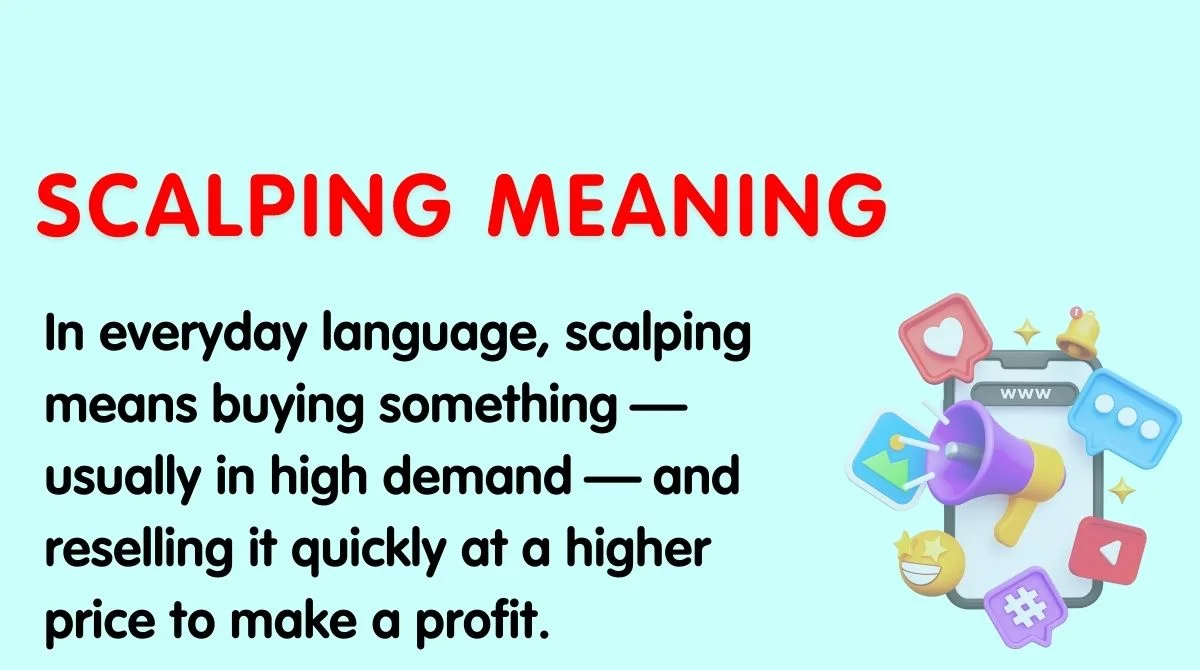
In everyday language, scalping means buying something — usually in high demand — and reselling it quickly at a higher price to make a profit.
It’s about speed, timing, and opportunity.
Here are a few real-life examples:
- Ticket scalping: Someone buys concert tickets the moment they go on sale and resells them for double or triple the price.
- Retail scalping: A person buys limited-edition sneakers or gaming consoles and resells them online at inflated rates.
- Stock market scalping: A trader buys and sells stocks within minutes or seconds to profit from small price changes.
So while the word stays the same, the scalping meaning shifts depending on the situation — from business strategy to controversial resale practice.
Origin and Background of the Term
The word “scalping” didn’t originally come from business or finance — it came from history.
Centuries ago, the term referred to the removal of the scalp in warfare, often used as proof of victory. Over time, the word evolved metaphorically to describe taking something quickly and leaving little behind, especially for personal gain.
By the late 19th and early 20th centuries, the term entered economic language. Ticket resellers were called “scalpers” because they were seen as taking advantage of scarcity, much like stripping something valuable from its source.
In financial markets, traders later adopted the term because of how fast and sharp the profits were — small slices taken rapidly, like a blade through paper.
Language evolves with culture, and today, “scalping” has become a multi-context word tied to commerce, ethics, and opportunity.
How Scalping Is Used in Daily Life
You might be surprised how often the term pops up in casual conversations — especially online. Here’s how people commonly use it today:
- “These tickets are gone — scalpers bought everything.”
- “That guy’s a reseller, not a collector. He’s scalping sneakers.”
- “In trading, I use a scalping strategy for quick profits.”
- “The PS5 shortage got worse because of online scalping bots.”
- “Some people see scalping as smart business; others see it as unfair.”
- “The government is trying to regulate ticket scalping laws.”
Whether in finance, retail, or everyday frustration, the word usually signals speed, profit, and controversy.
Emotional or Practical Meaning of Scalping
Here’s where things get interesting — because scalping isn’t just a technical term. It’s an emotional word.
For buyers, scalping often feels:
- Unfair
- Exploitative
- Frustrating
You wanted that ticket, phone, or game console — but now it’s gone, and the price has doubled. That hurts. 😔
For sellers or traders, though, scalping can feel:
- Strategic
- Smart
- Entrepreneurial
Some see it as understanding market demand and acting quickly — a form of hustle culture in motion.
Culturally, scalping sits at the crossroads of capitalism, ethics, and access. It raises questions like:
- Should profit come before fairness?
- Is scarcity natural or manufactured?
- Where should regulation step in?
That emotional tension is what keeps the term relevant — and controversial — today.
Similar or Related Terms
Here are some words you’ll often see connected to scalping, along with how they differ:
- Reselling: General term for selling something again, not necessarily at a high markup.
- Flipping: Buying undervalued items and reselling for profit, usually with improvements or value-add.
- Arbitrage: Buying in one market and selling in another for profit due to price differences.
- Price gouging: Charging excessively high prices, especially during emergencies — often illegal.
- Day trading: Buying and selling financial assets within the same day (scalping is a fast subset).
Each term overlaps slightly, but scalping focuses on speed and scarcity, often with emotional impact on buyers.
Common Misunderstandings About Scalping
Let’s clear up some confusion — because scalping is often misunderstood.
❌ 1. “Scalping is always illegal.”
Not true. In many places, ticket scalping is legal, though regulated. Financial scalping is completely legal.
❌ 2. “All resellers are scalpers.”
Nope. Reselling can be fair, ethical, and value-driven. Scalping usually implies excessive markup and urgency.
❌ 3. “Scalping only happens with tickets.”
Wrong again. It happens with electronics, sneakers, stocks, NFTs, and even real estate in some contexts.
❌ 4. “Scalpers don’t add value.”
In some markets, scalpers provide liquidity and availability — though the emotional cost can still be high.
❌ 5. “Scalping is a modern internet thing.”
Actually, it’s been around for over a century — the internet just amplified its scale and speed.
Understanding these nuances helps you use the term accurately and confidently.
Examples of Scalping in Sentences
Here are some natural, everyday examples:
- “I couldn’t get concert tickets because scalpers bought them all in seconds.”
- “He made quick profits by scalping crypto during market volatility.”
- “People are tired of sneaker scalping bots ruining drops.”
- “She doesn’t collect — she just scalps limited editions online.”
- “Some traders love scalping because it offers fast, small wins.”
- “The government introduced new laws to control ticket scalping.”
- “Scalping turns excitement into frustration for real fans.”
- “He tried scalping stocks but found it mentally exhausting.”
Why Understanding Scalping Matters Today
In today’s digital economy, speed is power — and scalping thrives on speed.
With automated bots, instant payments, and global marketplaces, scalping has evolved into something much bigger than street-side ticket sellers. It now affects:
- Concerts and sports events
- Gaming consoles and electronics
- Sneakers and collectibles
- Stock and crypto markets
Understanding the scalping meaning helps you:
✅ Make smarter buying decisions
✅ Avoid scams and inflated pricing
✅ Recognize ethical vs unethical practices
✅ Navigate trading strategies responsibly
It also gives you the language to express frustration — or opportunity — accurately.
In a world where supply shortages and hype cycles are constant, knowing how scalping works empowers you to stay ahead instead of feeling left behind.
Frequently Asked Questions
What does scalping mean in simple words?
Scalping means buying something quickly and reselling it at a higher price, usually because demand is high and supply is limited.
Is scalping positive or negative?
It depends on context. In finance, it’s often seen as a legitimate strategy. In retail and ticket sales, it’s usually viewed negatively because it limits fair access.
Where is scalping commonly used?
You’ll see scalping in:
- Ticket markets
- Stock trading
- Cryptocurrency trading
- Sneakers and collectibles
- Electronics and gaming consoles
Is scalping formal or informal?
The term is semi-formal. It’s commonly used in business, finance, and casual conversation — but less in academic writing.
Why do people search for scalping meaning?
People usually search it because:
- They encountered high resale prices
- They heard it in trading discussions
- They want to understand market behavior
- They’re curious about fairness in commerce
Language evolves with experience — and scalping is a word tied to real emotions and money.
Conclusion
At its heart, the scalping meaning is about speed, scarcity, and opportunity — but emotionally, it’s about fairness, frustration, and sometimes ambition.
Whether you’re a concert fan, sneaker lover, investor, or just someone trying to understand modern
marketplaces, knowing what scalping really means helps you navigate today’s economy with clarity instead of confusion.
Words shape how we see the world — and when you understand them deeply, you gain confidence, control, and perspective. 🌟
Keep learning, stay curious, and remember: knowledge is the one thing no one can scalp from you.