Have you ever been told to “toe the line” at work, school, or even at home — and felt unsure whether it was encouragement or a warning? You’re not alone.
This phrase shows up everywhere, from office meetings to news headlines, yet many people use it without fully understanding what it really means.
At its core, toe the line meaning revolves around following rules, expectations, or authority — but there’s more nuance than that. Sometimes it’s about teamwork.
Other times, it feels like pressure. And occasionally, it’s just about doing what’s required so life runs smoothly.
Understanding expressions like this helps you communicate more clearly, avoid misunderstandings, and sound more natural in English.
Plus, knowing the emotional weight behind phrases gives your conversations depth and confidence.
In this guide, we’ll explore where “toe the line” came from, how it’s used today, what people often get wrong about it, and how you can use it naturally in everyday life — without sounding stiff or robotic. Let’s dive in 👇
What Does Toe the Line Mean?
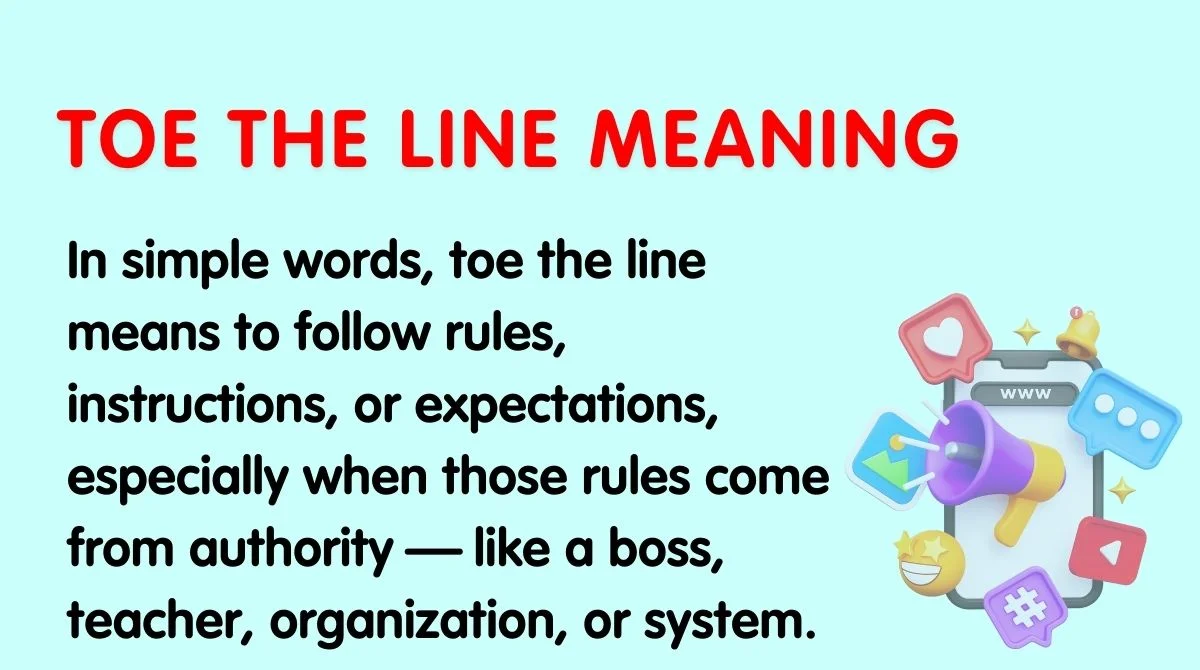
In simple words, toe the line means to follow rules, instructions, or expectations, especially when those rules come from authority — like a boss, teacher, organization, or system.
It often implies discipline, obedience, or compliance, but not always in a negative way. Sometimes it just means cooperating for the greater good.
Real-life examples:
- At work:
“The manager expects everyone to toe the line with company policies.” - At school:
“If students don’t toe the line, they face disciplinary action.” - In relationships:
“He felt like he had to toe the line to keep peace in the family.”
So basically, when someone says “toe the line,” they’re talking about staying within boundaries — whether spoken or unspoken.
Origin and Background of the Term
The story behind toe the line is more interesting than most people realize.
The phrase dates back to the early 19th century, and many historians believe it came from military drills. Soldiers were often ordered to line up with their toes touching a drawn line on the ground. Anyone whose foot crossed it was seen as undisciplined or out of formation.
Imagine a drill sergeant pacing back and forth, barking commands while soldiers nervously adjust their stance, making sure their boots touch the chalk line perfectly. That visual stuck — and the phrase slowly evolved to mean staying within limits or obeying authority.
Another theory traces the phrase to boxing rings, where fighters stood with their toes on a line before a match began. Again, the idea was discipline, order, and readiness.
Over time, the physical meaning faded, but the symbolic meaning stayed strong — especially in workplaces, politics, and institutions.
How Toe the Line Is Used in Daily Life
You’ll hear this phrase in all kinds of situations — some serious, some casual. Let’s break it down into everyday contexts.
- In the workplace
“The company expects employees to toe the line on safety protocols.” - In politics
“Party members were pressured to toe the line on controversial votes.” - In families
“As a teenager, she felt she had to toe the line or lose privileges.” - In schools
“Students who refuse to toe the line may face suspension.” - In sports
“The coach made it clear: toe the line or sit on the bench.” - In friendships
“He didn’t want to toe the line, but he also didn’t want conflict.”
Sometimes it’s about structure and order. Other times, it feels more like control or pressure. The tone depends entirely on the situation.
Emotional or Practical Meaning of Toe the Line
Beyond its literal meaning, toe the line carries emotional weight.
On the positive side, it can represent:
- Discipline
- Responsibility
- Teamwork
- Professionalism
For example, in a hospital setting, staff must toe the line with safety procedures — not because they’re forced, but because lives depend on it.
But emotionally, it can also suggest:
- Loss of freedom
- Suppression of individuality
- Fear of consequences
Think of a creative employee who feels forced to toe the line instead of sharing bold ideas. Over time, that pressure can lead to frustration or burnout.
In today’s world — where people value authenticity, mental health, and self-expression — the phrase often sparks debate. When should we toe the line for stability, and when should we challenge it for growth?
That tension is what makes this phrase so powerful.
Similar or Related Terms
Here are some common expressions related to toe the line, along with how they differ:
- Follow the rules – Neutral and straightforward; no emotional tone.
- Fall in line – Similar meaning, slightly more formal.
- Play by the book – Focuses on doing things exactly according to procedure.
- Stick to the rules – Casual and conversational.
- March in step – Implies unity or conformity.
- Comply – More legal or official tone.
👉 Toe the line often carries more emotional or power-related context than most of these.
Common Misunderstandings About Toe the Line
Let’s clear up some things people often get wrong.
1. “It always means something negative.”
Not true. Sometimes it simply means being responsible or maintaining standards.
2. “It means agreeing with someone.”
Not exactly. You can toe the line without agreeing — you’re just following rules or expectations.
3. “It’s only used in politics or work.”
Nope. It works in family, school, sports, and social situations too.
4. “It means standing on an actual line.”
That was the original meaning centuries ago, but today it’s entirely figurative.
5. “It’s outdated or old-fashioned.”
Not at all. It’s still widely used in modern English — especially in news, media, and business.
6. “It means giving up your values.”
Sometimes it might feel that way, but not always. Often, it just means cooperating for structure or harmony.
Examples of Toe the Line in Sentences
Here are some natural, everyday examples:
- “If you want to keep your job, you’ll need to toe the line.”
- “She refused to toe the line and spoke up about the unfair policy.”
- “The coach expects every player to toe the line — no excuses.”
- “He’s tired of toeing the line and wants to start his own business.”
- “They were warned to toe the line or face serious consequences.”
- “Sometimes you have to toe the line, even when you don’t agree.”
- “She toed the line for years before finally chasing her dream.”
- “Not everyone is comfortable toeing the line in strict systems.”
Why Understanding Toe the Line Matters Today
In today’s world, where individuality, freedom, and mental well-being are more valued than ever, phrases like toe the line matter deeply.
You’ll hear it in:
- Workplace policies
- Political debates
- Educational systems
- Family expectations
- Social movements
Understanding its meaning helps you:
✔ Communicate clearly
✔ Interpret tone and intent
✔ Avoid misunderstandings
✔ Respond thoughtfully
For example, when a manager says, “We expect everyone to toe the line,” are they encouraging professionalism — or discouraging creativity? The difference lies in context, and understanding this phrase lets you read between the lines.
More importantly, knowing expressions like this empowers you to choose when to cooperate — and when to challenge. Language isn’t just about words; it’s about power, emotion, and human connection.
And that’s what makes mastering phrases like this truly valuable.
Frequently Asked Questions
What does toe the line mean in simple words?
It means to follow rules or expectations, especially those set by authority figures like bosses, teachers, or institutions.
Is toe the line positive or negative?
It depends on the context. It can be positive when it means responsibility or teamwork, and negative when it implies pressure or loss of freedom.
Where is toe the line commonly used?
It’s commonly used in workplaces, politics, schools, families, sports, and media discussions.
Is toe the line formal or informal?
It’s neutral — appropriate for both professional and casual conversations, depending on tone.
Why do people search for toe the line meaning?
Because it’s a commonly used phrase that can sound confusing or emotionally charged, and people want to understand its real meaning and usage.
Conclusion
So now you know — toe the line isn’t just about rules. It’s about boundaries, authority, cooperation, and sometimes quiet resistance.
It reflects moments when we choose stability over risk, peace over conflict, or structure over freedom — and moments when we finally decide we won’t anymore.
Language shapes how we see the world, and understanding expressions like this helps you navigate conversations with confidence, clarity, and emotional intelligence.
Remember: sometimes toeing the line protects what matters — and sometimes stepping over it leads to growth.
The power lies in knowing the difference. 💛

Thomas Reed helps learners master English words through simple explanations and real-life usage.