Last updated on October 5th, 2026 at 04:26 am
Have you ever heard someone say, “That idea feels derivative,” and wondered what they actually meant?
Maybe you nodded along politely while secretly thinking, Wait… derivative of what? 😅 Don’t worry — you’re not alone.
The derivative meaning of a word, idea, or work often sounds more complicated than it really is.
In simple terms, it’s about something that comes from something else — an idea built on another idea, a word formed from another word, or even a product inspired by an earlier creation.
Understanding this concept isn’t just for academics or writers. It helps you become a better communicator, a sharper thinker, and even a more creative person.
Whether you’re a student, teacher, content creator, or just curious about language, this term pops up more often than you realize.
In this article, we’ll break down the derivative meaning in a friendly, relatable way — no boring dictionary definitions, no robotic tone.
Just clear explanations, real-life examples, and practical insight you can actually use.
Let’s dive in. 🚀
Sextant Meaning
Dominion Meaning
Jealousy Meaning Explained
Cape Meaning
Numb Meaning Explained
What Does Derivative Meaning Mean?
The derivative meaning of something refers to a meaning, idea, or form that is taken from or developed from another source rather than being entirely original.
Think of it like this:
If something is the root, then a derivative is the branch that grows from it.
In language, a derivative word is formed from another word.
In creativity, a derivative idea comes from an existing concept.
In everyday conversation, calling something derivative usually means it feels copied, inspired, or not very original.
Real-Life Examples:
- The word happiness is derived from happy.
- A movie inspired heavily by another film might be called derivative.
- A student essay that closely follows another source’s structure could be described as derivative — even if it isn’t copied word-for-word.
So, the derivative meaning isn’t always negative. Sometimes it simply means something evolved from something else — and that’s how growth happens.
Derivatives Meaning
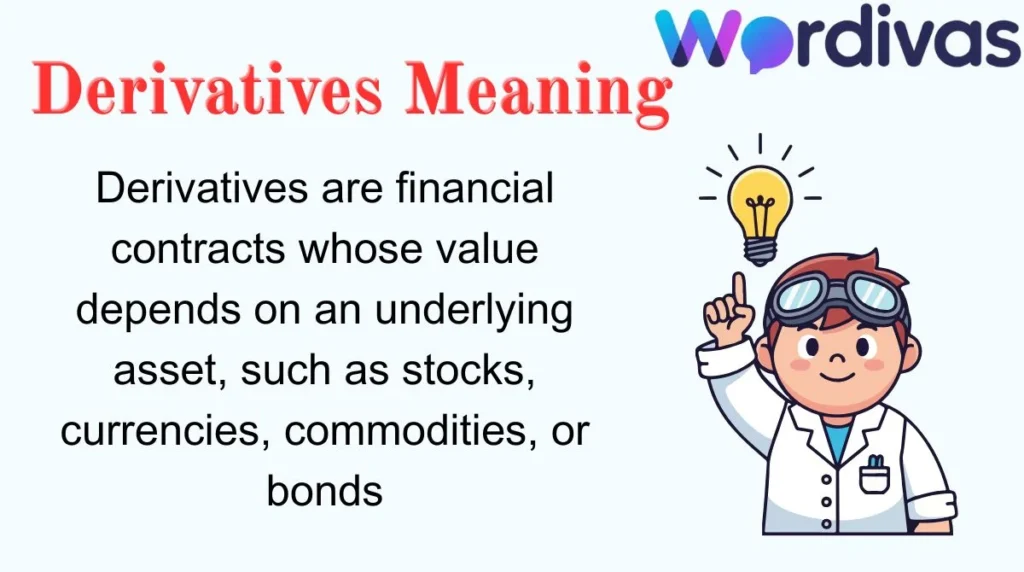
Derivatives are financial contracts whose value depends on an underlying asset, such as stocks, currencies, commodities, or bonds.
Investors use derivatives to reduce risk, earn profit, or predict future price movements in the market.
Common types of derivatives include futures, options, forwards, and swaps.
For example, a farmer may use a futures contract to lock in the future price of crops and avoid losses caused by price changes. Businesses and traders also use derivatives to protect investments from sudden market fluctuations.
These contracts are widely used in the financial world because they help manage uncertainty and improve trading opportunities.
However, derivatives can also involve high risk if they are not used carefully. Understanding derivatives is important for anyone interested in finance, trading, or investment markets around the world today.
Origin and Background of the Term
The word derivative comes from the Latin word “derivare,” which means “to draw off” or “to flow from.” Imagine water flowing from a river into smaller streams — that’s the original image behind this term.
Centuries ago, scholars used it in linguistics to explain how words evolve. For example, Latin gave birth to French, Spanish, and Italian — all derivatives of one ancient language.
Later, writers, artists, and critics adopted the term to talk about ideas and creativity. By the 1800s, calling a piece of work derivative often meant it lacked originality — especially in art, literature, or music.
But here’s the interesting part…
Not all derivatives are bad. Some of the world’s greatest ideas — from smartphones to modern novels — are built on earlier versions. They didn’t appear from thin air. They evolved.
That’s the deeper story behind derivative meaning — it’s not about copying; it’s about connection.
How Derivative Meaning Is Used in Daily Life
You might be surprised how often this term quietly slips into everyday conversations. Let’s look at some relatable examples.
- In school:
“Your essay feels derivative of the sample paper.”
(Meaning: It follows it too closely.) - In movies and TV:
“That show is entertaining, but the plot feels derivative.”
(Meaning: It resembles earlier stories.) - In language learning:
“The word worker is derivative of work.” - In business:
“Their product feels derivative of Apple’s design.” - In music:
“The song sounds derivative of 90s pop.” - In casual chat:
“His jokes are funny, but kinda derivative lately.”
As you can see, the derivative meaning adapts to context — sometimes neutral, sometimes critical, sometimes purely descriptive.
Derivative Meaning in Medical Context
In a medical context, derivative usually means something that is derived, developed, or obtained from another substance, treatment, or medical concept.
For example, a medicine may be described as a derivative of a particular chemical compound when its structure is based on that compound but has been modified.
The term can also appear when discussing derivative tests or measurements, where one result is calculated or obtained from another measurement.
In simple words, derivative means something that comes from or is developed from something else.
The exact meaning depends on the medical sentence where the word appears.
So, if you see “derivative” in a medical report, medicine description, or research article, look at the surrounding words to understand what it refers to.
Emotional or Practical Meaning of Derivative Meaning
On the surface, the word derivative sounds technical. But emotionally? It carries weight.
When someone calls your work derivative, it can sting. It feels like they’re saying, “This isn’t really yours.” And honestly — that hurts.
But here’s the flip side…
Every idea we’ve ever had is shaped by something we saw, heard, read, or experienced. Even creativity has a family tree. 🌳
So the practical meaning of derivative isn’t about shaming originality — it’s about recognizing influence. And in many cultures, especially in art, storytelling, and learning, influence is not only normal — it’s expected.
Think about:
- Recipes passed down generations
- Stories retold across cultures
- Music remixed into new genres
They’re all derivative — yet deeply meaningful.
Understanding this helps us judge ideas more fairly and create with more confidence, knowing originality doesn’t mean isolation.
Similar or Related Terms
Here are some closely related words and how they differ:
- Inspired – Positively influenced by something else
- Adapted – Changed to fit a new purpose or format
- Imitative – Closely copying, often without creativity
- Plagiarized – Illegally or unethically copied (very different from derivative)
- Derivative – Developed from something earlier, sometimes neutrally, sometimes critically
- Spin-off – A new version based on an existing work
👉 The key difference:
Derivative ≠ Plagiarism.
Derivative means influenced. Plagiarism means stolen.
Common Misunderstandings About Derivative Meaning
Let’s clear up some myths — because this word is often misunderstood.
❌ Misunderstanding 1: Derivative always means copied
✅ Reality: It can mean inspired, influenced, or developed — not necessarily copied.
❌ Misunderstanding 2: Derivative ideas are worthless
✅ Reality: Most innovations come from improving earlier ideas.
❌ Misunderstanding 3: Derivative only applies to art
✅ Reality: It’s used in language, math, science, business, and more.
❌ Misunderstanding 4: Derivative and plagiarism are the same
✅ Reality: Plagiarism is unethical copying. Derivative work can be ethical and creative.
❌ Misunderstanding 5: Being derivative means lacking intelligence
✅ Reality: Learning and building on others’ ideas is how intelligence grows.
❌ Misunderstanding 6: Original ideas have no roots
✅ Reality: Every idea has a backstory — even genius ones.
Understanding the derivative meaning properly helps you use the term wisely — and avoid unnecessary judgment.
Derivative Meaning in Relationship
When derivative is used in the context of a relationship, it generally means something that is based on, influenced by, or developed from another relationship, idea, or situation.
For example, someone might describe a relationship as “derivative” if its dynamics or characteristics seem to come from another relationship or established pattern.
In everyday conversation, however, derivative is not a common word for describing romantic or personal relationships.
It is more often used in a figurative or analytical way. In simple terms, if something is derivative in a relationship context, it means it comes from or is based on something else rather than being completely original.
The exact meaning depends on the sentence and how the speaker is using the word.
Examples of Derivative Meaning in Sentences
Here are natural, everyday sentences to help you see how the term works in real life:
- Her novel was engaging, but critics said it felt derivative of older fantasy stories.
- The word teacher is derivative of the verb teach.
- That fashion trend looks derivative of 90s streetwear.
- His jokes used to be original, but lately they’ve felt derivative.
- The company’s logo design is derivative of a famous brand’s style.
- Many modern apps are derivative of earlier platforms — just improved.
- The film’s plot felt derivative, but the acting saved it.
- That idea may be derivative, but your execution makes it fresh.
See? The tone shifts based on context — sometimes neutral, sometimes critical, sometimes descriptive.
Why Understanding Derivative Meaning Matters Today
In today’s digital world, content is everywhere.
Blogs. Videos. TikToks. Music. Memes. Art. AI.
And the big question people ask is: “Is this original?”
Understanding the derivative meaning helps you:
- Avoid plagiarism unintentionally
- Give credit where it’s due
- Build stronger creative work
- Communicate more clearly
- Think critically about originality
In education, it helps students learn responsibly.
In business, it helps brands innovate without copying.
In creativity, it helps artists remix ideas ethically.
In everyday life, it helps people express opinions accurately.
And honestly? It also builds emotional intelligence — because you learn how to critique without crushing creativity.
In a world where everything builds on something else, knowing the difference between inspired and derivative is more important than ever.
Derivatives Market Meaning

The derivatives market is a financial marketplace where people buy and sell derivative contracts. These contracts get their value from assets like stocks, commodities, interest rates, currencies, or market indexes.
The derivatives market helps investors manage risk and protect themselves from price changes in the future. It is divided into two main categories: exchange-traded derivatives and over-the-counter derivatives.
Exchange-traded derivatives are bought and sold on organized exchanges, while over-the-counter derivatives are privately traded between parties.
Traders, banks, companies, and investors participate in this market for hedging, speculation, and investment purposes.
The derivatives market plays an important role in the global economy because it increases market efficiency and liquidity.
However, it can also create financial risks if trading activities are not properly controlled or managed.
ASP Meaning
Coercion Meaning
Diameter Meaning Explained Simply
Partake Meaning
Symmetry Meaning
Frequently Asked Questions
What does derivative meaning mean in simple words?
It means something that comes from something else — like a word, idea, or work that’s based on an earlier one.
Is derivative meaning positive or negative?
It can be either, depending on context. Sometimes it’s neutral or descriptive, and sometimes it’s used critically to suggest lack of originality.
Where is derivative meaning commonly used?
It’s used in language, education, art, music, business, math, and everyday conversation — especially when discussing originality or influence.
Is derivative meaning formal or informal?
It’s mostly formal or academic, but people also use it casually when discussing movies, music, or creative work.
Why do people search for derivative meaning?
Because it’s commonly used in reviews, education, writing, and criticism, and many people want to understand whether it means copied, inspired, or something else.
Conclusion
At its heart, the derivative meaning isn’t about stealing — it’s about origin. It’s about understanding where ideas come from and how they evolve.
Every story you love, every song that moves you, every invention that changes your life — none of them appeared from nothing.
They grew from something else. And that’s not weakness. That’s humanity.
When you understand this word properly, you stop fearing influence — and start respecting creativity as a journey, not a destination.
So next time you hear someone say, “That feels derivative,” you’ll know exactly what they mean — and more importantly, how to think about it wisely.
✨ Remember: originality isn’t about being alone — it’s about building something meaningful from what came before.

Thomas Reed helps learners master English words through simple explanations and real-life usage.