Last updated on September 20th, 2026 at 03:57 am
Have you ever noticed how some people feel like family… even when they aren’t related by blood?
Maybe it’s a childhood friend who knows your story better than anyone, or a neighbor who shows up when life gets tough.
That feeling of connection, belonging, and shared identity is at the heart of kinship meaning.
In simple terms, kinship describes the relationships that connect people, whether through family ties, marriage, culture, or emotional bonds.
But it’s more than just a word — it’s about how humans form communities, support systems, and identities.
Understanding kinship helps us make sense of our family roles, cultural traditions, and even how societies function.
It shapes how we care for each other, resolve conflicts, and pass values from one generation to the next.
In this article, we’ll explore kinship in a clear, friendly way — no textbook tone, no confusing jargon. Just real-life meaning, relatable examples, and practical insights that actually matter.
By the end, you’ll not only understand the word — you’ll feel it. ❤️
Kinship Meaning in Sociology
In sociology, kinship refers to the social relationships that connect people through family, marriage, or other recognized forms of family ties.
It helps explain how individuals are related to one another and how families are organized within a society. Kinship can include relationships between parents and children, siblings, grandparents, cousins, and other relatives.
Different cultures may have different ideas about kinship and family responsibilities. These relationships often influence social roles, traditions, inheritance, and the way people support one another.
In sociology, studying kinship helps us understand how families work and how relationships between relatives shape communities and social life.
What Does Kinship Meaning Mean?
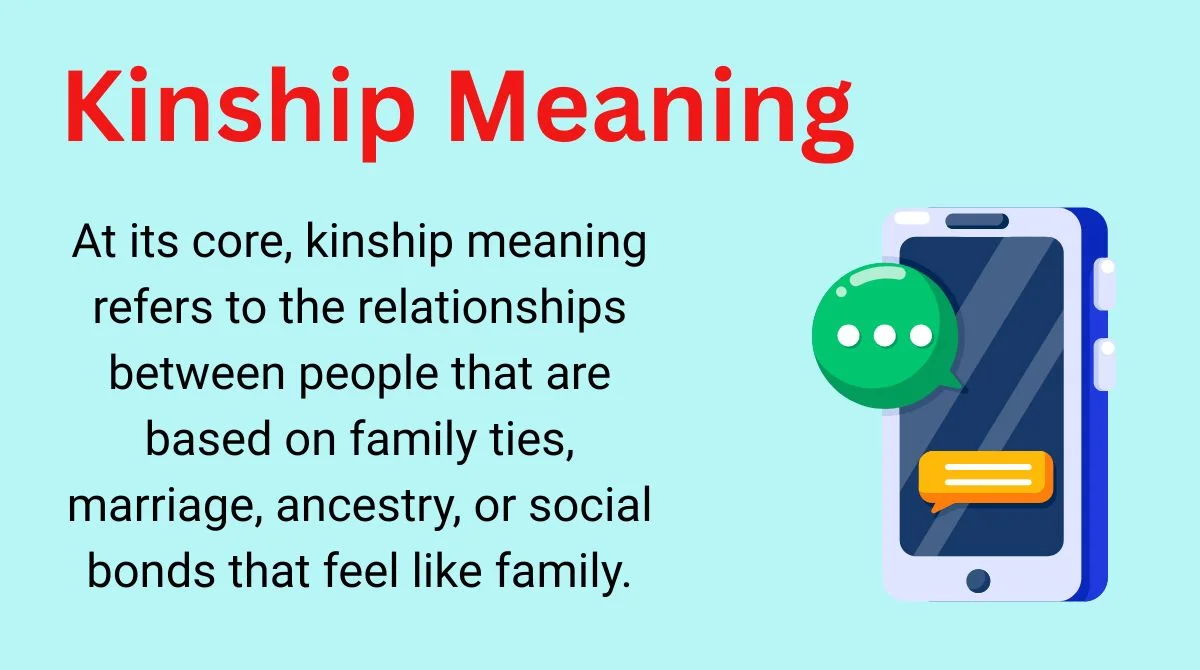
At its core, kinship meaning refers to the relationships between people that are based on family ties, marriage, ancestry, or social bonds that feel like family.
It’s not just about biology. Yes, parents, siblings, grandparents, cousins — they all fall under kinship. But so do adopted family members, in-laws, and even chosen family in many cultures.
Let’s look at a few real-life examples:
- A mother and daughter share a blood-based kinship.
- A husbexplicitly and and wife have a marital kinship.
- A foster parent and child share a social kinship, even without genetics.
In everyday life, kinship explains who belongs to your circle, who you call family, and who you feel responsible for. It’s the emotional and social glue that holds people together — not just in households, but in entire communities.
Instead of seeing kinship as a cold academic term, think of it as the map of human connection.
Kinship Meaning in Law
In law, kinship refers to the legal relationship between people who are connected by blood, marriage, or adoption.
Kinship plays an important role in many legal matters, including inheritance, child custody, guardianship, and family rights.
Courts often use kinship to determine who has legal responsibilities or benefits within a family.
For example, close relatives may have the right to inherit property when someone dies without a will.
Kinship can be divided into two main categories: consanguinity (blood relations) and affinity (relations through marriage).
Understanding kinship in law helps clarify family connections and ensures that legal decisions are made according to established family relationships and legal principles.
Origin and Background of the Term
The word “kinship” comes from the Old English word “cynn,” meaning family, race, or kind. Over time, it evolved into “kin,” which referred to people connected by blood or lineage.
Eventually, “kinship” came to describe the system of relationships that define family and social bonds.
Anthropologists began using the term more formally in the 19th and 20th centuries when studying how different cultures organize families.
What fascinated them wasn’t just who was related to whom — it was how societies define family differently.
For example:
- In some cultures, cousins are treated like siblings.
- In others, elders are considered parents to the whole village.
- Some communities recognize strong kinship with ancestors and future generations.
One anthropologist once described kinship as the “language of belonging.” That idea stuck — because kinship isn’t just about who shares DNA with you. It’s about who shares life with you.
From ancient triguilds bes to modern cities, kinship has always shaped how humans survive, thrive, and stay connected.
And even today, it quietly influences everything from inheritance laws to holiday dinners.
How Kinship Meaning Is Used in Daily Life
You may not say “kinship” out loud every day, but you live it constantly. Here are some real-world ways the concept shows up in everyday life:
- Family gatherings
When you attend weddings, reunions, or funerals, kinship defines who’s there and why. - Caring for relatives
Helping an aging parent or supporting a sibling through hard times is kinship in action. - Legal matters
Inheritance, guardianship, and custody decisions rely on kinship relationships. - Cultural traditions
Many rituals — naming ceremonies, weddings, funerals — are structured around kinship roles. - Adoption and foster care
These create powerful non-biological kinship bonds that are just as real. - Chosen family
Friends who become family — especially in LGBTQ+ communities — reflect modern kinship structures.
In short, kinship quietly shapes who we care for, who we trust, and who we feel responsible for — often without us even realizing it.
Emotional or Practical Meaning of Kinship
Kinship isn’t just a social structure — it’s deeply emotional.
It gives people a sense of:
- Belonging
- Security
- Identity
- Continuity
Think about a child who grows up knowing they’re supported by grandparents, parents, cousins, and siblings. That child often develops a stronger sense of stability because kinship creates a safety net.
On the emotional side, kinship means:
- Someone shows up when you’re sick.
- Someone celebrates your wins.
- Someone remembers where you came from.
On the practical side, kinship means:
- Shared caregiving.
- Financial support during hardship.
- Cultural knowledge passed down through generations.
In many cultures, kinship isn’t limited to the household — it extends to entire villages or clans. These networks ensure that no one is truly alone.
In modern life, where people move cities, change careers, and live far from relatives, kinship has evolved — but it hasn’t disappeared.
It’s simply transformed into blended families, chosen families, and emotional kinships that still meet the same human need: connection.
Similar or Related Terms
Here are some related words you’ll often see alongside kinship — and how they differ:
- Family – A general term for relatives or household members.
- Lineage – Ancestral line or descent from past generations.
- Ancestry – Family history or heritage.
- Blood relation – Biological family connection.
- In-laws – Family through marriage.
- Clan – A large kinship group, especially in tribal or cultural contexts.
- Community – A broader social group, sometimes replacing traditional kinship roles.
While these words overlap, kinship focuses specifically on the system of relationships — not just who someone is, but how they’re connected.
Common Misunderstandings About Kinship Meaning
Let’s clear up some myths that often confuse people about kinship:
- Kinship only means blood relations
Not true. Adoption, marriage, and chosen family all fall under kinship. - Kinship is outdated or old-fashioned
Actually, it’s evolving — not disappearing. Modern kinship looks different, but it’s still powerful. - Kinship only applies to traditional families
Single-parent households, blended families, LGBTQ+ families — all have valid kinship structures. - Kinship is only emotional, not practical
In reality, it affects laws, inheritance, caregiving, and social responsibility. - Kinship is the same everywhere
Every culture defines and practices kinship differently. - Kinship means you must like your relatives
Nope. Kinship describes connection — not necessarily emotional closeness.
Understanding these distinctions helps you see kinship as flexible, inclusive, and deeply human, not rigid or outdated.
between relatives shape communities and social life.
Kinship Meaning in Relationship
Kinship in a relationship means having a family or close family-like connection with another person.
It usually describes the bond between people who are related by blood, marriage, adoption, or sometimes through a recognized social relationship.
For example, a parent and child, brothers and sisters, or cousins share a kinship relationship.
Kinship can also describe the sense of belonging and connection people feel within a family. These relationships may involve love, care, support, responsibilities, and shared traditions. Simply put, kinship describes the connection that makes people part of the same family or family network.
Examples of Kinship Meaning in Sentences
Here are some natural, everyday examples of how kinship can be used:
- “Even though we aren’t related by blood, our bond feels like real kinship.”
- “In many cultures, kinship extends beyond the immediate family.”
- “Adoption creates strong kinship ties that last a lifetime.”
- “Their sense of kinship kept the community united during hard times.”
- “Marriage formed a new kinship between the two families.”
- “He felt kinship with people who shared his heritage.”
- “Kinship roles often determine who cares for children and elders.”
- “Their friendship grew into something deeper — almost like kinship.”
Why Understanding Kinship Meaning Matters Today
In today’s fast-moving, digital-first world, many people feel disconnected, isolated, or unsure where they belong. That’s exactly why understanding kinship is more important than ever.
Kinship reminds us that:
- Humans are wired for connection.
- Support systems matter more than ever.
- Family doesn’t have to look one way to be real.
In workplaces, schools, and communities, kinship concepts help us understand:
- Why mentorship relationships feel powerful.
- Why group identity matters.
- Why people protect and care for those they consider “their own.”
In social work, psychology, and education, professionals use kinship frameworks to support children, families, and communities more effectively. In law, kinship determines guardianship, inheritance, and rights. In culture, it preserves traditions and shared identity.
On a personal level, understanding kinship helps you:
- Appreciate your family structure — however unique it is.
- Respect other cultures’ family systems.
- Build deeper relationships with people around you.
Most importantly, kinship teaches us that connection is not accidental — it’s essential.
Kinship Meaning Examples
Kinship describes the relationship between family members based on blood, marriage, or adoption.
Common examples of kinship include the relationship between parents and children, brothers and sisters, grandparents and grandchildren, and uncles and nieces.
Relationships created through marriage, such as a hcontrol usband and wife or in-laws, are also examples of kinship.
In adopted families, the legal bond between adoptive parents and children is considered kinship as well.
For instance, a child may inherit property from their adoptive parents just as a biological child would. These examples show how kinship connects individuals within a family and influences social, cultural, and legal responsibilities.
Frequently Asked Questions
What does kinship mean in simple words?
Kinship means the relationships that connect people, especially through family, marriage, or emotional bonds that feel like family. It’s about who belongs to your circle and why.
Is kinship positive or negative?
Kinship is generally positive. It represents connection, support, and belonging. However, like any relationship, kinship can be complex — but the concept itself is neutral and widely valued.
Where is kinship commonly used?
Kinship is commonly used in:
- Sociology and anthropology
- Family law
- Cultural studies
- Everyday discussions about family and relationships
You’ll also see it in conversations about adoption, ancestry, and community bonds.
Is kinship formal or informal?
The word “kinship” is somewhat formal, but the idea behind it is very natural and everyday. People live kinship daily even if they don’t use the word itself.
Why do people search for kinship meaning?
People search for kinship meaning because they want to:
- Understand family relationships
- Learn about cultural structures
- Improve academic knowledge
- Make sense of emotional or social bonds
As family structures evolve, curiosity about kinship continues to grow.
Conclusion
At the end of the day, kinship meaning isn’t just about definitions — it’s about human connection.
It’s about who stands beside you when life gets heavy, who celebrates your milestones, and who reminds you where you come from.
Whether through blood, marriage, adoption, friendship, or shared experience, kinship shapes how we love, support, and understand each other.
And in a world that often feels rushed and disconnected, those bonds matter more than ever.
So next time you think about family — whether it’s the one you were born into or the one you chose — remember this: kinship isn’t about perfection. It’s about presence.
And sometimes, knowing you’re not alone is the most powerful thing of all. ❤️

Thomas Reed helps learners master English words through simple explanations and real-life usage.