Last updated on September 22nd, 2026 at 06:13 am
Imagine opening your bank account and seeing a large amount of money deposited at once instead of small payments trickling in over time.
That feeling — relief, excitement, maybe even nervousness — is exactly what the term lump sum often represents in real life.
Whether it’s a bonus from work, an insurance payout, or a retirement withdrawal, understanding the lump sum meaning can help you make smarter financial decisions and avoid costly mistakes.
It’s one of those phrases people hear often but don’t always stop to truly understand.
In simple terms, a lump sum means receiving all the money at once instead of in smaller installments.
But behind that simple definition lies a world of financial strategy, emotional decision-making, and long-term impact.
In this guide, we’ll break down what lump sum really means, where it came from, how it’s used today, and — most importantly — why it matters to you.
Let’s make this financial term feel human, practical, and empowering.
Lump Sum Meaning in French
The phrase “lump sum” in French is commonly translated as “somme forfaitaire” or “montant forfaitaire.” It refers to a fixed amount of money paid all at once instead of being divided into smaller payments.
For example, if someone receives a lump-sum payment, they get the full agreed amount in one payment.
The exact French translation can depend on the situation. In contracts, business, insurance, and financial contexts, “somme forfaitaire” is often used to describe a fixed total payment.
Understanding this phrase is useful when reading French financial documents, agreements, or payment terms.
What Does Lump Sum Mean?
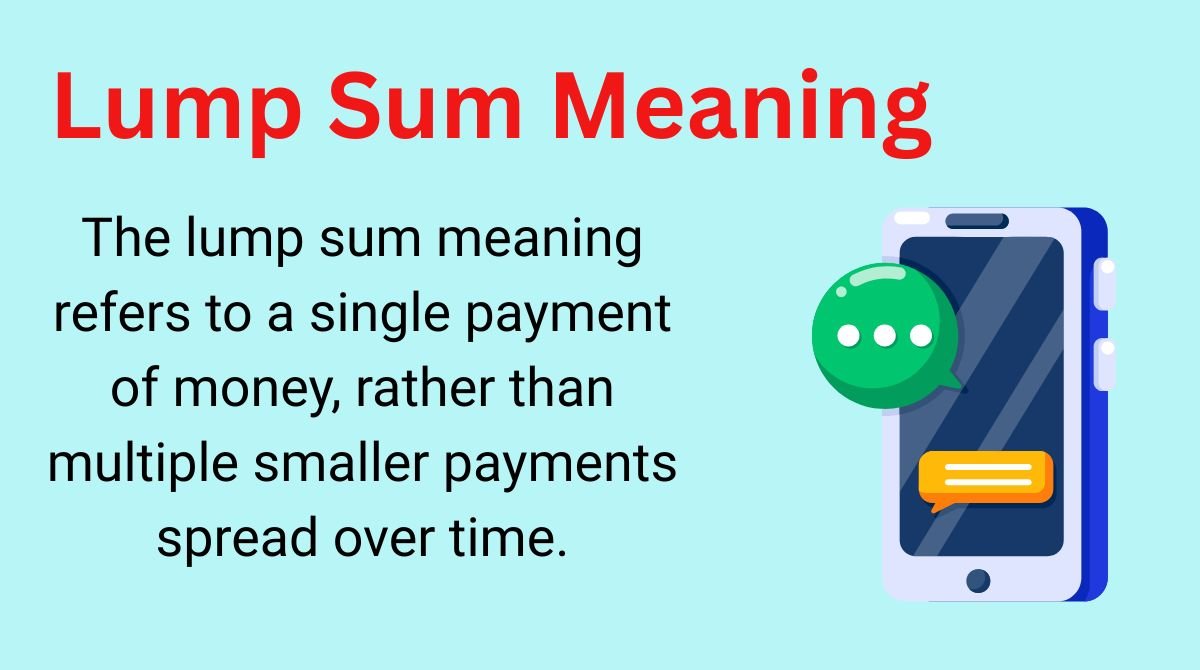
The lump sum meaning refers to a single payment of money, rather than multiple smaller payments spread over time.
Instead of receiving $1,000 every month for 10 months, you might receive $10,000 in one go. That’s a lump sum.
Let’s look at some real-life examples:
- A worker gets their annual bonus as one full payment.
- Someone receives an insurance settlement after an accident.
- A retiree withdraws their entire pension instead of monthly payments.
In each case, the money comes all at once, giving the person immediate access — but also full responsibility — over how it’s used.
It’s simple in theory, but powerful in practice.
Lump Sum Salary
A lump sum salary is a single payment made instead of several smaller payments over time. Employers may offer a lump sum salary as a bonus, settlement, severance package, or payment for a specific project.
Unlike monthly wages, the full amount is paid at once, making it easier to settle financial obligations quickly.
In some cases, employees may receive a lump sum instead of a salary increase or as compensation when leaving a job.
The exact terms depend on the employment agreement and company policy.
Understanding how a lump sum salary works is important because taxes, deductions, and legal obligations may differ from regular salary payments depending on the country and employment laws.
Origin and Background of the Term
The word lump has been part of the English language since the Middle Ages. Originally, it meant a solid mass or chunk of something, like a lump of clay or sugar.
Over time, people began using “lump” metaphorically — not just for physical objects, but for anything received in a single, solid amount.
That’s how “lump sum” was born: a phrase that literally means “a whole amount given at once.”
In early trade and labor systems, workers were often paid in bulk after completing large tasks instead of weekly wages.
Merchants preferred settling accounts in full rather than dealing with partial payments.
So historically, lump sums represented completion, closure, and certainty — ideas that still shape how we perceive them today.
How Lump Sum Is Used in Daily Life
You might be surprised how often lump sums show up in everyday situations. Let’s walk through some common examples.
- Salary bonuses
Many companies reward employees with a lump sum bonus instead of monthly increments. - Legal settlements
Courts often award compensation as a single payout rather than installments. - Insurance claims
After accidents or disasters, people may receive one large payment to cover damages. - Retirement withdrawals
Some retirees choose to take their pension in a lump sum instead of monthly payments. - Inheritance payments
Instead of structured disbursements, beneficiaries sometimes receive everything at once. - Freelance contracts
A freelancer might get paid a lump sum upon project completion.
In each case, the appeal is the same: immediate access to full funds — but that also means immediate responsibility.
Emotional or Practical Meaning of Lump Sum
Money isn’t just numbers. It’s emotional. And lump sums can feel overwhelming or empowering, depending on the situation.
For some, receiving a lump sum feels like freedom — a chance to clear debt, start a business, or invest for the future. For others, it brings anxiety: What if I spend it wrong? What if it runs out too soon?
Emotionally, lump sums often represent:
- Closure — after a lawsuit, insurance claim, or career phase
- Opportunity — a fresh start or major life upgrade
- Responsibility — suddenly managing a large amount alone
Practically, lump sums demand discipline and planning. Without structure, it’s easy to overspend. With structure, they can become life-changing tools.
Similar or Related Terms
Here are some commonly confused or related terms — and how they differ:
- Installments – Money paid over time in smaller amounts
- Annuity – Regular payments, often from investments or retirement plans
- One-time payment – Similar to lump sum but used in casual contexts
- Settlement – Legal compensation, often in lump sum form
- Payout – Any money distribution, either lump sum or recurring
- Bonus – Extra income, sometimes paid as a lump sum
👉 The key difference? A lump sum is always one complete payment, not spread out.
Common Misunderstandings About Lump Sum
Let’s clear up some popular myths.
1. Lump sums are always better than monthly payments
Not necessarily. Sometimes steady income offers better long-term security.
2. Lump sums mean free money
They often come with taxes, obligations, or financial trade-offs.
3. You can’t lose a lump sum
Without planning, large sums disappear faster than people expect.
4. Lump sums are only for rich people
Not true — bonuses, refunds, insurance claims, and settlements happen at all income levels.
5. Lump sums are risky by default
They’re only risky if unmanaged. With smart planning, they can be powerful.
6. Lump sums mean instant wealth
A lump sum doesn’t replace long-term income unless carefully invested.
Understanding these points helps people make confident, informed choices instead of emotional ones.
Lump Sum Meaning in Medical

In a medical context, “lump sum” does not usually describe a medical condition or symptom. “Lump” and “lump sum” have completely different meanings.
A lump can refer to a swelling or mass under or on the skin, while lump sum means a single, complete payment of money.
For example, medical insurance may provide a lump-sum payment for certain conditions or treatments.
The payment is made as one fixed amount rather than through several smaller payments. Therefore, when you see “lump sum” in a medical or insurance document, it generally refers to the payment arrangement rather than a physical lump.
Examples of Lump Sum in Sentences
Here are some natural, everyday uses:
- She received her annual bonus as a lump sum, not monthly payments.
- The insurance company paid him a lump sum settlement after the accident.
- Instead of installments, they chose a lump sum payout to clear their debts.
- He invested his retirement lump sum into a diversified portfolio.
- The freelancer negotiated a lump sum fee for the entire project.
- Winning the lottery gave her a massive lump sum, and suddenly life felt different.
- The company offered a lump sum severance package when downsizing.
- Receiving a lump sum inheritance changed how she viewed money.
Why Understanding Lump Sum Matters Today
In today’s world of side hustles, freelancing, investing, and early retirement planning, the lump sum meaning has never been more relevant.
People are no longer relying on just one paycheck. They’re managing bonuses, settlements, crypto gains, business profits, and payouts — often in large chunks rather than steady streams.
Understanding lump sums helps you:
- Make smarter investment decisions
- Avoid emotional overspending
- Plan taxes effectively
- Protect long-term financial security
Let’s take a real-life scenario.
Sarah, a 34-year-old designer, received a $40,000 severance lump sum after her company downsized. At first, she felt rich. She upgraded her phone, took a trip, and helped family — all great things. But within eight months, the money was gone, and she was job hunting under pressure.
Now compare that with James, who received a similar amount after selling a side business. He set aside emergency savings, invested part, and used the rest to skill up. Two years later, he doubled his income.
Same money. Different understanding.
That’s why learning what lump sums really mean — emotionally and practically — can change outcomes, not just bank balances.
Lump Sum Meaning in Law
In law, a lump sum refers to a single payment made to satisfy a financial obligation instead of paying in installments.
It is commonly used in legal settlements, compensation claims, divorce agreements, insurance payouts, and contract disputes.
Once the agreed lump sum is paid, it may fully resolve the legal obligation, depending on the terms of the agreement.
Courts and legal contracts often specify the payment amount, deadline, and any conditions attached to it.
The legal meaning of a lump sum can vary by jurisdiction, so reviewing the relevant laws or the contract itself is essential.
Understanding this term helps individuals make informed legal and financial decisions.
Frequently Asked Questions
What does lump sum mean in simple words?
A lump sum means getting all the money at once instead of receiving smaller payments over time. It’s one full payment, not installments.
Is lump sum positive or negative?
It can be either, depending on how it’s managed. Lump sums offer freedom and opportunity, but without planning, they can disappear quickly.
Where is lump sum commonly used?
Lump sums are common in salary bonuses, insurance claims, retirement payouts, legal settlements, freelance contracts, and inheritances.
Is lump sum formal or informal?
It’s a neutral business and financial term, used in both professional and everyday conversations.
Why do people search for lump sum meaning?
People want clarity before making financial decisions — especially when offered large payments. Understanding lump sum meaning helps them avoid costly mistakes and plan wisely.
Conclusion
Understanding the lump sum meaning isn’t just about vocabulary — it’s about confidence, clarity, and control over your financial future.
A lump sum can feel like a gift, a reward, or even a burden. But when you understand how it works and what it represents, it becomes something far more powerful: an opportunity.
Whether it’s a bonus, inheritance, settlement, or retirement payout, what matters most isn’t how much you receive — it’s what you do with it next.
Money doesn’t change lives by itself. Choices do. And now, you’re better equipped to make yours wisely.

Thomas Reed helps learners master English words through simple explanations and real-life usage.