Last updated on September 10th, 2026 at 04:21 pm
Have you ever wondered why words like runner, running, and ran all feel connected — even though they look different?
Or why we instinctively understand that unhappiness means more than just “not happy”? That’s where morphology meaning comes in.
Morphology is one of those fascinating language topics that sounds technical but shows up in everyday life more than we realize.
Every text message, book, email, or social post is quietly shaped by it. Once you understand how words are built, language stops feeling random — and starts feeling logical, creative, and alive.
In simple terms, morphology helps us understand how words are formed, how they change, and how their structure affects meaning.
Whether you’re learning English, teaching it, or just curious about how language works, this concept gives you powerful insight.
In this article, we’ll explore morphology meaning in a friendly, human way — with stories, examples, and practical explanations that actually stick.
By the end, you’ll see words differently — and maybe even fall a little in love with language again. 💬✨
Morphology Meaning in Psychology
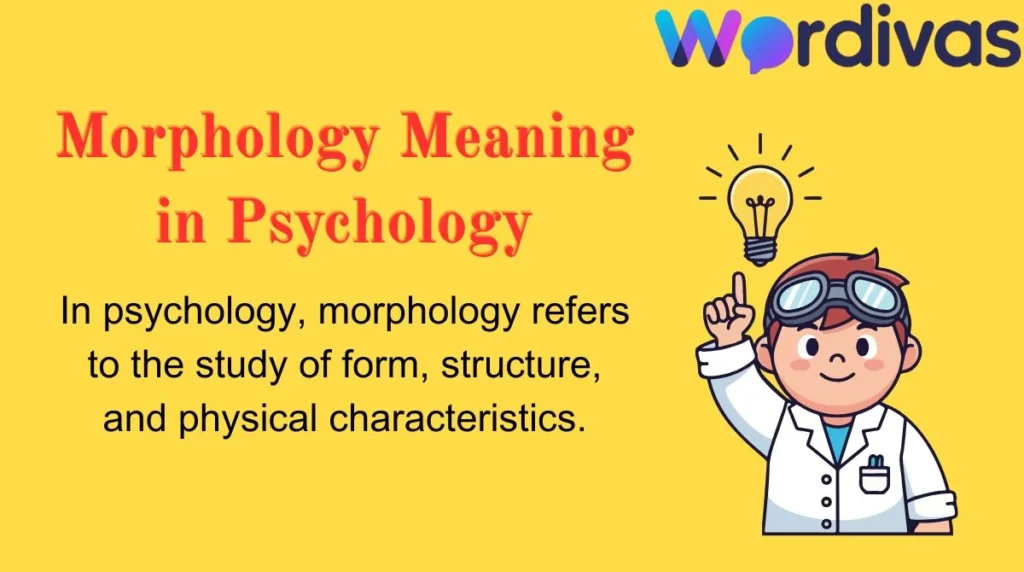
In psychology, morphology refers to the study of form, structure, and physical characteristics.
It can be used to describe the shape or appearance of the brain, body, or other biological structures that may relate to behavior and mental processes.
For example, researchers may study brain morphology to understand whether differences in brain structure are associated with memory, emotions, learning, or certain psychological conditions.
The term itself does not automatically indicate that a person has a problem; it simply describes structural features.
In psychological and neuroscience research, morphology is often considered alongside other factors such as genetics, environment, behavior, and experiences.
Understanding morphology can therefore help researchers explore how physical structures are connected with the way people think, feel, and behave.
What Does Morphology Meaning Mean?
Let’s break it down naturally.
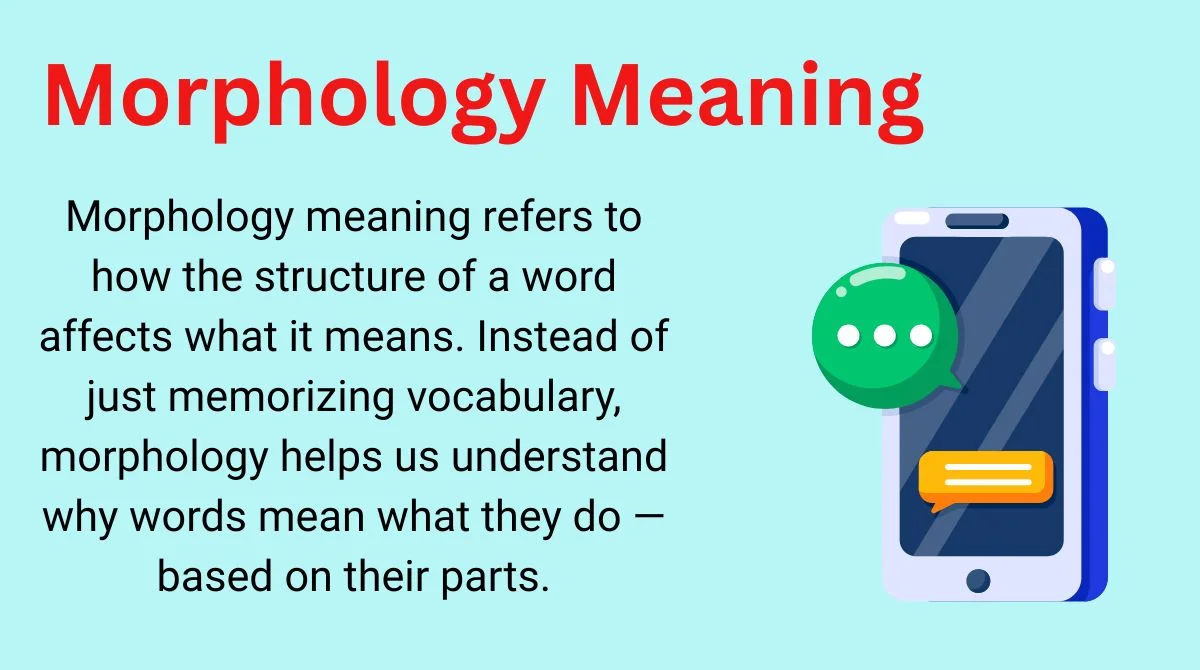
Morphology meaning refers to how the structure of a word affects what it means. Instead of just memorizing vocabulary, morphology helps us understand why words mean what they do — based on their parts.
Every word is made up of smaller units called morphemes — the smallest pieces of meaning. For example:
- Unhappy = un (not) + happy
- Teacher = teach + er (someone who does)
- Dogs = dog + s (more than one)
Once you spot these building blocks, words become easier to decode.
Real-life example:
Imagine you hear the word rebuild for the first time. Even if you’ve never seen it before, you instantly understand it means “build again.” That’s morphology at work — helping your brain process meaning fast.
Another example:
A child learns the word jumped and later says walked without being taught. Why? Because they’ve subconsciously understood how word endings change meaning.
That’s the beauty of morphology — it helps language make sense naturally.
Morphology Meaning in English
Morphology is a branch of linguistics that studies the structure and formation of words in a language.
It explains how words are created and how smaller units of meaning, called morphemes, combine to form complete words. Morphology helps people understand prefixes, suffixes, root words, and grammatical changes.
In English grammar, it plays an important role in improving vocabulary and understanding word patterns.
For example, adding “-ed” to a verb changes it to the past tense, while adding “un-” can create the opposite meaning of a word. Learning morphology makes it easier to recognize word meanings and use language correctly in both writing and speaking.
Origin and Background of the Term
The word morphology comes from the Greek words:
- Morphē — meaning form or shape
- Logos — meaning study or word
So, morphology literally means “the study of word forms.”
The concept dates back to early linguists who noticed that words weren’t just random sounds — they followed patterns. In the 1800s, scholars studying Latin, Greek, and Sanskrit saw that words changed shape depending on tense, number, or meaning.
Think of ancient scholars comparing:
- Run, ran, running
- Child, children
They realized these weren’t separate words — they were variations of the same core idea.
Over time, linguistics evolved, and morphology became one of its core branches. Today, it plays a huge role in:
- Language teaching
- Speech therapy
- Translation
- Artificial intelligence
- Reading development
So when we talk about morphology meaning, we’re talking about centuries of language study packed into everyday words — quietly guiding how we communicate.
How Morphology Meaning Is Used in Daily Life
You might not notice it, but morphology shapes your communication constantly. Let’s look at how.
1. Understanding New Words
When you see biodegradable, you recognize:
- bio = life
- degrade = break down
So you instantly get the meaning — without a dictionary.
2. Learning Languages Faster
Students who understand word roots pick up vocabulary quicker. Knowing spect means “see” helps with:
- Inspect
- Spectator
- Perspective
3. Reading Comprehension
When kids learn prefixes and suffixes, reading becomes smoother. They stop guessing and start decoding meaning.
4. Writing More Clearly
Writers use morphology to choose precise words. Helpful feels different from helpless — even though they share the same root.
5. Spelling Improvement
Knowing word parts helps with spelling. If you understand sign is inside signal, spelling suddenly feels logical.
6. Everyday Conversations
Even casual speech relies on morphology:
- “She’s redoing her room.”
- “That movie was unbelievable.”
- “I’ve misunderstood you.”
You already use morphology every day — now you just know its name.
Emotional or Practical Meaning of Morphology
Beyond grammar, morphology connects deeply to how we think and express ourselves.
Emotionally, words carry weight. Compare:
- Loved vs. loveless
- Hopeful vs. hopeless
- Careful vs. careless
Just a few letters can flip emotional meaning entirely. That’s morphology shaping emotion.
Practically, understanding morphology empowers people:
- Students gain confidence in reading.
- Writers sound clearer and more natural.
- ESL learners stop memorizing and start understanding.
- Professionals communicate with precision.
On a deeper level, morphology reminds us that language is flexible, creative, and evolving — just like humans. We don’t just use words; we shape them to fit new ideas, emotions, and experiences.
In a world where communication defines connection, knowing how words work under the surface is more than academic — it’s human.
Morphology Meaning in Linguistics
In linguistics, morphology is the study of the structure and formation of words. It examines how words are built from smaller meaningful units called morphemes.
For example, the word “unhelpful” can be divided into “un-,” “help,” and “-ful,” with each part contributing to the word’s meaning or grammatical function. Morphology helps explain how words change to show things such as tense, number, comparison, or grammatical relationships.
It also looks at how new words are formed and how different word forms are related to one another. By studying morphology, linguists can better understand the patterns that languages use to create and modify words.
This makes morphology an important part of linguistics, along with areas such as syntax, phonetics, and semantics.
Similar or Related Terms
Here are some closely related linguistic terms, explained simply:
- Phonology — Study of sounds in language
(How words sound) - Syntax — Study of sentence structure
(How words are arranged) - Semantics — Study of meaning
(What words mean) - Lexicology — Study of vocabulary
(Word collections) - Etymology — Study of word origins
(Where words come from)
👉 Morphology focuses specifically on word structure and formation, sitting between sound and meaning.
Common Misunderstandings About Morphology Meaning
Let’s clear up some common confusion — in a human way.
❌ 1. “Morphology only matters to linguists.”
Nope. Teachers, writers, students, translators, and even marketers use morphology daily — often without realizing it.
❌ 2. “It’s just about prefixes and suffixes.”
That’s part of it, but morphology also studies:
- Plurals (cat → cats)
- Verb tenses (walk → walked)
- Word transformations (beauty → beautiful)
❌ 3. “English morphology has no rules.”
English has plenty of rules — they’re just messier than some other languages. But patterns definitely exist.
❌ 4. “Kids learn words only by memorizing.”
Actually, kids use morphology instinctively. That’s why children say goed before learning went — they’re applying word-building rules.
❌ 5. “Morphology is too complex to be useful.”
Once explained simply, it becomes one of the most practical language tools you can learn.
Examples of Morphology Meaning in Sentences
Here are some natural, everyday examples:
- I realized unhappy meant “not happy” even before anyone explained it.
- She’s rewriting her resume to apply for a better job.
- The teacher taught us how kindness comes from the word kind.
- He felt powerless after losing control of the situation.
- Kids quickly learn that cats means more than one cat.
- That movie was forgettable, but the soundtrack wasn’t.
- I misunderstood the email and had to recheck the details.
- Learning word roots helped me guess meanings during exams.
See how morphology quietly shapes meaning in every sentence?
Why Understanding Morphology Meaning Matters Today
In today’s fast-moving, text-heavy world, communication happens everywhere — emails, social media, education platforms, global workplaces. Understanding morphology gives people a powerful advantage.
For Students
It boosts:
- Reading comprehension
- Vocabulary growth
- Spelling confidence
Instead of memorizing thousands of words, students learn how words are built, making learning faster and more lasting.
For Teachers
Morphology helps educators explain language logically instead of relying on memorization — especially helpful for struggling readers.
For ESL Learners
Morphology bridges languages. Once learners recognize patterns, English feels less chaotic and more structured.
For Writers & Professionals
Clear communication matters. Morphology improves:
- Tone precision
- Word choice
- Emotional impact
And culturally, morphology reflects how language evolves with society. New words like unfriend, selfie, and repost exist because morphology allows language to adapt.
In short, understanding morphology meaning isn’t just academic — it’s practical, empowering, and deeply human.
Morphology Meaning Example
A simple morphology example is the word “unhappiness.” This word is made up of three morphemes: “un-,” “happy,” and “-ness.” The prefix “un-” means “not,” the root word “happy” expresses a feeling of joy, and the suffix “-ness” changes the adjective into a noun. Together, these parts create the meaning “the state of not being happy.”
Another example is “played,” where the root word “play” combines with the suffix “-ed” to show past tense.
These examples demonstrate how morphology explains the way words are formed and how different word parts contribute to meaning in English grammar.
Frequently Asked Questions
What does morphology meaning in simple words?
Morphology meaning explains how words are built and how their parts change what they mean. It’s about understanding word structure, not just memorizing vocabulary.
Is morphology positive or negative?
Neither — it’s neutral. But learning it has positive effects, especially for reading, writing, and language learning.
Where is morphology commonly used?
It’s used in:
- Education
- Linguistics
- Language learning
- Speech therapy
- Writing and editing
Basically, anywhere language matters — which is everywhere.
Is morphology formal or informal?
The term itself is academic, but the concept applies to both formal and informal language — from textbooks to text messages.
Why do people search for morphology meaning?
People search for it to:
- Understand language better
- Improve reading or writing skills
- Learn linguistics concepts
- Help with exams or teaching
Language curiosity is a powerful motivator.
Conclusion
At first glance, morphology might sound like a technical linguistic term — but in reality, it’s the quiet engine behind every word we use.
Understanding morphology meaning helps us decode language instead of memorizing it, making communication clearer, learning faster, and expression richer.
From children learning their first words to professionals crafting meaningful messages, morphology shapes how we connect through language.
It reminds us that words aren’t random — they’re beautifully built, layered with structure, logic, and emotion.
And here’s the most inspiring part: once you start noticing how words are formed, you can’t unsee it — and suddenly, language feels less like a subject and more like a living system you’re part of.
✨ Every word you understand deeply becomes another tool for connection, growth, and confidence. ✨

Thomas Reed helps learners master English words through simple explanations and real-life usage.