Last updated on September 19th, 2026 at 05:21 am
Have you ever listened to someone talk and thought, “I understand the words… but none of this makes sense”?
Maybe it was a confusing email, a rambling speech, or even a social media post that felt like random ideas thrown together. That experience has a name — word salad.
In simple terms, word salad meaning refers to speech or writing that sounds grammatical but lacks logical meaning.
It can feel frustrating, puzzling, or even unsettling, depending on the situation. And in today’s world of fast communication, texts, and online conversations, we encounter it more often than we realize.
Understanding this term matters more than you might think. It helps you communicate better, recognize when someone may need support, and avoid unintentionally confusing others.
Plus, it sharpens your language awareness — a skill that’s always valuable.
In this article, we’ll explore what word salad really means, where it came from, how it shows up in daily life, and why knowing about it can make you a more thoughtful communicator. Let’s dive in. 😊
What Does Word Salad Mean?
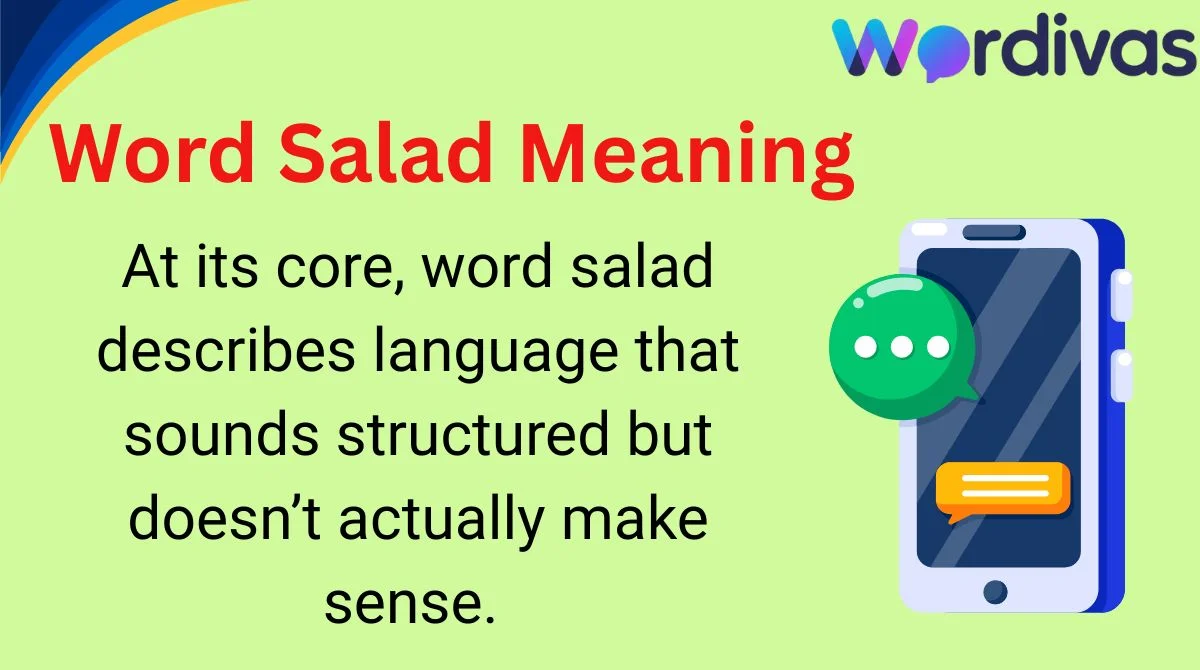
At its core, word salad describes language that sounds structured but doesn’t actually make sense. The sentences may be grammatically correct, yet the ideas are disconnected, illogical, or jumbled together.
Think of it like tossing random ingredients into a bowl — tomatoes, cereal, hot sauce, and chocolate chips. Technically, it’s a salad… but nobody wants to eat it. That’s exactly how word salad works in language.
Here are a few real-life examples:
- A meeting presentation where the speaker uses lots of fancy words but never lands on a clear point.
- A text message that jumps from topic to topic with no connection.
- A medical situation where someone speaks fluently, yet their words don’t form meaningful thoughts.
In everyday conversation, people use the term casually. But in psychology and medicine, word salad has a more specific and serious meaning — which we’ll explore shortly.
Word Salad Meaning and Examples
“Word salad” refers to speech or writing that contains many words but lacks a clear, logical meaning or connection between ideas.
In everyday conversation, people may use the term when someone explains something in a confusing or disorganized way.
For example, if someone says, “The meeting was about success, and success is like a window because windows open opportunities,” the ideas may feel disconnected and difficult to follow.
The term can also be used more casually for unclear writing, confusing explanations, or excessive jargon.
However, it is important to consider the context because confusing speech does not automatically indicate a mental health condition.
Origin and Background of the Term
The term word salad didn’t start on social media or in memes. It actually comes from the world of psychiatry.
In the early 20th century, mental health professionals noticed that some patients spoke in long, flowing sentences that sounded normal but were completely incoherent.
To describe this pattern, clinicians began using the metaphor “word salad,” comparing it to a bowl of mixed ingredients with no real structure or logic.
Over time, the term moved beyond clinical settings and entered everyday language.
Writers, teachers, and communicators began using it to describe unclear writing, confusing speeches, or overly complicated jargon.
Today, word salad lives in two worlds:
- Clinical: A symptom of certain mental health conditions.
- Casual: A way to describe unclear or rambling communication.
Both uses are valid — but understanding the difference is important for empathy and accuracy.
How Word Salad Is Used in Daily Life
You don’t have to be in a doctor’s office to encounter word salad. It pops up in everyday situations more often than we realize.
Here are some common examples:
- Corporate jargon overload
“We need to synergize scalable paradigms to leverage our operational bandwidth.”
Sounds impressive — means almost nothing. - Political speeches
Long, emotional statements that avoid answering the actual question. - Student essays
When someone uses big words without fully understanding them. - Social media captions
Hashtags, quotes, and phrases mashed together without a clear point. - Text messages when someone’s exhausted
You’ve probably sent one yourself at 2 a.m. 😅 - Medical or emotional distress situations
When someone is overwhelmed, anxious, or unwell, their speech can become disorganized.
In casual settings, word salad is often unintentional and harmless. But in clinical contexts, it can be a meaningful sign that someone needs help.
Emotional or Practical Meaning of Word Salad
Beyond its technical definition, word salad carries emotional weight.
When you hear someone speaking in word salad, you might feel:
- Confused
- Frustrated
- Concerned
- Or even disconnected
In relationships, unclear communication can lead to misunderstandings, arguments, and emotional distance. At work, it can result in missed deadlines, poor decisions, or wasted time.
But there’s another side to it too.
Sometimes, word salad isn’t about confusion — it’s about overwhelm. When someone’s stressed, grieving, anxious, or exhausted, their thoughts may not come out clearly. Their brain is racing, and language struggles to keep up.
Understanding this helps us respond with empathy instead of judgment.
Instead of thinking:
“Why can’t they just explain themselves clearly?”
We can think:
“Maybe something deeper is going on.”
That shift in perspective makes a huge difference in communication and human connection.
Similar or Related Terms
Here are some related terms you might hear alongside word salad, along with how they differ:
- Gibberish – Nonsense sounds or words with no recognizable meaning.
- Rambling – Long, unfocused speech that wanders off-topic but still makes partial sense.
- Incoherent speech – Language that lacks clarity or logical structure.
- Jargon overload – Too many technical or specialized terms, making communication confusing.
- Stream of consciousness – A writing style that mimics raw thought flow (not always meaningless).
- Circumstantial speech – Overly detailed explanations that eventually reach the point.
While these overlap, word salad is unique because it often sounds fluent and grammatical — yet completely lacks meaning.
Common Misunderstandings About Word Salad
Let’s clear up a few myths.
- “Word salad only happens in mental illness.”
Not true. Anyone can produce word salad when stressed, tired, or trying too hard to sound smart. - “It means someone is unintelligent.”
Absolutely not. Some highly intelligent people struggle with clarity when overwhelmed or anxious. - “It’s just bad grammar.”
Grammar can be perfect — the issue is meaning, not structure. - “All confusing speech is word salad.”
Confusion and word salad overlap, but word salad usually lacks logical connections entirely. - “People do it on purpose.”
Sometimes (like in marketing jargon), but often it’s completely unintentional. - “It’s always harmless.”
Not always. In medical contexts, it can signal serious mental or neurological conditions.
Understanding these distinctions helps us respond appropriately instead of making assumptions.
Examples of Word Salad in Sentences
Here are some natural, everyday examples:
- “The calendar whispers productivity while the future negotiates coffee with deadlines.”
- “I just feel like the sky of emotions is walking sideways through tomorrow.”
- “We need to leverage our innovation ecosystem to maximize holistic deliverables.”
- “My brain is soup today — everything’s loud but nothing makes sense.”
- “The happiness of yesterday folded into the ceiling fan of uncertainty.”
- “Let’s circle back to the synergy of actionable alignment strategies.”
- “My thoughts are running, but none of them know where they’re going.”
- “The meeting turned into a buffet of words with no real meaning.”
Some are humorous. Some feel poetic. Others feel unsettling. Context always matters.
Why Understanding Word Salad Matters Today
In a world overflowing with content, clarity is more valuable than ever.
We’re surrounded by:
- Marketing slogans
- Social media posts
- Political messaging
- Corporate emails
- AI-generated content
Sometimes, language is used to impress instead of express, and that’s where word salad thrives.
Understanding word salad meaning helps you:
- Communicate more clearly
- Write more effectively
- Spot empty language
- Respond compassionately when someone struggles to express themselves
- Avoid misunderstanding serious mental health signals
In education, it helps teachers identify when students don’t fully grasp material. In healthcare, it helps professionals recognize cognitive or psychological distress. In everyday life, it helps relationships run smoother.
And honestly? It makes you a better listener — someone who seeks meaning, not just words.
Word Salad Meaning in Psychiatry
In psychiatry, “word salad” describes severely disorganized speech in which words or phrases may be strung together without understandable logical connections.
It can occur in some psychiatric or neurological conditions, particularly when thought and speech become significantly disorganized.
A clinician does not diagnose a condition simply because someone occasionally speaks confusingly or goes off topic.
Instead, they consider the person’s overall symptoms, communication pattern, history, and other relevant factors. For this reason, “word salad” has a more specific meaning in psychiatry than it does in everyday conversation.
Frequently Asked Questions
What does word salad mean in simple words?
Word salad means using words that sound normal but don’t make logical sense together. It’s like mixing random thoughts into sentences that don’t connect clearly.
Is word salad positive or negative?
It’s usually neutral or negative, depending on context. Casually, it can be funny or harmless. Clinically, it may signal serious mental health concerns and should be taken seriously.
Where is word salad commonly used?
You’ll hear it in:
- Psychology and psychiatry
- Writing and education
- Workplace communication
- Casual conversations and online discussions
It shows up anywhere language loses clarity.
Is word salad formal or informal?
The term itself is informal, but it’s also used professionally in medical and psychological settings. The context determines how serious it is.
Why do people search for word salad meaning?
People search for it because they’ve:
- Heard it used in conversation
- Experienced confusing communication
- Seen it in mental health discussions
- Encountered unclear writing or speech
Curiosity and real-life confusion drive the search.
Conclusion
Language is powerful — it connects us, comforts us, and helps us make sense of the world. But when words lose their meaning, communication breaks down.
That’s why understanding word salad meaning matters more than most people realize.
Sometimes, word salad is funny. Sometimes, it’s frustrating. And sometimes, it’s a quiet signal that someone needs patience, compassion, or professional support.
The more clearly we understand language, the better we can listen — and the better we listen, the more human our connections become. 💛
So next time words feel tangled, remember: clarity isn’t just about sounding smart — it’s about being understood.

Thomas Reed helps learners master English words through simple explanations and real-life usage.