Last updated on September 19th, 2026 at 06:05 am
Have you ever felt suddenly alert, energized, or emotionally stirred by something — a song, a memory, a message, or even a conversation?
That inner shift you felt might be connected to arousal, even if you didn’t have a word for it at the time.
The term arousal meaning often gets misunderstood or limited to one context, but it actually plays a huge role in how we think, feel, learn, react, and connect with others.
It’s not just about attraction — it’s about awareness, motivation, excitement, focus, and emotional engagement.
In psychology, education, relationships, and even everyday conversations, arousal shapes how deeply we experience moments.
Understanding it can help you manage stress, improve focus, strengthen relationships, and better understand your own emotional responses.
In this guide, we’ll explore the real-life meaning of arousal in simple terms — no confusing jargon, no robotic tone — just honest, human explanations that actually make sense.
Let’s break it down together. 💡
Arousal Meaning in Psychology
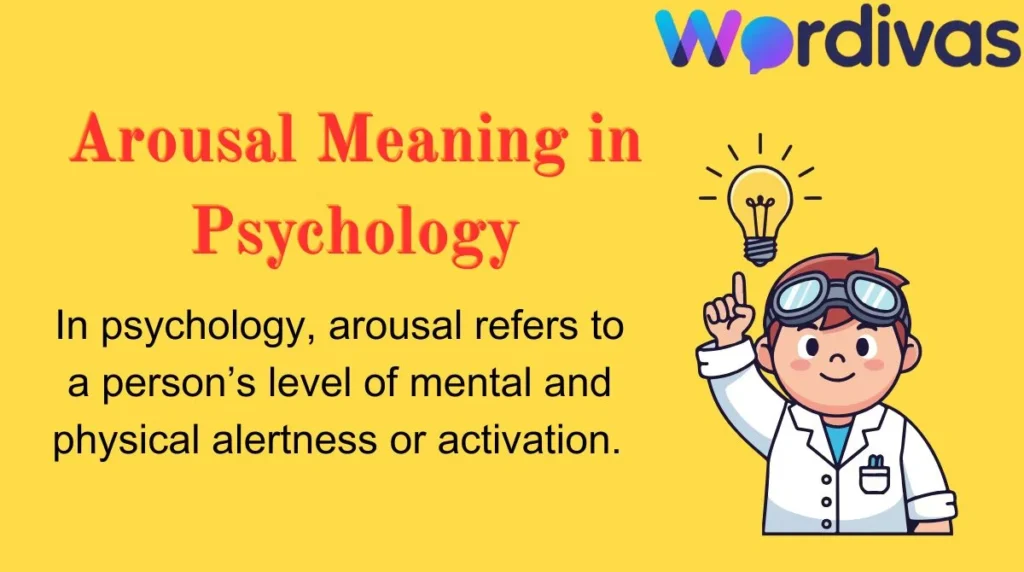
In psychology, arousal refers to a person’s level of mental and physical alertness or activation.
It describes how awake, attentive, excited, calm, or stimulated someone feels at a particular moment.
Arousal can range from very low, such as during deep relaxation or sleep, to very high, such as during excitement, stress, or fear.
Psychologists often study arousal because it can affect attention, emotions, motivation, and performance.
For example, a moderate level of arousal may help a person concentrate and perform a task effectively, while extremely high arousal can make it harder to think clearly. The meaning of arousal in psychology is therefore broader than simply feeling excited; it generally describes the overall state of activation of the mind and body.
What Does Arousal Mean?
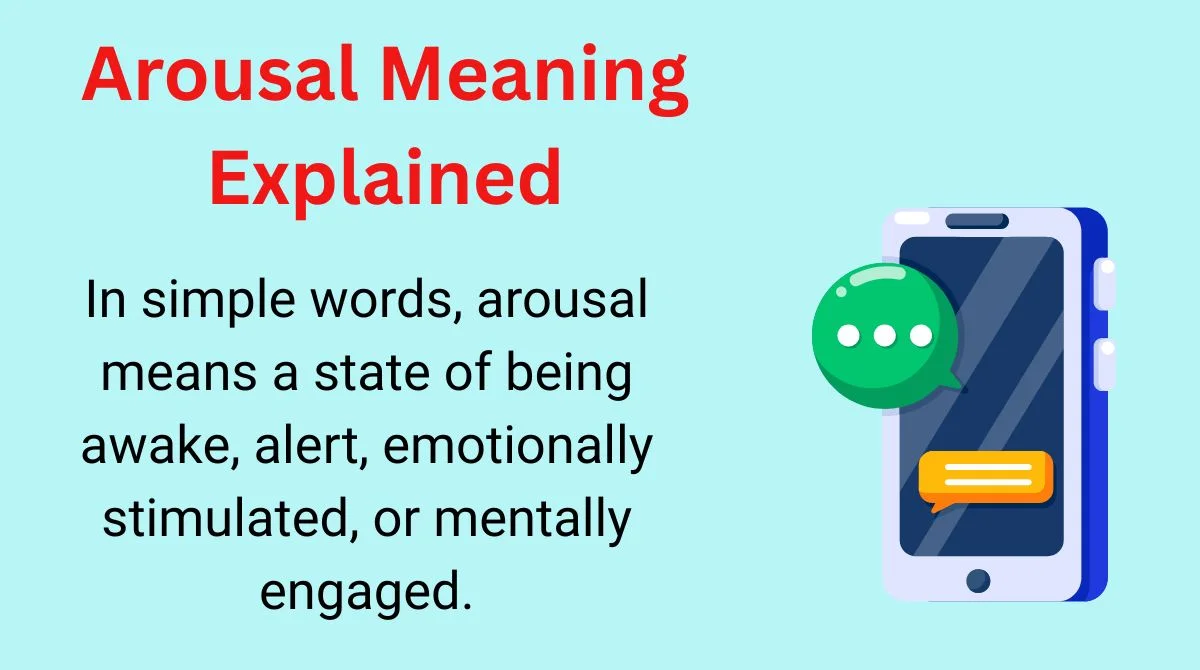
In simple words, arousal means a state of being awake, alert, emotionally stimulated, or mentally engaged. It’s when your mind and body shift from calm or neutral into a more energized or responsive state.
It doesn’t always mean excitement or attraction. Sometimes, arousal looks like:
- Feeling focused before a big presentation
- Feeling nervous before an exam
- Feeling energized during a workout
- Feeling emotionally moved by a movie scene
Think of arousal like a dimmer switch. Some moments turn it up slightly — others turn it way up. It’s not good or bad by itself; it simply reflects how activated your nervous system is in response to something.
For example:
- When your heart races before speaking in public, that’s arousal.
- When you feel deeply engaged while reading a great book, that’s arousal.
- When you feel emotionally stirred by music, that’s arousal too.
In short, arousal = mental and physical activation in response to a stimulus.
Arousal Definition
Arousal is a state of physical, mental, or emotional alertness and excitement. In psychology, it refers to the level of activation that affects how people think, feel, and respond to different situations.
Arousal can occur because of emotions, stress, interest, or external events.
For example, a person may experience increased arousal before giving a speech or while watching an exciting movie.
The term is commonly used in psychology, medicine, and everyday language to describe changes in awareness and energy levels.
Different levels of arousal can influence concentration, performance, and behavior. Maintaining a balanced level of arousal is important because too little or too much can affect a person’s ability to perform tasks effectively.
Origin and Background of the Term
The word arousal comes from the Old English word “ārusian,” meaning to awaken or rise up. Originally, it described waking someone from sleep — gently stirring them into awareness.
Over time, psychologists adopted the term to describe how the brain and body shift from rest into alertness or activity.
In the early 1900s, scientists studying attention, emotion, and behavior realized something powerful: humans perform best when they’re moderately aroused, not too relaxed and not too stressed.
That idea became known as the Yerkes-Dodson Law, which suggests that a healthy level of arousal improves performance, while too little causes boredom and too much causes anxiety.
Later, the term entered everyday language — especially in emotional and physical contexts — and gradually became associated with attraction as well.
But its original meaning was always broader: awakening the mind and body into action.
So while modern culture may narrow its use, arousal has always been about activation, awareness, and responsiveness.
How Arousal Is Used in Daily Life
You might not use the word “arousal” daily, but you experience it constantly. Here’s how it shows up in real life:
- Before an important meeting
Your palms sweat, heart beats faster, and mind sharpens — that’s arousal preparing you to perform. - During a scary movie
Your pulse rises, eyes widen, and muscles tense — emotional arousal. - While exercising
Increased heart rate and energy levels — physical arousal. - When falling in love
Butterflies, excitement, emotional intensity — emotional arousal again. - While studying something fascinating
Deep focus, curiosity, and engagement — cognitive arousal. - When hearing unexpected news
Sudden alertness — mental arousal.
So yes — arousal isn’t rare. It’s part of everyday human experience, whether we notice it or not.
Emotional or Practical Meaning of Arousal
Emotionally, arousal helps us connect deeply with moments. Without it, life would feel flat, muted, and disconnected.
Imagine watching your favorite movie without feeling anything — no suspense, no joy, no tears. That absence of arousal would strip meaning from the experience.
Practically, arousal helps us:
- Learn faster
- React quicker
- Stay motivated
- Stay safe in emergencies
- Build emotional connections
But here’s the key: balance matters.
Too little arousal can lead to boredom, low motivation, or disengagement. Too much arousal can cause stress, anxiety, panic, or burnout. The sweet spot — moderate arousal — helps us perform at our best.
In modern life, where distractions are everywhere and stress levels are high, understanding arousal helps people regulate their emotions, improve focus, and protect mental health.
In short, arousal fuels experience — and learning to manage it gives you control over how you respond to the world.
Similar or Related Terms
Here are some related words people often confuse with arousal — along with how they differ:
- Excitement – A positive emotional response; arousal can be positive or negative.
- Alertness – Mental awareness; arousal includes physical and emotional activation too.
- Stimulation – The trigger; arousal is the response.
- Anxiety – A form of high arousal linked to fear or worry.
- Engagement – Sustained attention; arousal is the initial activation.
- Attraction – A specific type of emotional or physical arousal.
Each overlaps slightly, but arousal is the umbrella state of activation behind them all.
Common Misunderstandings About Arousal
Let’s clear up some of the biggest myths.
- “Arousal only means sexual.”
❌ False. Sexual arousal is just one type. Emotional, mental, and physical arousal exist too. - “Arousal is always positive.”
❌ Not always. Stress, fear, and anxiety are also forms of arousal. - “Calm people don’t experience arousal.”
❌ Even calm people feel arousal — they just regulate it well. - “High arousal means better performance.”
❌ Too much arousal can hurt focus and decision-making. - “Arousal and attraction are the same.”
❌ Attraction can cause arousal, but arousal doesn’t always involve attraction. - “Arousal is something you can’t control.”
❌ While you can’t stop it entirely, you can manage it through breathing, awareness, and habits.
Understanding these differences helps people talk about emotions more accurately — and without awkward confusion.
Emotional Arousal Meaning Explained
Emotional arousal refers to the level of emotional activation or excitement a person experiences in response to a situation, thought, or event.
It can involve feelings such as excitement, happiness, fear, anger, or nervousness.
emotional arousal means emotions feel intense and your body may become more alert, while low arousal is associated with calmer and more relaxed feelings.
The term is commonly used in psychology to describe how strongly an emotional experience activates the mind and body.
Examples of Arousal in Sentences
Here are some natural, everyday ways the word fits into real conversations:
- “Public speaking still causes a lot of arousal for me, but I’ve learned to manage it.”
- “The suspenseful music increased the emotional arousal in the movie scene.”
- “A little mental arousal helps me focus better when studying.”
- “Exercise boosts physical arousal and energy levels.”
- “Stress creates high arousal, but not always in a healthy way.”
- “That speech really sparked emotional arousal in the audience.”
- “Moderate arousal improves learning and performance.”
- “Deep breathing helps lower nervous arousal before interviews.”
Why Understanding Arousal Matters Today
In today’s fast-paced, always-connected world, people are experiencing higher arousal levels than ever — constant notifications, deadlines, news alerts, and digital stimulation keep our nervous systems switched on.
When unmanaged, this leads to:
- Burnout
- Anxiety
- Sleep problems
- Emotional exhaustion
But when understood and regulated, arousal becomes a tool, not a threat.
Teachers use arousal to keep students engaged. Athletes use it to boost performance. Therapists help clients regulate arousal to manage stress and trauma. Leaders use emotional arousal to inspire teams.
Even in relationships, understanding arousal helps people recognize emotional reactions, improve communication, and deepen connection.
In simple terms, arousal awareness = emotional intelligence.
When you understand your own activation patterns, you gain power over how you react — instead of letting your nervous system run the show.
And honestly? That kind of self-awareness changes lives.
Arousal Examples
Arousal can appear in many everyday situations. A student may feel aroused or highly alert before an important exam.
Athletes often experience increased arousal before a competition, which helps them stay focused.
Watching a suspenseful movie or hearing unexpected news can also raise arousal levels. People may notice physical signs such as a faster heartbeat, increased attention, or heightened emotions.
In psychology, moderate arousal is often linked with better performance and motivation. However, very high levels of arousal may lead to anxiety or stress.
These examples show how arousal influences thoughts, emotions, and actions in daily life and plays an important role in human behavior.
Frequently Asked Questions
What does arousal mean in simple words?
Arousal means being mentally, emotionally, or physically activated or alert in response to something happening around you.
Is arousal positive or negative?
Neither — it depends on the situation. Moderate arousal helps performance and focus, while too much can cause stress and anxiety.
Where is arousal commonly used?
It’s used in psychology, education, medicine, relationships, sports, and everyday conversations about emotions and reactions.
Is arousal formal or informal?
It’s considered neutral and professional, especially in psychology and science, but also used casually in conversation.
Why do people search for arousal meaning?
Because the term is often misunderstood or limited to one context, and people want a clear, accurate explanation.
Conclusion
At its core, arousal meaning isn’t about one narrow experience — it’s about how your mind and body wake up to the world.
It’s the heartbeat before action, the focus before learning, the emotion behind connection, and the energy behind movement.
When you understand arousal, you stop fearing your reactions and start understanding them.
You learn when to calm yourself, when to energize yourself, and when to simply sit with what you’re feeling.
Life isn’t meant to be flat — it’s meant to be felt. And arousal is the spark that reminds us we’re alive, aware, and capable of growth.
✨ The more you understand your inner reactions, the more power you gain to shape your outer world.

Thomas Reed helps learners master English words through simple explanations and real-life usage.