Last updated on September 18th, 2026 at 04:00 am
Have you ever felt exhausted after helping someone, even though you wanted to say no? Or maybe you’ve stayed silent in a situation that made you uncomfortable, just to avoid conflict.
If so, you’ve already brushed up against the boundaries meaning, even if you didn’t realize it at the time.
Boundaries aren’t walls. They’re not about pushing people away. Instead, they’re about protecting your peace, your time, and your emotional well-being.
Think of boundaries as invisible lines that help others understand how to treat you — and help you understand how to treat yourself.
In today’s fast-paced, always-connected world, knowing the true meaning of boundaries matters more than ever.
Whether it’s at work, in relationships, online, or even with family, boundaries shape how healthy, balanced, and fulfilled we feel in daily life.
In this article, we’ll explore what boundaries really mean, where the concept comes from, how they show up in everyday situations, and why learning to set them can honestly change your life for the better.
Boundaries Meaning in Friendship
Boundaries meaning in friendship refers to the personal limits that help keep a friendship healthy, comfortable, and respectful.
These limits can involve privacy, personal space, time, communication, and emotional needs.
For example, a person may prefer not to discuss certain private topics, may need time alone, or may not be comfortable with constant texting.
Healthy boundaries allow both friends to understand what is acceptable and what is not.
Setting a boundary does not mean being rude or ending a friendship. Instead, it helps prevent misunderstandings and builds mutual respect.
Good friends listen to each other’s boundaries and avoid putting unnecessary pressure on one another. Clear and respectful boundaries can make friendships stronger because both people feel valued, safe, and understood.
What Does Boundaries Meaning Mean?
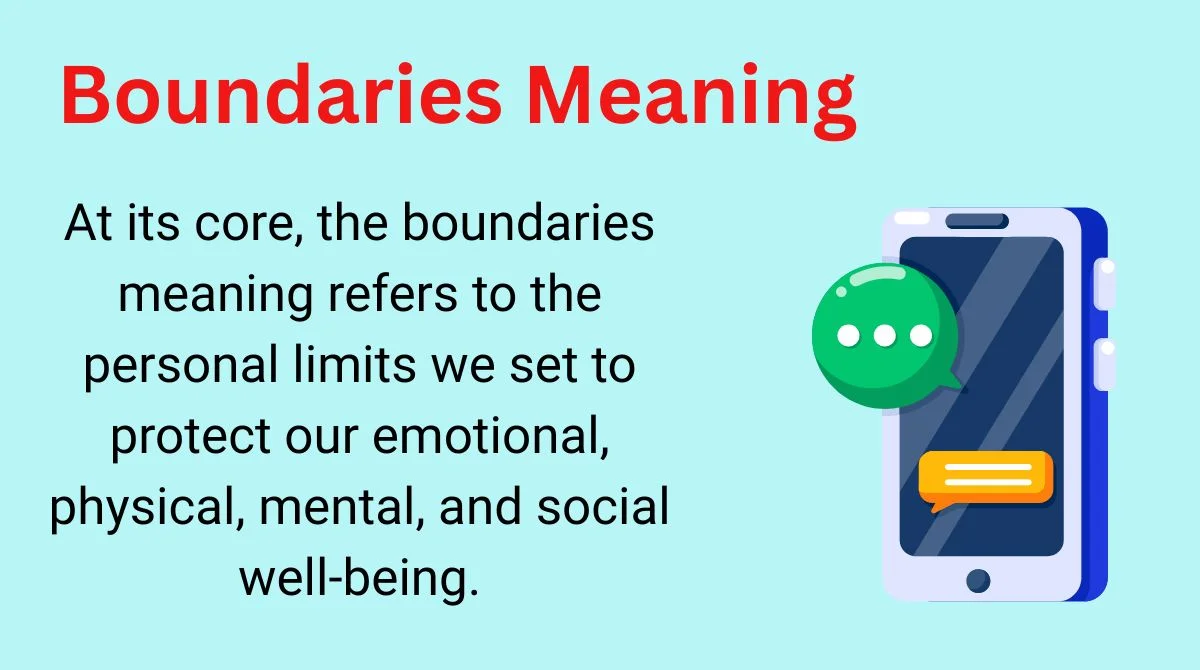
At its core, the boundaries meaning refers to the personal limits we set to protect our emotional, physical, mental, and social well-being.
These limits define what’s okay and what’s not okay for us — in relationships, conversations, work, and life in general.
Instead of thinking about boundaries as rules for others, think of them as guidelines for yourself. They help you decide when to say yes, when to say no, and when to pause.
Let’s look at a few real-life examples:
- If you don’t answer work emails after 7 p.m., that’s a time boundary.
- If you tell a friend you’re not comfortable discussing certain personal topics, that’s an emotional boundary.
- If you step back when someone stands too close to you, that’s a physical boundary.
In simple terms, boundaries are how we teach people how to treat us — kindly, respectfully, and honestly.
Boundaries Meaning in Life
Boundaries in life are the personal limits people set to protect their emotions, time, values, and well-being.
Healthy boundaries help individuals maintain respect in relationships and create a balance between personal and professional life.
They allow people to say no when necessary and prevent others from taking advantage of them.
Boundaries can be physical, emotional, or mental, and they play an important role in reducing stress and improving self-confidence.
Setting clear boundaries helps people focus on their priorities and maintain healthy connections with others.
In simple terms, boundaries are guidelines that define what is acceptable and what is not, helping individuals live a happier and more peaceful life.
Origin and Background of the Term
The word “boundary” originally comes from the Old French word bonde, meaning a limit or marker.
Historically, boundaries were physical — fences around land, walls around cities, borders between countries. They existed to define space, ownership, and safety.
But over time, the idea of boundaries expanded beyond geography and into human behavior and psychology.
In the mid-20th century, psychologists and therapists began using the concept to describe emotional and relational limits.
As people started talking more openly about mental health, personal growth, and communication, boundaries became a key part of those conversations.
One therapist famously described boundaries as the “skin” of the soul — not something rigid, but something flexible enough to protect us while still allowing connection.
Today, the boundaries meaning blends both old and new ideas: defining space, protecting well-being, and building healthier relationships — without cutting ourselves off from others.
How Boundaries Are Used in Daily Life
You might be surprised how often boundaries show up in your everyday life, even when you don’t label them as such. Here are some practical examples that most people can relate to:
- At work:
You tell your manager you can’t stay late every evening. That’s a boundary around your time and energy. - With friends:
You let someone know you’re not comfortable joking about a sensitive topic. That’s an emotional boundary. - In relationships:
You ask your partner to respect your need for alone time. That’s a personal boundary. - Online:
You mute or unfollow accounts that make you feel anxious or insecure. That’s a mental health boundary. - With family:
You decline conversations that turn into arguments. That’s a communication boundary. - With yourself:
You decide not to overwork or overcommit. That’s a self-care boundary.
In all these situations, boundaries aren’t about being rude or distant. They’re about honoring your limits while still showing respect to others.
Boundaries Meaning in French
The word “boundaries” can be translated into French as “limites” or “frontières,” depending on the context.
When talking about personal relationships, “limites” is usually the more natural choice.
For example, “personal boundaries” can be translated as “limites personnelles.”
The word describes limits that a person sets to protect their comfort, privacy, time, or personal space. In a friendship or relationship, setting boundaries can be expressed as “établir des limites,” meaning “to set boundaries.”
The exact French translation may change depending on the situation. “Frontière” is more commonly used for a physical or geographical border, while “limite” can refer to a personal, emotional, or social limit.
Understanding this difference can help you use “boundaries” correctly when speaking or writing in French.
Emotional and Practical Meaning of Boundaries
Emotionally, boundaries create safety. They allow you to be yourself without fear of being judged, manipulated, or overwhelmed.
When boundaries are healthy, relationships feel balanced — not draining, not controlling, not one-sided.
Practically, boundaries help you:
- Protect your time
- Preserve your energy
- Maintain self-respect
- Avoid burnout
- Communicate clearly
In modern life, where people are constantly reachable and expectations are high, boundaries have become essential for mental health. Without them, it’s easy to feel stretched thin, resentful, or invisible.
Culturally, the conversation around boundaries has grown stronger as people recognize the importance of consent, emotional intelligence, and self-awareness. We’re learning that saying no doesn’t make you selfish — it makes you honest.
The deeper boundaries meaning isn’t just about limits. It’s about self-worth. When you set boundaries, you’re quietly telling the world, “I matter too.”
Similar or Related Terms
Here are some words and phrases closely related to boundaries, along with how they differ:
- Limits – General restrictions, but not always personal or emotional
- Personal space – Physical and emotional comfort zones
- Consent – Permission or agreement, especially in physical or emotional contexts
- Self-respect – Valuing yourself enough to protect your needs
- Assertiveness – Expressing needs clearly without aggression
- Emotional intelligence – Understanding and managing emotions, including boundaries
While these concepts overlap, boundaries specifically focus on where you end and others begin — emotionally, mentally, and physically.
Common Misunderstandings About Boundaries
Despite how helpful boundaries are, they’re often misunderstood. Let’s clear up some of the most common myths:
- “Boundaries mean pushing people away.”
Not true. Healthy boundaries actually strengthen relationships by preventing resentment and misunderstanding. - “Only selfish people set boundaries.”
In reality, boundaries come from self-respect, not selfishness. You can care deeply and still say no. - “Boundaries are rigid and unchangeable.”
Boundaries are flexible. They can shift with time, trust, and circumstances. - “If someone loves me, they shouldn’t need boundaries.”
Even the healthiest relationships need clear limits. Love doesn’t erase personal needs. - “Setting boundaries causes conflict.”
Sometimes, yes — but long-term silence causes far more damage than honest communication. - “Boundaries are only for difficult people.”
Everyone needs boundaries — not just in toxic relationships, but in healthy ones too.
Understanding these misconceptions helps us embrace the true meaning of boundaries without guilt or fear.
Examples of Boundaries in Sentences
Here are some natural, everyday examples of how boundaries might show up in real conversations:
- “I need some quiet time tonight, so I won’t be answering calls.”
- “I’m not comfortable discussing that topic, but thank you for understanding.”
- “I can help you tomorrow, but I can’t stay late tonight.”
- “Please don’t speak to me that way — I want us to communicate respectfully.”
- “I need weekends to recharge, so I won’t be checking work emails.”
- “I care about you, but I need space right now.”
- “I’m happy to listen, but I can’t fix this for you.”
- “That joke crosses my boundaries — can we change the subject?”
Each sentence reflects calm, respectful communication — not aggression, not guilt, just honesty.
Why Understanding Boundaries Meaning Matters Today
In today’s world, people are more connected than ever — yet often feel more overwhelmed, burned out, and emotionally drained.
Notifications never stop. Work follows us home. Relationships blur into obligations.
Without boundaries, life can start to feel like a constant performance instead of something we actually get to live.
Understanding the boundaries meaning gives people the tools to:
- Say no without guilt
- Ask for space without shame
- Protect their mental health
- Build healthier relationships
- Avoid emotional exhaustion
Boundaries are especially important in modern conversations about workplace wellness, emotional labor, digital detoxing, consent, and self-care. They’re not trends — they’re life skills.
One powerful example:
A teacher I once spoke with shared that she used to answer student emails at midnight, grade papers every weekend, and say yes to every request. She loved her job — but felt constantly drained.
When she finally set clear work boundaries, her energy improved, her students respected her more, and her passion returned.
Nothing about her dedication changed — just her limits.
Understanding boundaries doesn’t make you colder. It makes you clearer. And clarity creates connection, not distance.
Boundaries Meaning Examples
Understanding boundaries becomes easier through examples. For instance, refusing extra work when your schedule is full is a professional boundary. Asking others to respect your privacy is a personal boundary.
In friendships, telling someone that hurtful jokes are unacceptable is an emotional boundary.
Parents may set boundaries by limiting screen time for children, while students can create study boundaries by avoiding distractions during learning hours.
Saying no to requests that make you uncomfortable is another example of healthy boundaries.
These examples show how boundaries help people protect their time, emotions, and energy while building respectful and balanced relationships with family, friends, and colleagues.
Frequently Asked Questions
What does boundaries meaning mean in simple words?
In simple terms, boundaries mean knowing your limits and communicating them clearly. They help protect your time, emotions, and well-being while allowing healthy relationships to grow.
Is boundaries positive or negative?
Boundaries are positive. They support mental health, reduce stress, and create stronger relationships. They’re not about control — they’re about balance and respect.
Where are boundaries commonly used?
Boundaries show up in relationships, families, workplaces, friendships, online spaces, and even within yourself. Anywhere people interact, boundaries matter.
Is boundaries formal or informal?
The word “boundaries” can be used in both formal and informal settings. You’ll hear it in therapy, education, business, and everyday conversations.
Why do people search for boundaries meaning?
People search for it because they feel overwhelmed, disrespected, burned out, or confused in relationships — and want to understand how to protect themselves without hurting others. Over time, the meaning of boundaries has evolved from physical limits to emotional and psychological well-being.
Conclusion
Understanding the boundaries meaning isn’t about building walls — it’s about building self-respect, clarity, and healthier connections.
Boundaries don’t make you distant. They make you honest. They don’t weaken relationships. They strengthen them by creating space for trust, respect, and emotional safety.
Whether you’re learning to say no without guilt, asking for space without fear, or simply honoring your own needs for the first time, boundaries remind you that your feelings matter too.
And here’s the truth:
You don’t have to burn yourself to keep others warm.
You’re allowed to protect your peace — and still love deeply.

Thomas Reed helps learners master English words through simple explanations and real-life usage.