Last updated on October 10th, 2026 at 04:02 am
Have you ever met someone who constantly asks tough questions, challenges ideas, or pushes others out of their comfort zones — not to annoy, but to improve things?
Maybe it’s that coworker who won’t let weak plans slide. Or that friend who always asks, “But why?” when everyone else just agrees.
That person might be a gadfly — and no, it’s not just an insect.
The gadfly meaning goes far beyond biology. In everyday language, it describes someone who provokes thought, challenges authority, and keeps people accountable.
Sometimes they’re loved. Sometimes they’re misunderstood. But often, they’re essential.
In this article, you’ll discover what gadfly truly means, where it comes from, how it’s used in daily life, and why understanding it matters more today than ever.
We’ll explore real-life examples, emotional significance, and even common misconceptions — all in simple, human language.
By the end, you won’t just know the word. You’ll feel what it stands for. And who knows — you might realize you’ve been a gadfly yourself without even noticing.
Let’s dive in 🐝
Fetus Meaning Explained Simply
Gadfly Meaning Socrates
The term gadfly is closely connected with the ancient Greek philosopher Socrates.
He compared himself to a gadfly, an insect that annoys or repeatedly bothers a larger animal.
Socrates used this comparison to describe his role in society.
He believed that his questions and challenges encouraged people to examine their beliefs, actions, and assumptions.
Rather than simply accepting popular opinions, he pushed others to think more deeply.
Today, calling someone a “gadfly” often means that the person constantly challenges established ideas or authority.
The word can have a slightly negative sense because a gadfly may be seen as irritating, but it can also suggest someone who encourages positive change by asking difficult questions.
What Does Gadfly Mean?
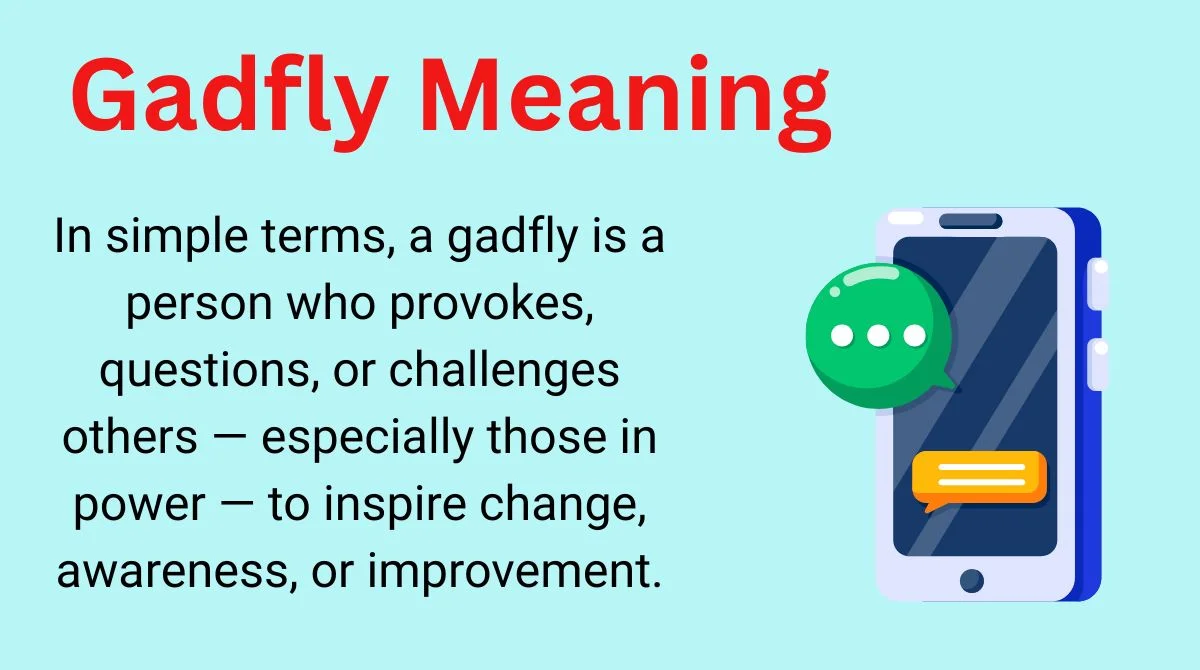
In simple terms, a gadfly is a person who provokes, questions, or challenges others — especially those in power — to inspire change, awareness, or improvement.
It’s not about being rude or annoying for fun. A true gadfly pushes people to think deeper, act better, and avoid complacency.
Real-Life Examples:
- A journalist who keeps asking uncomfortable questions at press conferences.
- A student who challenges outdated school policies respectfully.
- A team member who won’t accept lazy thinking and demands better solutions.
Think of a gadfly as someone who stirs the pot — but for the right reasons. They don’t let society, systems, or individuals drift into laziness or silence.
Sometimes they’re called troublemakers. But often, they’re the reason progress happens.
Gadfly Meaning Socrates
In philosophy, the term “gadfly” is strongly connected with Socrates. He used this word to describe his role in Athenian society.
A gadfly is a small insect that disturbs animals by constantly bothering them.
Socrates compared himself to a gadfly because he continuously questioned people, challenged their beliefs, and encouraged critical thinking.
According to him, Athens was like a large lazy horse, and he acted as the gadfly that kept the city awake and active.
His method of asking deep questions pushed citizens to examine truth, morality, and wisdom.
Although many people found his behavior irritating, Socrates believed it was necessary for improving society.
Today, the phrase “Socratic gadfly” is often used for someone who challenges accepted ideas and inspires intellectual discussion through persistent questioning.
Origin and Background of the Term
The word gadfly originally referred to a real insect — a biting fly that irritates livestock, causing them to move instead of standing still.
But its modern meaning comes from ancient Greece, specifically from Socrates, the famous philosopher.
Socrates once described himself as a gadfly to the Athenian state. He said Athens was like a large, lazy horse, and he was the gadfly sent to keep it awake — by questioning beliefs, challenging assumptions, and encouraging critical thinking.
He wasn’t trying to irritate people. He was trying to wake them up.
Over time, the term evolved into a metaphor for anyone who persistently questions authority, challenges norms, or refuses to let bad ideas go unchallenged.
So when someone calls you a gadfly today, they might actually be saying:
“You make people uncomfortable — but in a way that helps.”
And honestly? That’s kind of powerful.
How Gadfly Is Used in Daily Life
You’ll hear the word gadfly most often in politics, journalism, education, and activism — but it shows up everywhere once you start noticing.
Here are some everyday ways it’s used:
- “She’s a gadfly in the office — always challenging weak ideas.”
- “The reporter became known as a political gadfly for exposing corruption.”
- “He played the gadfly role in meetings, pushing everyone to think deeper.”
- “Some saw her as annoying, but others respected her as a gadfly.”
- “Every team needs a gadfly to stop groupthink.”
- “The teacher encouraged students to be gadflies and question assumptions.”
In most cases, the tone is respectful, even if slightly critical. A gadfly isn’t silent. They’re not passive. They don’t just nod and move on.
They poke — but with purpose.
Emotional or Practical Meaning of Gadfly
Emotionally, the word gadfly carries both tension and respect.
On one hand, gadflies can feel uncomfortable to be around. They challenge comfort zones. They ask the questions others avoid. They disrupt smooth conversations.
But on the other hand, they’re often deeply needed.
A gadfly:
- Protects truth
- Encourages accountability
- Sparks progress
- Prevents stagnation
In a world where people often avoid conflict and chase approval, gadflies are the ones who say, “Wait — something’s not right here.”
Socially and culturally, gadflies have driven major change:
- Civil rights activists
- Investigative journalists
- Reformers
- Whistleblowers
They weren’t always liked. But history often proves them right.
So emotionally, the word carries a quiet message:
Growth is uncomfortable — but necessary.
And gadflies are the ones brave enough to embrace that discomfort.
Similar or Related Terms
Here are some words related to gadfly, along with how they differ:
- Critic – Someone who evaluates or judges; not always constructive.
- Provocateur – Someone who deliberately provokes reactions, sometimes for attention.
- Whistleblower – Someone who exposes wrongdoing, often within organizations.
- Rebel – Someone who resists authority or tradition, not always thoughtfully.
- Reformer – Someone who works to improve systems through change.
- Truth-teller – Someone who speaks honestly, even when it’s uncomfortable.
Gadfly stands out because it blends persistent questioning, moral purpose, and intellectual challenge — without necessarily being aggressive or destructive.
It’s not rebellion for rebellion’s sake.
It’s disruption with intention.
Common Misunderstandings About Gadfly
Let’s clear up some misconceptions — because this word is often misunderstood.
1. Gadflies are just annoying people
Not true. A real gadfly isn’t irritating for fun. They challenge because they care.
2. Gadfly always has a negative meaning
Wrong. While it can feel uncomfortable, the term is often admiring, especially in intellectual or professional contexts.
3. Gadflies are aggressive or rude
Not necessarily. Many gadflies are calm, thoughtful, and respectful — just persistent.
4. Gadflies enjoy conflict
Most don’t. They just value truth more than comfort.
5. Gadflies oppose everything
Nope. They challenge weak ideas, not all ideas.
6. Only activists or politicians can be gadflies
Anyone can be one — students, parents, employees, friends, leaders.
In short: a gadfly isn’t a troublemaker.
They’re a truth-maker.
Gadfly Synonym
A gadfly is someone who persistently challenges, questions, or irritates others, especially people in positions of authority.
Depending on the context, several words can work as synonyms.
Provocateur describes someone who deliberately encourages reactions or debate. Agitator can refer to a person who pushes strongly for change.
Critic is a simpler choice for someone who points out problems or weaknesses. Challenger works when the focus is on questioning established ideas.
Irritant emphasizes the annoying side of the word, while troublemaker is more negative.
In a positive context, reformer may fit when someone challenges old ideas to encourage improvement.
The best synonym depends on whether “gadfly” is being used positively, negatively, or simply to describe someone who keeps questioning others.
Examples of Gadfly in Sentences
Here are natural, everyday examples so you can see how the word works in real life:
- “She became the company’s gadfly by questioning unfair policies.”
- “The journalist was known as a political gadfly who refused to stay silent.”
- “He played the gadfly role in meetings, pushing everyone to think harder.”
- “Some found her annoying, but others admired her as a gadfly.”
- “Every healthy organization needs at least one gadfly.”
- “The professor encouraged students to be gadflies, not passive learners.”
- “His gadfly nature helped expose problems others ignored.”
- “She wasn’t rebellious — just a thoughtful gadfly who wanted improvement.”
Once you understand the meaning, you’ll notice how powerful the word feels in context.
Why Understanding Gadfly Meaning Matters Today
In today’s world, silence is easy — but thinking critically isn’t.
We live in a time of:
- Misinformation
- Echo chambers
- Cancel culture
- Blind loyalty to opinions
That’s exactly why the gadfly mindset matters more than ever.
Gadflies:
- Ask hard questions when others stay quiet
- Challenge false narratives
- Defend ethical standards
- Encourage progress instead of comfort
In workplaces, gadflies prevent bad decisions.
In education, they promote critical thinking.
In society, they protect truth.
In personal life, they inspire growth.
Understanding the gadfly meaning doesn’t just improve vocabulary — it helps you recognize the value of voices that challenge instead of flatter.
And sometimes, the person you find most irritating…
might be the one helping you grow the most.
That’s a powerful realization.
Gadfly Meaning Political
In politics, the word “gadfly” refers to a person who constantly criticizes leaders, policies, or powerful institutions.
A political gadfly often asks difficult questions and refuses to stay silent about social or government issues.
These individuals may be journalists, activists, politicians, or public speakers who challenge authority and encourage accountability.
While some people see them as annoying or disruptive, others believe they play an important role in protecting democracy and free speech.
Political gadflies usually focus on exposing corruption, unfair decisions, or hidden problems within society.
Their actions can create debate and push governments to respond to public concerns.
In modern political discussions, the term is commonly used for outspoken individuals who influence public opinion by challenging the status quo and demanding transparency from those in power.
Frequently Asked Questions
What does gadfly mean in simple words?
A gadfly is someone who asks tough questions, challenges ideas, or pushes others to think better — even when it feels uncomfortable.
Is gadfly positive or negative?
It can sound negative, but it’s often positive, especially when used to describe someone who promotes truth, accountability, and improvement.
Where is gadfly commonly used?
You’ll hear it in politics, journalism, education, workplaces, activism, and discussions about leadership or reform.
Is gadfly formal or informal?
It’s mostly formal or semi-formal, often used in professional, academic, or journalistic contexts.
Why do people search for gadfly meaning?
Because it’s not a common everyday word, and its meaning goes beyond the literal insect — people want to understand its deeper social and emotional use. Change With Passage of time.
Conclusion
So now you know — the gadfly meaning isn’t about annoyance. It’s about awakening.
A gadfly is someone brave enough to question what others accept, challenge what others ignore, and speak when silence feels easier.
They don’t seek attention — they seek truth, growth, and progress.
In a world that often rewards comfort over courage, gadflies remind us that real change starts with uncomfortable questions.
Whether it’s in classrooms, workplaces, governments, or friendships — we need people who dare to say, “Wait… let’s think about this.”
And maybe, just maybe, the next time someone calls you a gadfly…
you’ll take it as a compliment — because growth always begins with bold voices and brave minds. 💛

Thomas Reed helps learners master English words through simple explanations and real-life usage.