Last updated on October 10th, 2026 at 04:02 am
Have you ever met someone who chooses kindness even when it’s hard? Someone who lifts others while carrying their own struggles?
That kind of person reminds me of the bodhisattva meaning — a concept that goes far beyond religion and into the heart of what it means to be human.
At its core, a bodhisattva is someone who seeks wisdom and awakening, but instead of rushing toward personal peace, they choose to stay behind and help others reach it too.
It’s a powerful idea rooted in compassion, not perfection. You don’t need to wear robes, meditate for hours, or live in a monastery to understand it. You just need a heart that cares.
In today’s fast-moving world, where stress and self-focus dominate, this ancient concept feels more relevant than ever.
Understanding bodhisattva meaning helps us rethink success, kindness, and what it truly means to live a meaningful life.
Let’s explore where this term comes from, what it really means, and how it quietly shows up in everyday life — maybe even in yours.
Fetus Meaning Explained Simply
Bodhisattva Meaning in Buddhism
In Buddhism, a bodhisattva is a person who is dedicated to attaining enlightenment while also helping other beings move toward freedom from suffering.
The idea is especially important in Mahayana Buddhism, where compassion and wisdom are central values.
Rather than seeking enlightenment only for themselves, bodhisattvas are traditionally described as making a commitment to benefit others.
The word comes from Sanskrit, combining ideas related to awakening and being. Famous bodhisattvas include Avalokiteshvara, associated with compassion, and Manjushri, associated with wisdom.
In everyday Buddhist teachings, the bodhisattva ideal encourages people to develop kindness, patience, compassion, and wisdom.
It represents the idea that spiritual growth is closely connected with helping others.
What Does Bodhisattva Mean?
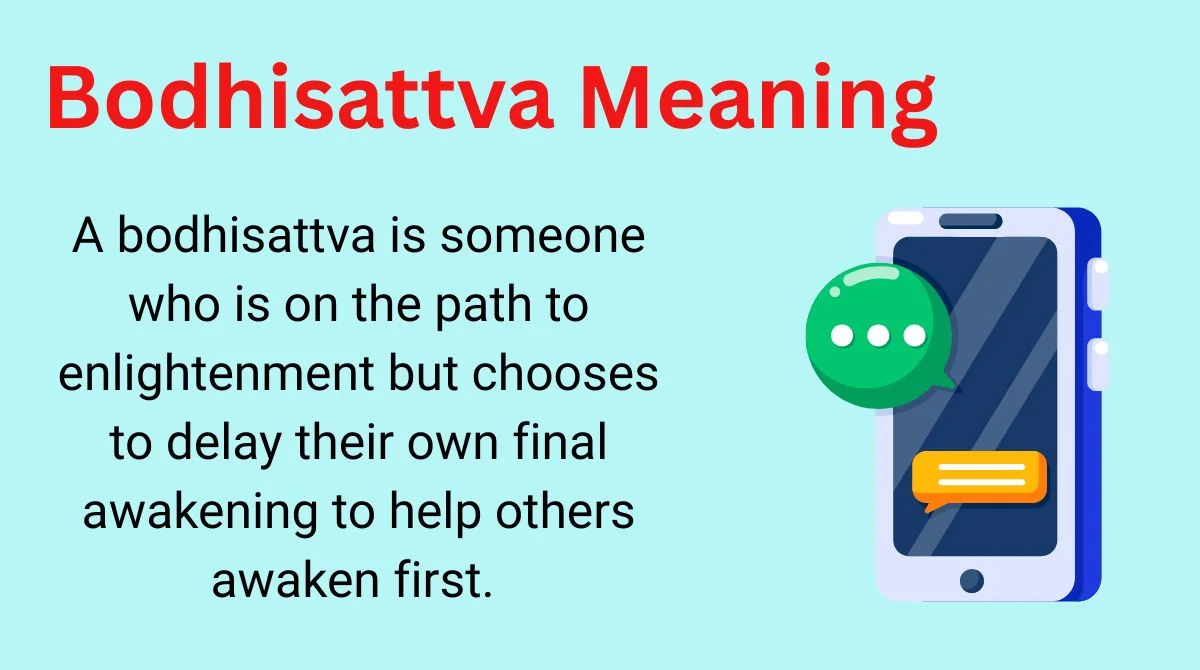
A bodhisattva is someone who is on the path to enlightenment but chooses to delay their own final awakening to help others awaken first.
Instead of seeking peace only for themselves, they dedicate their life to compassion, service, and wisdom.
In simpler words?
A bodhisattva is a helper of humanity.
Think of a teacher who stays after class to help struggling students. Or a nurse who works long hours not just for a paycheck, but because easing pain matters to them.
These people may not call themselves bodhisattvas, but their actions reflect the spirit.
Here are a few real-life-style examples:
- A parent who sacrifices personal dreams to raise children with love.
- A volunteer who feeds the homeless week after week without recognition.
- A friend who listens deeply when you’re hurting instead of offering quick fixes.
The bodhisattva meaning isn’t about being perfect. It’s about choosing compassion again and again, even when it’s inconvenient or exhausting.
Bodhisattva vs Buddha
A Bodhisattva and a Buddha are important figures in Buddhism, but they are not the same. A Buddha is a person who has reached complete enlightenment and is free from suffering and the cycle of rebirth.
The most famous example is Gautama Buddha.
A Bodhisattva, on the other hand, is someone who seeks enlightenment but chooses to help others achieve spiritual growth before entering final nirvana.
Bodhisattvas are known for their compassion, wisdom, and dedication to humanity.
In Mahayana Buddhism, Bodhisattvas are highly respected because they delay their own liberation to guide others. While every Buddha was once a Bodhisattva, not every Bodhisattva becomes a Buddha immediately.
The main difference lies in their spiritual stage and purpose of helping others.
Origin and Background of the Term
The word bodhisattva comes from ancient Sanskrit:
- “Bodhi” means awakening or enlightenment
- “Sattva” means being or essence
So, bodhisattva literally means “an awakened being” — or more accurately, someone moving toward awakening while helping others along the way.
This concept became central in Mahayana Buddhism around the first century BCE. But its roots stretch even deeper into early Buddhist thought.
The Buddha himself, before attaining enlightenment, was considered a bodhisattva — someone striving toward wisdom while cultivating compassion.
One of the most beautiful stories comes from Buddhist legends about Avalokiteshvara, the bodhisattva of compassion.
It’s said that after nearly reaching enlightenment, Avalokiteshvara heard the cries of suffering beings and turned back, choosing to stay in the world until all were free from suffering.
In some versions, their heart breaks into pieces — and from those pieces arise new arms and eyes, symbolizing endless compassion and awareness.
Whether taken literally or symbolically, the story sends a powerful message:
True wisdom isn’t about escape — it’s about engagement.
Over centuries, this idea spread across Asia — shaping spiritual traditions in India, China, Tibet, Japan, Korea, and beyond. Yet its meaning remains timeless: awakening is incomplete if others are left behind.
How Bodhisattva Is Used in Daily Life
Even if you’ve never studied Buddhism, the bodhisattva spirit shows up everywhere. Let’s look at some everyday ways the concept quietly lives among us:
- Teachers and mentors
A teacher who believes in a struggling student when no one else does is practicing bodhisattva-like compassion. - Healthcare workers
Doctors and nurses who treat patients with dignity and patience — even under pressure — embody this spirit daily. - Parents and caregivers
Staying up all night with a sick child without complaint? That’s bodhisattva energy in action. - Community volunteers
People who serve meals, clean neighborhoods, or support disaster victims without seeking praise reflect selfless service. - Friends who listen deeply
Sometimes the most powerful act isn’t fixing — it’s simply being present. That’s bodhisattva compassion too. - Activists and changemakers
Those working for justice, equality, and peace often carry a bodhisattva mindset — helping others awaken to truth and dignity.
In modern language, we might call these people helpers, healers, or servant leaders. But spiritually speaking, their actions align closely with the bodhisattva meaning.
Emotional or Practical Meaning of Bodhisattva
Here’s where the concept really becomes powerful.
The bodhisattva meaning isn’t just philosophical — it’s emotional, relational, and deeply human. It asks a bold question:
What if your happiness mattered — but so did everyone else’s?
In many cultures today, success is measured by money, titles, and personal comfort. But the bodhisattva path flips that idea. It says fulfillment comes from connection, not competition. From lifting others, not outpacing them.
Emotionally, the bodhisattva ideal reminds us:
- You don’t have to be perfect to be helpful.
- You can heal while still healing yourself.
- Compassion isn’t weakness — it’s courage.
Practically, this mindset improves relationships, workplaces, and communities. People who operate with empathy communicate better, resolve conflicts faster, and build trust more easily.
In therapy circles, similar ideas appear as emotional intelligence, compassion-based living, and service-oriented purpose. In leadership, it’s known as servant leadership — leading by supporting rather than controlling.
So even outside religion, the bodhisattva meaning remains incredibly relevant. It’s about choosing humanity over ego, connection over isolation, and kindness over indifference.
And honestly? The world could use more of that.
Similar or Related Terms
Here are some terms closely related to bodhisattva, along with simple explanations:
- Buddha — Someone who has fully awakened and completed the journey of enlightenment.
- Arhat — A person who seeks personal liberation rather than delaying awakening to help others.
- Compassionate leader — A modern term for someone who leads with empathy and service.
- Saint — In Christianity, a person devoted to spiritual goodness and helping others.
- Healer — Someone who supports emotional, physical, or spiritual well-being.
Each of these shares overlapping values, but the bodhisattva meaning uniquely emphasizes postponing personal liberation to uplift others — a rare and beautiful form of selflessness.
Common Misunderstandings About Bodhisattva
Let’s clear up some myths. These misunderstandings stop people from fully appreciating the depth of the term.
1. “You must be Buddhist to be a bodhisattva.”
Not true. While rooted in Buddhism, the values behind bodhisattva — compassion, service, patience — are universal.
2. “A bodhisattva is perfect or holy.”
Nope. Bodhisattvas are works in progress. They struggle, learn, fail, and grow — just like everyone else.
3. “It means sacrificing yourself completely.”
It’s not about burnout or self-neglect. Healthy compassion includes caring for yourself too.
4. “Only monks or spiritual teachers qualify.”
Absolutely not. Everyday people — parents, workers, students — can live bodhisattva values through kindness and intention.
5. “It’s just a religious label.”
While spiritual in origin, bodhisattva is more of a mindset and lifestyle than a religious title.
6. “You must renounce the world.”
In fact, bodhisattvas engage deeply with the world. They don’t escape life — they embrace it.
Understanding these truths helps us see the bodhisattva meaning not as unreachable, but as beautifully human.
Bodhisattva in Chinese
The Chinese word for bodhisattva is 菩萨 (púsà). It is the common Chinese Buddhist term used for a bodhisattva, a being associated with the pursuit of enlightenment and compassion toward others.
The term appears frequently in Chinese Buddhist texts, temples, artwork, and everyday religious expressions.
Well-known bodhisattvas in Chinese Buddhism include 观音 (Guānyīn), the Chinese form of Avalokiteshvara, and 文殊 (Wénshū), associated with wisdom.
You may also see 菩萨 used in Chinese Buddhist culture to refer respectfully to compassionate spiritual figures.
Pronunciation-wise, púsà is roughly pronounced “poo-sah,” with the tones being important in standard Mandarin.
Examples of Bodhisattva in Sentences
Here are natural, everyday sentences using the word bodhisattva:
- “Her patience with struggling students made her feel like a modern-day bodhisattva.”
- “He wasn’t perfect, but his compassion for others reflected the heart of a bodhisattva.”
- “In Buddhism, a bodhisattva chooses to help others awaken before seeking final enlightenment.”
- “That nurse works with the calm strength of a bodhisattva — steady, kind, and tireless.”
- “The story of the bodhisattva reminds us that wisdom grows through service.”
- “She joked that her grandmother was a bodhisattva in disguise — always helping, never complaining.”
- “You don’t need robes to be a bodhisattva; you just need a caring heart.”
- “The bodhisattva path teaches us to walk together, not alone.”
Why Understanding Bodhisattva Meaning Matters Today
Let’s be honest — the modern world feels loud, rushed, and disconnected at times. Social media rewards attention, not empathy. Hustle culture praises achievement, not kindness. Many people feel isolated even while surrounded by others.
That’s where the bodhisattva meaning becomes deeply important.
It reminds us:
- Success isn’t just about what you achieve — it’s about who you uplift.
- Healing doesn’t happen in isolation — it happens in relationships.
- True strength lies in compassion, not dominance.
In education, this mindset encourages teachers to nurture emotional intelligence, not just grades.
In leadership, it fosters collaboration instead of competition. In families, it builds trust instead of fear.
Even mental health professionals use similar concepts today — teaching people to cultivate self-compassion, empathy, and mindful awareness. These ideas echo bodhisattva values, whether they use the term or not.
Perhaps most importantly, understanding this concept helps people feel less alone. It tells us that suffering isn’t something to escape — it’s something we can face together.
In a world craving meaning, connection, and kindness, the bodhisattva path feels less like ancient philosophy and more like modern wisdom.
Bodhisattva Examples
Many famous Bodhisattvas are honored in Buddhist traditions for their kindness and wisdom.
One well-known example is Avalokiteshvara, who represents compassion and mercy. Another important Bodhisattva is Manjushri, known for symbolizing wisdom and knowledge.
Ksitigarbha is respected for helping souls suffering in difficult conditions. In Tibetan Buddhism, Tara is admired as a protector and guide.
These Bodhisattvas inspire Buddhists to practice kindness, patience, and selflessness in daily life.
Their stories teach people to care for others and follow the path of spiritual development with compassion and understanding.
Frequently Asked Questions
What does bodhisattva mean in simple words?
A bodhisattva is someone who wants to grow wiser and happier but chooses to help others first instead of focusing only on themselves.
Is bodhisattva positive or negative?
Very positive. The term represents compassion, generosity, patience, and kindness — some of the highest human values.
Where is bodhisattva commonly used?
It’s most commonly used in Buddhist teachings, spiritual discussions, philosophy, mindfulness practices, and personal growth contexts.
Is bodhisattva formal or informal?
The word itself is formal and spiritual, but the idea behind it is used casually when describing compassionate or selfless people.
Why do people search for bodhisattva meaning?
People search for it out of curiosity, spiritual interest, personal growth, or cultural learning. Many feel drawn to its message of compassion and purpose.
Conclusion
At its heart, the bodhisattva meaning isn’t about becoming someone extraordinary — it’s about becoming more deeply human.
It’s about choosing kindness when bitterness feels easier. Choosing patience when frustration rises. Choosing connection when isolation feels safer.
You don’t need enlightenment to live this way. You don’t need special training. You just need intention — the quiet decision to leave people better than you found them.
Every small act of compassion matters. Every moment of understanding counts. Every kind word plants a seed.
And who knows? Maybe the world doesn’t need more perfect people — maybe it just needs more bodhisattvas in everyday clothes. 🌱

Thomas Reed helps learners master English words through simple explanations and real-life usage.