Last updated on October 6th, 2026 at 04:46 am
Have you ever watched someone help a stranger and felt that quiet warmth in your chest? That moment — small but powerful — captures the humanity meaning better than any dictionary ever could.
Humanity isn’t just about being biologically human. It’s about kindness, empathy, compassion, and how we treat one another when no one’s watching.
In a world full of fast opinions, loud headlines, and digital noise, understanding humanity feels more important than ever.
We use the word casually — “Have some humanity!” — but rarely stop to reflect on what it really means. Is it emotion? Morality? Connection? Or something deeper?
In this article, we’ll explore the true meaning of humanity, where the word came from, how it shows up in daily life, and why it still matters — maybe now more than ever.
You’ll see real examples, simple explanations, and relatable stories that make this timeless concept feel refreshingly real.
Let’s dive into what it really means to be human — beyond biology, beyond labels, beyond differences.
Sapient Meaning Explained
Headway Meaning
Siege Meaning Explained
Gait Meaning Explained
Witchcraft Meaning
What Does Humanity Mean?
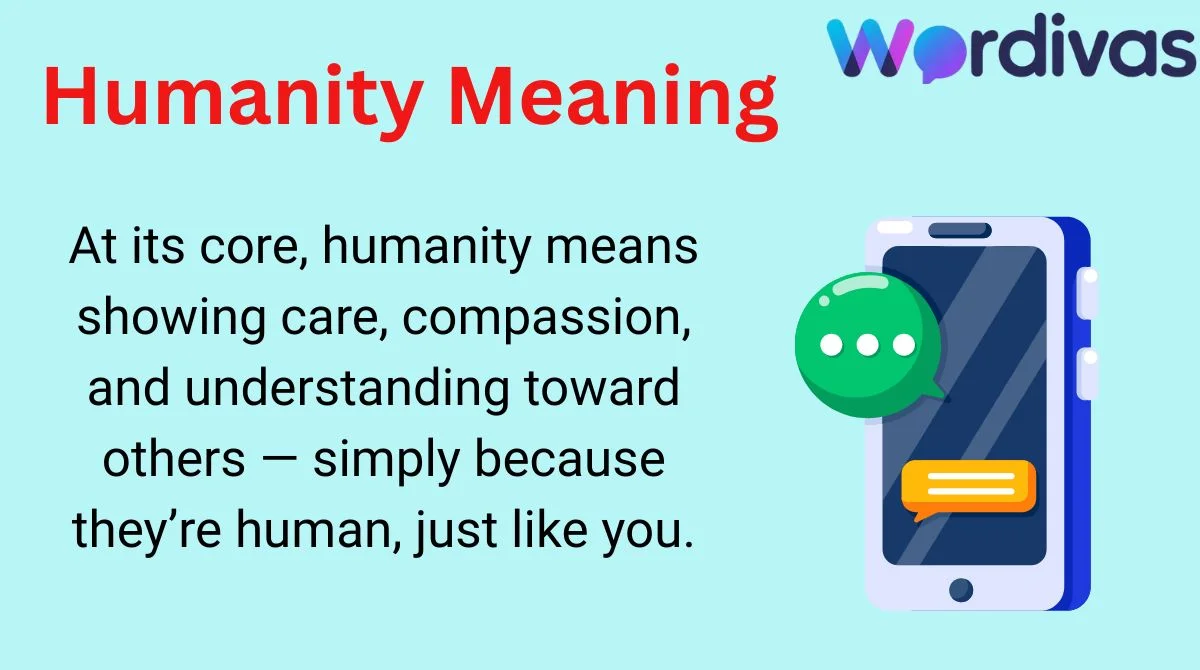
At its core, humanity means showing care, compassion, and understanding toward others — simply because they’re human, just like you.
It’s the part of us that chooses kindness over cruelty, empathy over judgment, and connection over indifference. Humanity isn’t perfection. It’s effort. It’s trying to do right even when it’s hard.
Here are a few real-life examples:
- A stranger holding the door for someone with full hands
- A nurse comforting a scared patient late at night
- A friend listening without interrupting when you’re hurting
None of these acts are grand. But together, they reflect what humanity looks like in action — everyday moments of decency that make life gentler and more meaningful.
Humanity isn’t about being flawless. It’s about being real, compassionate, and willing to care.
Showing Humanity Meaning
“Showing humanity” means demonstrating kindness, compassion, understanding, and care toward other people.
It describes treating others with respect and recognizing their feelings and difficulties. For example, helping someone who is struggling, forgiving a mistake, or listening patiently can all be ways of showing humanity.
The phrase is often used when someone chooses kindness instead of anger, judgment, or selfishness.
It can also describe small acts of goodness that make people feel supported and valued. In everyday English, “showing humanity” suggests that a person is behaving with empathy and a genuine concern for others.
For example: “She showed humanity by helping the injured stranger.” Here, it means she showed compassion and care.
Origin and Background of the Term
The word humanity comes from the Latin word humanitas, which meant kindness, refinement, and education — not just being human in body, but in character.
In ancient Rome, humanitas described people who were cultured, ethical, and compassionate. It wasn’t about power or status. It was about how you treated others.
During the Renaissance, scholars revived the concept, believing education should create better humans — not just smarter ones. Literature, philosophy, and art weren’t meant to impress. They were meant to build empathy.
Fast forward to today, and the meaning has evolved, but the heart remains the same. Whether spoken in a hospital hallway or a courtroom speech, humanity still represents our shared moral responsibility.
One historian once wrote that civilization advances not through inventions, but through how gently people learn to treat one another. That idea still holds.
How Humanity Is Used in Daily Life
We might not always notice it, but humanity shows up constantly — in conversations, choices, and reactions.
Here’s how it plays out in everyday life:
- Helping without being asked, like assisting someone who drops groceries
- Forgiving mistakes, especially when it’s easier to stay angry
- Listening fully, instead of waiting to respond
- Speaking kindly, even during disagreements
- Standing up for others, when something feels wrong
- Showing patience, when someone’s struggling
You don’t need to change the world to practice humanity. Sometimes, it’s as simple as choosing softness where hardness would be easier.
And honestly? Those small moments are what people remember.
Emotional or Practical Meaning of Humanity
Emotionally, humanity represents our capacity to care deeply — even when it hurts, even when it’s inconvenient. It’s the part of us that recognizes someone else’s pain and thinks, “That could be me.”
Practically, humanity shapes how societies function. Laws, hospitals, charities, schools — all exist because humans decided other humans matter.
In modern life, where screens separate us and opinions divide us, humanity becomes even more essential. It reminds us that behind every profile photo, headline, and argument is a real person with fears, hopes, and stories.
Humanity isn’t weakness. It’s emotional intelligence in action. It’s choosing connection over ego.
And sometimes, it’s simply staying kind in a world that rewards coldness.
Similar or Related Terms
Here are words often connected to humanity — and how they differ:
- Compassion – Feeling and responding to others’ suffering
- Empathy – Understanding how someone else feels emotionally
- Kindness – Small acts of care or generosity
- Altruism – Helping others without expecting anything back
- Benevolence – A long-term tendency toward goodwill
- Humaneness – Gentle, ethical treatment of people or animals
While these words overlap, humanity is the umbrella — the deeper quality that includes all of them.
Common Misunderstandings About Humanity
Let’s clear up a few misconceptions that often confuse people.
- Humanity means being nice all the time
Not true. Humanity includes honesty, boundaries, and sometimes tough love — not just politeness. - Humanity equals weakness
Actually, choosing compassion in difficult moments requires real strength. - Only emotional people show humanity
Logic-driven people can be deeply humane too. It’s about values, not personality. - Humanity means agreeing with everyone
Nope. You can disagree and still treat someone with dignity. - Humanity is outdated in modern society
If anything, it’s more relevant than ever in a fast, divided world. - Big gestures define humanity
In reality, it’s the small, consistent actions that matter most.
Examples of Humanity in Sentences
Here are natural, everyday examples:
- “The teacher showed real humanity when she stayed late to help struggling students.”
- “In the chaos, it was a stranger’s kindness that reminded him of humanity.”
- “We don’t need more opinions — we need more humanity.”
- “Her forgiveness showed the best side of humanity.”
- “Even in conflict, he spoke with humanity.”
- “The doctor’s compassion reflected true humanity.”
- “A little humanity goes a long way in difficult times.”
- “That moment restored my faith in humanity.”
Why Understanding Humanity Meaning Matters Today
Let’s be honest — the world feels tense sometimes.
News cycles are heavy. Conversations turn sharp. People retreat into bubbles. And in moments like that, understanding the true meaning of humanity becomes more than a philosophical idea — it becomes a survival skill.
When you understand humanity, you:
- Communicate better
- Judge less quickly
- Resolve conflict more peacefully
- Build stronger relationships
- Become emotionally resilient
In schools, teaching humanity reduces bullying.
In workplaces, it improves leadership.
In families, it strengthens trust.
And in society, it builds hope.
Understanding humanity doesn’t make life perfect. But it makes life more livable, more meaningful, and more connected — especially when things feel uncertain.
Sometimes, being human is the bravest thing you can be.
Good Humanity Meaning
“Good humanity” generally refers to positive human qualities such as kindness, compassion, honesty, empathy, and respect for others.
When someone is described as having good humanity, it means they care about people and try to treat others fairly and kindly.
Good humanity can be seen in simple actions, such as helping someone in need, respecting different opinions, or being there for a friend during a difficult time.
The phrase focuses on the good qualities that make people caring and considerate toward one another.
For example: “His good humanity was clear when he helped the elderly man.” In this sentence, “good humanity” highlights his kindness, compassion, and willingness to help someone else.
FACOG Meaning
Dissolve Meaning
Grok Meaning
Salty Meaning Explained
Groom Meaning
Frequently Asked Questions
What does humanity mean in simple words?
Humanity means being kind, caring, and understanding toward others. It’s about treating people with respect and compassion just because they’re human — like you.
Is humanity positive or negative?
Humanity is overwhelmingly positive. It represents the best parts of human behavior — empathy, kindness, and moral responsibility.
Where is humanity commonly used?
The word humanity is used in:
- Education
- Healthcare
- Literature
- Social work
- Everyday conversations
- Motivational or ethical discussions
It’s especially common when talking about kindness, morality, or shared human values.
Is humanity formal or informal?
Humanity works in both formal and informal settings. You’ll hear it in academic writing, speeches, and casual conversations alike.
Why do people search for humanity meaning?
People search for it because:
- They want clarity on emotional or moral concepts
- They see the word in books or conversations
- They’re exploring empathy, kindness, or ethics
- They’re seeking deeper personal understanding
Over time, as society evolves, so does how people relate to the idea of humanity — but its core meaning remains timeless.
Conclusion
Humanity isn’t something you’re born with and forget about. It’s something you practice — in conversations, choices, reactions, and silence.
It’s in how you speak when you’re tired.
It’s in how you listen when someone’s hurting.
It’s in how you treat people who can’t give you anything back.
Understanding the humanity meaning isn’t about memorizing definitions. It’s about recognizing the shared thread that connects us all — fear, hope, love, struggle, growth.
In a world that often feels divided, choosing humanity is a quiet act of courage. And sometimes, that courage — small, unseen, uncelebrated — changes more than we’ll ever know.
✨ Never underestimate the power of being human in a world that desperately needs it.

Thomas Reed helps learners master English words through simple explanations and real-life usage.