Last updated on September 18th, 2026 at 03:40 am
Have you ever walked past a garden and noticed a beautiful wooden frame covered in roses or ivy climbing upward like nature’s artwork?
That structure is called a trellis, and it’s doing more than just looking pretty. It’s quietly supporting growth, shaping space, and adding charm to everyday life.
The trellis meaning goes beyond a simple garden feature — it’s also a metaphor for support, guidance, and structure in many areas of life.
Whether you’re a gardener, writer, designer, or just someone curious about words, understanding this term can give you a fresh perspective.
In this article, we’ll explore what “trellis” really means, where it comes from, and how it’s used both literally and symbolically today.
Along the way, you’ll find real-life examples, relatable stories, and practical insights — all in simple, human-friendly language. Let’s climb into it 🌱.
What Does Trellis Mean?
A trellis is a structure made of wood, metal, or plastic that supports climbing plants like roses, grapes, or ivy. It helps plants grow upward instead of spreading across the ground.
But the meaning doesn’t stop there.
In everyday language, a trellis can also mean support, framework, or guidance — something that helps ideas, people, or systems grow stronger and more organized.
Real-life examples:
- In gardening: A rose bush climbs beautifully along a wooden trellis.
- In education: A teacher provides a “trellis” of support to help students understand complex topics.
- In writing: An outline acts as a trellis for your thoughts.
So in simple terms, a trellis is something that holds, supports, and shapes growth — whether physical or abstract.
Wood Trellis Meaning
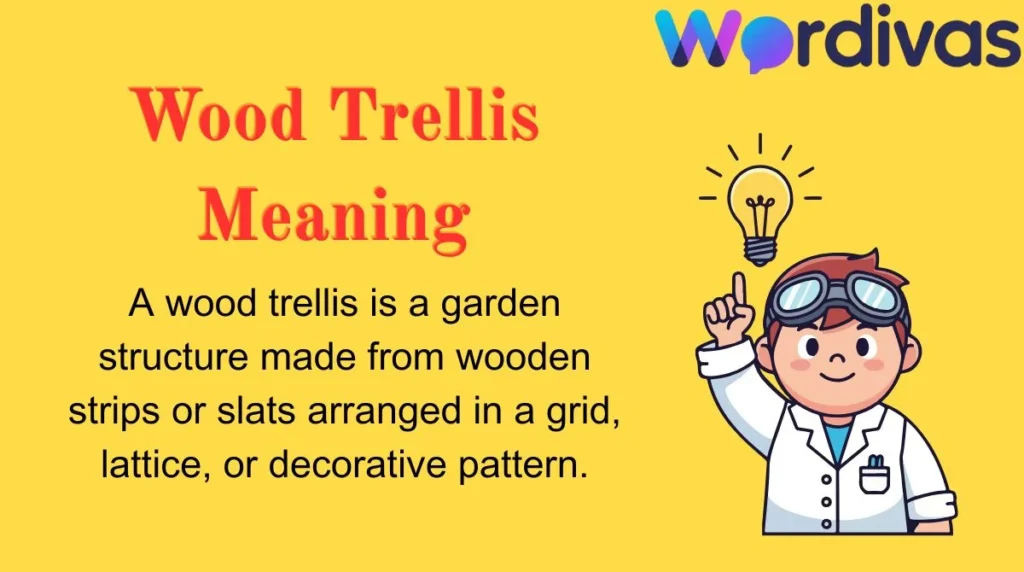
A wood trellis is a garden structure made from wooden strips or slats arranged in a grid, lattice, or decorative pattern.
It is commonly used to support climbing plants such as roses, vines, jasmine, and other flowering plants.
A wood trellis can be attached to a wall, fence, or placed directly in the garden. Besides helping plants grow upward, it can also add beauty and privacy to outdoor spaces.
Wooden trellises are popular because they have a natural appearance that blends well with gardens and landscapes.
Depending on the design, they can be simple and practical or highly decorative. In everyday English, “wood trellis” simply refers to a trellis made primarily from wood.
Origin and Background of the Term
The word trellis comes from the Old French word trelis, meaning “lattice” or “framework.” It originally referred to woven or crisscrossed structures used in gardens and architecture.
Centuries ago, European gardeners began using trellises to grow grapevines against stone walls.
This helped conserve space, improve air circulation, and make harvesting easier. Over time, trellises became popular decorative features in courtyards, castles, and public gardens.
But language evolves — and so did the word.
Writers and thinkers eventually borrowed the term to describe mental and emotional support systems.
For example, psychologists talk about “learning scaffolds” or “trellises” that help people grow intellectually. The structure remained the same — only the context changed.
It’s beautiful how a simple garden tool became a metaphor for human growth, isn’t it?
How Trellis Is Used in Daily Life
You may not realize it, but the concept of a trellis shows up in everyday moments more than you think.
Here are some practical examples:
- Gardening: Tomato plants climb a trellis to stay healthy and upright.
- Home decor: A decorative trellis adds charm to patios and balconies.
- Education: Teachers provide structured lessons as a “trellis” for learning.
- Writing: Outlines and frameworks act as trellises for ideas.
- Career growth: Mentors serve as trellises for professional development.
- Emotional support: Friends and family act as trellises during hard times.
In each case, the meaning stays consistent — support that enables growth.
Emotional or Practical Meaning of Trellis
Beyond its physical use, the word “trellis” carries a deeply emotional message.
Think about it — vines don’t grow tall on their own. They need something steady to climb. People are the same way. We thrive when we have guidance, encouragement, and structure.
A trellis represents:
- Support during growth
- Stability in uncertain times
- A foundation for creativity
In modern life, where people often feel overwhelmed, the idea of having a trellis — a coach, plan, mentor, or routine — can be incredibly empowering. It reminds us that needing support doesn’t mean weakness; it means wisdom.
And that’s a powerful lesson hidden inside a humble garden structure.
Similar or Related Terms
Here are some words closely related to trellis — with simple explanations:
- Lattice – A crisscrossed framework, often decorative.
- Pergola – A larger outdoor structure that provides shade and plant support.
- Arbor – An arched garden structure for climbing plants.
- Framework – A basic structure supporting something abstract, like ideas.
- Scaffold – Temporary support, especially in construction or learning.
Each term overlaps slightly, but trellis specifically focuses on supporting upward growth, especially for plants.
Common Misunderstandings About Trellis
Let’s clear up some confusion people often have about this word:
- A trellis is not the same as a fence.
A fence blocks or separates; a trellis supports growth. - It’s not only decorative.
Trellises are functional tools that improve plant health. - Not just for gardens.
The word is widely used in education, psychology, and writing. - Not limited to wood.
Trellises can be metal, plastic, wire, or bamboo. - It doesn’t mean restriction.
Some think support limits freedom — but a trellis actually encourages growth. - Not outdated.
Trellises are more popular than ever in urban gardening and modern design.
Once you understand these points, the word feels much more versatile and meaningful.
Examples of Trellis in Sentences
Here are some natural, everyday sentences using the word trellis:
- The jasmine climbed the trellis and filled the yard with fragrance.
- She built a simple wooden trellis for her tomato plants.
- His mentor became a trellis for his career growth.
- The vines wrapped gently around the garden trellis.
- Teachers often act as trellises for young learners.
- A white trellis added charm to their small patio.
- The outline served as a trellis for her essay.
- Emotional support can be a trellis during hard times.
Why Understanding Trellis Meaning Matters Today
In today’s fast-paced world, we’re all trying to grow — personally, professionally, emotionally. And growth without structure often leads to burnout, confusion, or stagnation.
Understanding the trellis meaning helps us recognize something important:
Growth thrives best with support.
Whether you’re starting a business, learning a skill, healing emotionally, or raising a child — having a framework makes success more achievable.
In education, trellis-based teaching methods improve comprehension. In wellness, emotional support systems boost resilience.
In gardening, trellises maximize space and improve plant health. The concept works everywhere because it reflects how humans naturally grow.
Once you understand this word deeply, you stop seeing it as just a garden object — and start seeing it as a life principle.
Trellis Meaning in English
The word “trellis” in English refers to a framework, usually made of wood, metal, or another material, that supports climbing plants as they grow.
It often has a lattice-like design with open spaces between the strips.
Gardeners use trellises to guide plants such as ivy, grapes, roses, and flowering vines upward instead of allowing them to spread across the ground.
A trellis can also be used as a decorative garden feature or to create a sense of privacy.
In simple English, a trellis is a supporting structure for climbing plants. The word is mainly associated with gardening, landscaping, and outdoor decoration.
Frequently Asked Questions
What does trellis mean in simple words?
A trellis is a structure that supports plants as they grow upward. It can also mean anything that supports growth or development.
Is trellis positive or negative?
It’s very positive. It represents support, growth, structure, and stability.
Where is trellis commonly used?
Trellis is used in gardening, landscaping, education, writing, psychology, and even career development discussions.
Is trellis formal or informal?
It’s a neutral word — perfectly fine in both casual conversation and professional writing.
Why do people search for trellis meaning?
People want to understand its literal gardening use and its deeper metaphorical meaning in learning, growth, and life.
Conclusion
So now you know — the trellis meaning is much more than a garden tool. It’s a symbol of support, guidance, and healthy growth, whether we’re talking about plants, people, or ideas.
From ancient vineyards to modern classrooms, from backyard gardens to emotional well-being — trellises quietly remind us that growth doesn’t happen in isolation.
We all need something steady to climb toward our potential.
And here’s the beautiful truth: seeking support doesn’t make you weak — it makes you wise enough to grow strong. 🌿

Thomas Reed helps learners master English words through simple explanations and real-life usage.